

Key Takeaways
- Pre-sales is a margin lever, not an admin expense. Your margin is set at the quote, not on-site. With large construction projects typically running up to 80% over budget and roughly nine in ten seeing cost overruns or delays (McKinsey), controlling the lead-to-quote stage is one of the few profit levers fully within your control.
- Speed wins deals. Responding to an enquiry within five minutes makes you about 21 times more likely to qualify the lead than waiting 30 minutes (MIT/InsideSales), yet the average B2B response time is around 47 hours and close to a quarter of businesses never reply at all.
- Bid better, not more. Commercial contractors win roughly ~25% of bids on average (about one in four), but fewer than 6% track their bid-hit ratio. Selectivity and accuracy beat raw volume.
- Quotation quality protects you. Estimators spend 60–80% of their week on manual takeoffs; automating BOQs and reusing rate libraries can cut preparation time sharply and roughly double bid capacity without new headcount.
- The sales-to-project handoff is where context dies. Scattered tools lose scope, pricing, and survey data the moment a lead is won; a connected pipeline carries it straight into execution.
- One purpose-built platform beats a fragmented stack. Running leads, surveys, BOQs, and quotations on a system like RDash means faster quotes, higher win rates, no leads lost, and a clean start to every project.
Ask any contractor, interior fit-out firm or design-and-build studio where their profit really leaks, and most will point to site delays, rework and material wastage. But a growing body of evidence says the damage often begins much earlier, in the messy, under-managed stretch between a fresh enquiry and a signed contract. That stretch is your pre-sales pipeline: leads, site surveys, estimates and quotations. In most construction businesses, it runs on WhatsApp threads, half-finished spreadsheets and the memory of whichever estimator happened to pick up the phone.
This guide breaks down how to manage pre-sales leads and quotations properly: what the stages actually are, where deals leak, the numbers that prove why it matters, and a step-by-step system you can put in place this quarter.
Throughout, we will show how a purpose-built platform like RDash turns a fragmented pre-sales process into a single, trackable pipeline that flows cleanly into execution.
First, Why Does Pre-Sales Deserve Your Attention?
Construction is a digital laggard catching up fast. The global construction management software market was valued at roughly USD 11.58 billion in 2026 and is projected to reach USD 17.81 billion by 2031, an 8.99% CAGR. A parallel forecast puts the broader construction software market at USD 11.78 billion in 2026, growing to USD 24.72 billion by 2034 at a 9.70% CAGR. The signal is unmistakable: firms are abandoning spreadsheets for connected platforms, and the ones moving first are pulling ahead.
Why the rush? Because the cost of not having a system is brutal and it compounds. McKinsey’s landmark research found that large construction projects typically run up to 80% over budget and take 20% longer than planned. A more recent McKinsey analysis of over 500 major projects found average cost overruns of at least 79% against initial budgets and delays averaging 52%. Some of that pain is unavoidable site risk. But a meaningful chunk traces straight back to weak pre-sales discipline: rushed estimates, mispriced scope, and quotes built on assumptions that were never verified.
Here is the uncomfortable truth. A bad quote does not just lose you a deal. Winning on a bad quote can be worse, because you are now contractually locked into a job you underpriced. Pre-sales, done right, is where you protect your margin before a single brick is laid.
What Does “Pre-Sales” Actually Mean in Construction?
In most B2B contexts, pre-sales is simple: capture a lead, qualify it, send a proposal, follow up. Construction adds two heavyweight steps in the middle, a site survey and a detailed estimate or BOQ, that make the process longer, more technical and far more prone to leakage.
Here is the full journey, stage by stage.
Stage | What happens | Where it usually breaks |
1. Lead capture | Enquiries arrive from ads, your website, referrals or walk-ins | Leads scattered across chats, inboxes and notebooks; no single list |
2. Qualification and recce | You score the lead and run a site survey (recce) to capture real scope | Slow response; site photos and measurements lost between field and office |
3. BOQ and estimate | You build the bill of quantities and cost the job | Re-typed BOQs, versioning errors, outdated rates, pricing mistakes |
4. Quotation | You share a clear, itemised, branded quote | Quotes take days; formatting is inconsistent; no template discipline |
5. Follow-up and negotiation | You nurture, revise and close | Follow-ups forgotten; no ownership, no reminders |
6. Conversion | Won lead becomes a live project | Scope and context lost in the sales-to-delivery handoff |
Every one of those “where it breaks” cells is a place where a real deal, and real margin, quietly disappears. Let us look at the data on exactly how.
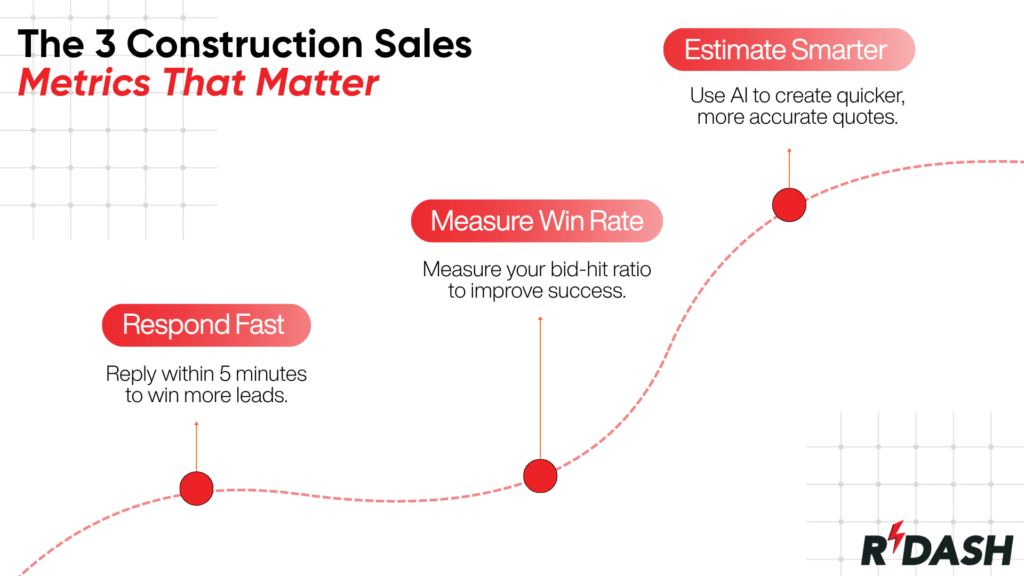
Three Numbers Every Construction Sales Team Should Plaster on the Wall
1. Speed wins. Slowness kills.
The single most under-appreciated lever in pre-sales is response time. The MIT/InsideSales Lead Response Management Study, conducted by Dr James Oldroyd across more than 15,000 leads and 100,000 call attempts, found that you are 21 times more likely to qualify a lead if you respond within five minutes rather than 30 minutes, and roughly 100 times more likely to even make contact. Harvard Business Review’s separate 2011 audit of 2,241 companies added the gut-punch: the average business took around 42 hours to respond, and 23% never responded at all. More recent B2B benchmarks put the average even higher, at around 47 hours, nearly two full working days.
And whoever gets there first usually wins. Sales research commonly cited across the industry puts the share of buyers who purchase from the first business to respond at around 78%. Persistence matters just as much as speed: the average sales rep gives up after barely more than one attempt, while top performers make six or more attempts in the first 48 hours.
For a construction firm fielding high-value enquiries, this is enormous. If a homeowner or facilities manager fills out three contractors’ forms and only one replies within the hour, that contractor has already half-won the job before an estimate even exists.
2. Your win rate is lower than you think, and you are probably not tracking it.
Contractors love volume. The instinct is: bid more, win more. The data says otherwise. According to industry data, the average bid win rate for a commercial contractor is around 25%, meaning for every ten bids submitted, you would win two to three. It splits sharply by bid type: closer to 10–20% for hard or public competitive work, and materially higher for negotiated or selective bids where relationships and pre-qualification do the heavy lifting.
The scarier statistic is how few firms even measure this. In construction estimating expert George Hedley’s survey of more than 5,000 general contractors and subcontractors, fewer than 6% knew and tracked their bid-hit ratio. As Hedley puts it, running a construction business without knowing your bid-hit ratio is like driving blindfolded. A widely used benchmark is to aim for around a 4:1 bid-hit ratio on private work (one award for every four submissions) and to treat anything worse than roughly 10:1 or 11:1 on public work as too expensive to sustain. The right number depends entirely on whether you chase competitive tenders or negotiated work.
3. Estimating is expensive, and most of it is wasted motion.
Every quote costs real money to produce. A single commercial bid averages around 28 hours of estimating labour using traditional methods, and larger or more complex jobs can run to well over 100 hours across a team. Most of that time is not strategic; it is manual grunt work. Across multiple industry sources, estimators spend 60–80% of their working week on takeoffs alone, leaving little room for value engineering or bid strategy.
The fix is well documented. AI-assisted takeoff typically cuts takeoff time by 60–80%, letting the same estimator roughly double or triple bid capacity without adding headcount, and bid-management tooling can reduce proposal-preparation time by 40–50%. That matters because inaccurate estimates contribute to cost overruns in more than 85% of construction projects, according to the McKinsey Global Institute. Freeing estimators to price carefully rather than quickly is a direct margin play, not a productivity nicety.
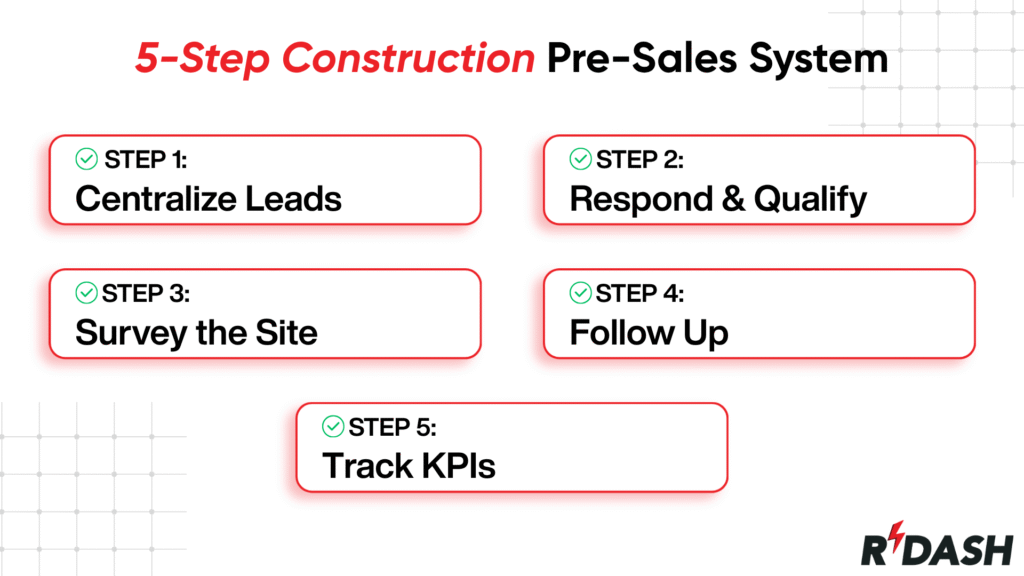
How to Manage Pre-Sales Leads: A Five-Step System
Now the practical part. Here is a system you can implement regardless of your firm’s size, along with the specific behaviours that separate teams who convert from teams who leak.
Step 1: Centralise every lead into one funnel
The first rule is simple: a lead that is not recorded does not exist. If your enquiries live in one person’s WhatsApp, a shared inbox, and a receptionist’s notepad, you do not have a pipeline; you have three graveyards. The fix is a single, structured funnel where every enquiry lands, is tagged by source, and is assigned an owner.
This is exactly what a construction CRM is built for. RDash’s pre-sales and lead management module lets teams create, or import leads into funnels and capture enquiries from ads and your website, so nothing depends on someone remembering to log it. Because RDash unifies pre-sales and delivery. Its CRM connects lead management, client quotations and project conversion into a single workflow. This means the context you gather now is not lost the moment the deal is won.
Step 2: Respond fast, then qualify hard
Given the five-minute rule above, your first goal is an instant acknowledgement, even an automated one, followed quickly by a genuine human touch. But speed without qualification just fills your estimating team’s plate with junk. The two work together: reply fast to protect the relationship, qualify hard to protect your estimating hours.
A lightweight qualification framework keeps this consistent. Many teams adapt the classic BANT lens to construction.
Criterion | The question to answer |
Budget | Does the client’s budget match the scope they are describing? |
Authority | Are you talking to the decision-maker, or a gatekeeper? |
Need | Is there a real, defined project, or just early exploration? |
Timeline | When do they actually intend to award and start? |
Qualified leads move forward to a site survey. Poor-fit leads get parked or politely declined before you sink 20-plus hours into an estimate you were never going to win.
Step 3: Run a disciplined site survey (recce)
The recce is where construction pre-sales earns its accuracy. A thorough site survey captures measurements, existing conditions, access constraints, and technical observations that determine whether your estimate is realistic or a guess. Skipping or rushing it is a leading cause of the assumptions that later blow up into cost overruns.
The classic failure mode is the field-to-office gap: the surveyor captures great detail on site, but it arrives back at the estimating desk as blurry photos and half-legible notes. RDash closes this gap with a guided mobile site survey that captures spaces, measurements, and technical details in a structured format and syncs them back to the office team in real time, so the person building the estimate works from what is actually on site, not what someone half-remembers.
Step 4: Nurture with structure, not memory
Most construction deals are not won on the first call. They are won on the fifth follow-up, after a revised quote and a clarified scope. Yet, as we saw, the average rep quits after barely more than one attempt. The fix is to make follow-up a system property, not a personal virtue: every lead sits at a defined stage, with a next action, an owner, and a reminder.
A stage-based funnel (New → Qualified → Surveyed → Quoted → Negotiating → Won or Lost) gives your team and your leadership instant visibility into where every deal is and what is stalling. This is the difference between “I think we sent them something last week” and a pipeline you can actually forecast from.
Step 5: Track the metrics that reveal the leaks
You cannot fix what you do not measure. The essential pre-sales KPIs for a construction firm are these.
Metric | Why it matters | Healthy target |
Lead response time | The single biggest predictor of conversion | Under 5 minutes to first touch |
Lead-to-survey rate | Are qualified leads actually getting site visits? | Tracked by source |
Bid-hit / win ratio | Your true competitiveness | Around 4:1 on private work; benchmark by type |
Quote turnaround time | Speed from survey to quote sent | Days, not weeks |
Follow-up attempts per lead | Persistence discipline | 5-plus before “lost” |
Estimating hours per won job | The real cost of your pipeline | Falling over time |
Tracking your win ratio by project type and client is especially powerful. It tells you which work to chase and which to walk away from. As one long-standing piece of contractor advice puts it: do not invest estimating time in bids you have little real chance of winning. Be selective, and your win ratio climbs.

How to Manage Quotations: Accuracy, Speed and Control
Lead management gets the client to the table. The quotation is where you win or lose the deal, and where you lock in (or leak) your margin. Here is how to run this stage properly.
Get the vocabulary right: RFQ, RFI, BOQ, SOR.
A construction quotation has its own toolkit, and using each term correctly keeps everyone aligned.
- A Request for Quotation (RFQ) is a formal document used to solicit price quotes from suppliers or subcontractors for specific goods or services, containing detailed specifications, quantities, and delivery requirements. Use it when scope is clear, and you want to compare prices.
- A Request for Information (RFI) is issued to seek clarification on drawings, specifications, or documentation, closing the ambiguity gaps that otherwise force estimators to guess.
- A Bill of Quantities (BOQ) is the itemised list of scope, quantities and rates that underpins your quote.
- A Schedule of Rates (SOR) provides standardised rates across tasks and materials, ensuring consistency and letting contractors prepare competitive bids quickly.
The RFI point is worth dwelling on. When drawings are incomplete, your estimate is only as good as your assumptions, and contractors who raise RFIs early to remove ambiguity tend to submit stronger, more defensible bids. Owners increasingly prefer proposals with fewer grey areas.
Build quotes from reusable templates and rate libraries
The reason quotes take days is almost always that they are built from scratch every time: BOQs retyped, rates hunted down, formatting rebuilt. The reason they contain errors is the same. The fix is a library: standard scope items, a maintained rate database, and quotation templates you clone and adjust.
This is where a construction-specific platform pulls ahead of a generic ERP or spreadsheet. With RDash, teams can quickly assemble a scope of items with quantities and rates from scratch or an existing format, build BOQs and manage change orders, and generate and share quotations directly, then manage proposal approvals against the same record. Rather than only uploading a BOQ as an Excel file, RDash offers item-level BOQ control: tracking client confirmation on individual scope items and consolidating changes into a change-order proposal the client can review and approve.
Control versions, approvals and change orders
A quote is rarely a one-shot document. It gets revised, re-priced and renegotiated. Without version control, you end up with three conflicting “final” quotes and a client holding the cheapest one. A proper system keeps a single source of truth, an audit trail of every change, and clear approval gates, so the number you are committed to is the number you actually agreed.
This discipline flows directly into financial control once the job starts. Consolidating estimates, budgets, and actuals on one platform gives real-time visibility that manual, disconnected systems cannot, and that is the foundation for catching a margin problem in week two instead of month six.
Do not forget the supply side.
Your quote to the client is only as accurate as the quotes you get from your vendors and subcontractors. Sending structured RFQs to your supplier pool, comparing responses on price, delivery, and terms, and locking in rate contracts is what makes your client-facing number trustworthy. RDash’s rate contracts and vendor management let teams establish digital rate contracts and compare rates to select the right vendor for each order, so your estimate is based on real, current supplier pricing rather than last year’s guess.
The Hidden Killer: The Sales-to-Project Handoff
Here is the stage almost everyone underestimates. You have captured the lead, surveyed the site, priced the BOQ, sent the quote, followed up, and won. Now the deal has to move from the sales team to the delivery team, and in most firms this is where a mountain of hard-won context evaporates. The scope is negotiated over six weeks, the design iterations, the client’s specific asks, the agreed rates: all of it has to be re-explained, re-entered, or, worse, rediscovered on site when something does not match.
McKinsey identifies fragmentation, where different teams work from different versions of the truth, as a core reason construction productivity has stayed flat for decades. The McKinsey Global Institute has estimated that closing the sector’s productivity gap could unlock around USD 1.6 trillion of additional value globally per year, and better data flow between planning and execution is one of the biggest levers.
A connected platform eliminates the handoff cliff entirely. Because RDash carries lead, survey, BOQ, and quotation data through to execution, a won lead converts into a live project, with all the information developed to date, in a single step. Nothing gets re-typed; nothing gets lost.
What “Good” Looks Like in Practice
Consider RDash’s SharkShopfits case study. Founded in 2003, SharkShopfits is a leading Indian retail shopfitting manufacturer with more than 400 employees and two advanced manufacturing facilities in Delhi NCR. It was running on a fragmented stack of disjointed tools for tracking, approvals, and communication. The consequences were textbook: confusion between production and site teams, scope creep from undocumented changes, and poor real-time visibility that led to miscommunication and delays. After consolidating onto RDash, the company reported an 8% reduction in project costs, a 30% drop in client escalations, and project timelines accelerated by 35%.
The pattern repeats across RDash’s customer base. Synergy reported 15% better cash-flow visibility, and Spacify Interiors cut margin bleeds by 15% by controlling scope changes. RDash serves 450-plus businesses across India and the UAE, including Livspace, JSW Homes, Amazon and ICICI Bank, and is backed by Y Combinator, Stellaris and Zacua Ventures.
A note on vendor figures: the outcomes above are RDash’s own reported client results and will vary by firm and project type. Treat them as directional rather than guaranteed.
Your Pre-Sales Management Checklist
Pull this out before your next quarter of pipeline planning.
# | Action | Done? |
1 | Every lead lands in one funnel, tagged by source, with an owner | ☐ |
2 | Automated acknowledgement fires instantly; human follow-up within 5 minutes | ☐ |
3 | A written bid / no-bid or qualification rule filters weak leads early | ☐ |
4 | Site surveys are captured digitally and sync to the estimating desk | ☐ |
5 | Quotes are built from templates, a rate library and a master BOQ catalogue | ☐ |
6 | Every quote has version control, approval gates and a change-order trail | ☐ |
7 | Supplier RFQs and rate contracts feed your client-facing pricing | ☐ |
8 | Follow-ups are systematised, with 5-plus attempts before a lead is “lost” | ☐ |
9 | You track response time, win ratio, quote turnaround and estimating hours | ☐ |
10 | Won leads convert to live projects with zero re-entry of scope | ☐ |
If you cannot tick most of these today, that is not a failure; it is a roadmap.
The Bottom Line
Managing pre-sales leads and quotations is not administrative housekeeping; it is one of the highest-leverage things a construction business can fix. The market is digitising fast, the cost of a leaky pipeline is measured in lost bids and eroded margin, and the winning behaviours are well established: respond in minutes, qualify hard, survey properly, quote from reusable templates, follow up relentlessly, track the right metrics, and hand off to delivery without losing a thing.
The firms pulling ahead are not necessarily bidding more; they are bidding better, on a connected system that carries every inquiry from first contact to signed contract to finished project. That is the entire premise behind RDash: one platform, from lead to handover, so your pipeline stops leaking, and your margin stops hiding. If you are ready to see it on your own workflow, RDash’s team runs a free walkthrough, and the blog by RDash is a solid next read on estimating, BOQs, and construction finance.
Frequently Asked Questions
What is the difference between lead management and quotation management in construction?
Lead management is about capturing and nurturing the relationship: getting enquiries into a pipeline, responding fast, qualifying and following up. Quotation management is about building and controlling the commercial offer: surveys, BOQs, rates, versions and approvals. They are two halves of one pre-sales process, and the biggest gains come from connecting them so context flows from one to the other, and then into delivery. A platform like RDash is designed to run both on one system.
How fast should I respond to a construction enquiry?
As fast as humanly or automatically possible. The research is blunt: responding within five minutes makes you around 21 times more likely to qualify a lead than waiting 30 minutes, and the first responder wins most deals. An automated instant acknowledgement plus a genuine human follow-up within minutes is the winning combination.
What is a good bid-hit ratio for a contractor?
It depends on your work mix. A common rule of thumb is to aim for around 4:1 on private work (one award for every four bids) and to treat anything worse than roughly 10:1 or 11:1 on public or competitive bidding as too costly to sustain. The more important discipline is simply tracking it: since fewer than 6% of firms do, knowing yours is already a competitive edge.
What is a BOQ, and how is it different from an RFQ?
A Bill of Quantities (BOQ) is the itemised breakdown of scope, quantities and rates that sits underneath your quote; it defines what is being built and in what volumes. A Request for Quotation (RFQ) is the document you send to suppliers or subcontractors to get priced against a defined scope. In practice, a well-structured BOQ feeds your RFQs, and the supplier prices that come back make your client-facing quote accurate.
Do I really need software, or can I manage pre-sales in Excel and WhatsApp?
You can start there, and many firms do. The problem is that spreadsheets and chat do not scale, do not enforce follow-up, lose the field-to-office link, and drop context at the sales-to-project handoff. As soon as you are running multiple concurrent enquiries, a construction-specific platform pays for itself in leads not lost and estimating hours not wasted. Explore how RDash structures the full lead-to-handover workflow to see the difference.
How does managing pre-sales well protect my margin?
Because margin is set at the quote, not on site. Accurate surveys and BOQs prevent underpricing; disciplined follow-up wins the right jobs; version control stops you committing to a superseded number; and a clean handoff means the team delivers exactly what was priced. Given that most large projects run over budget, controlling the pre-sales stage is one of the few margin levers entirely within your control.