

The workflows mentioned in this article are, in our understanding, foundational to managing a construction business. This perspective has been shaped primarily by working with 300+ construction teams across Developers, General Contractors, and Specialty Contractors-spanning multiple sub-streams such as Homes, offices, mixed-use development colonies, Transmission Lines, Roads and Bridges, Airports, energy projects, and more.
Journey of Discovering these workflows
Over time, working closely with hundreds of construction teams, we saw a consistent pattern: projects struggle not because teams lack effort or intent, but because core workflows aren’t standardized and enforced. When basics like vendor PO management, invoice processing, payment approvals, and daily progress reporting run on informal threads and spreadsheets, margins leak, working capital stretches, and customer experience deteriorates. Each of these “basic” processes can quietly cost 1-2% in margins. The takeaway is simple-construction success isn’t about flashy tech; it’s about disciplined execution of foundational workflows.
The Four Critical Departments in Construction Project Management
At the heart of construction project management are four key departments whose coordination (or lack thereof) can make or break a project’s success. The Design Department is responsible for keeping the project on track during pre-construction phase. The Procurement Team handles vendor selection, material ordering, and supply chain management to ensure materials arrive when needed. The Site Execution Team comprises project managers, site engineers, and laborers who physically construct the project according to specifications. Finally, the Finance Department manages budgets, processes payments, tracks expenses, and ensures compliance with financial regulations. When these departments operate in silos rather than as a unified system, projects inevitably suffer from delays, budget overruns, and quality issues. The disconnection creates a devastating ripple effect: delayed materials lead to idle labor costs, incomplete documentation delays client payments, and hasty workarounds compromise quality
Snapshot of the consolidated workflow – covering all parts of construction management
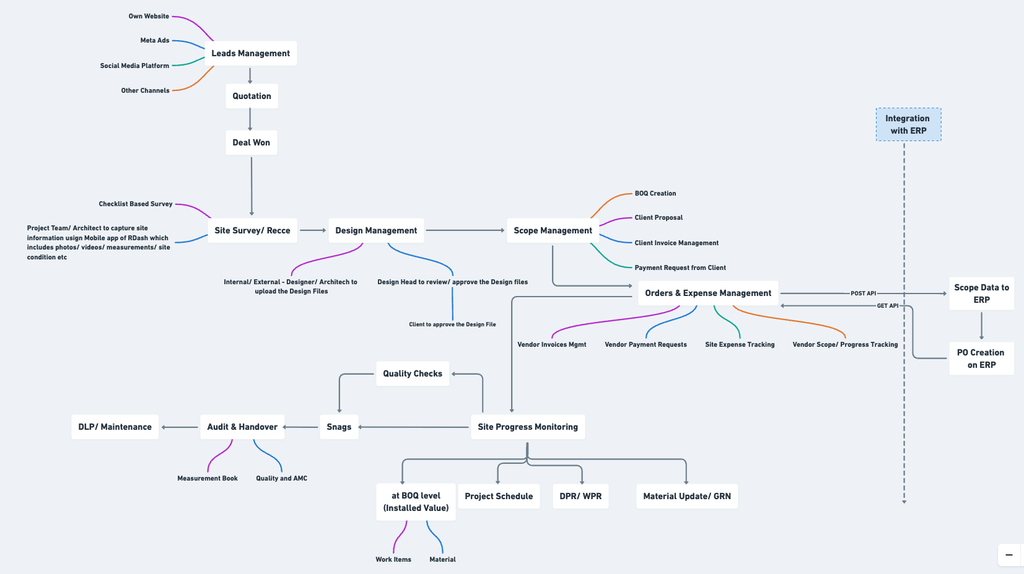
In the sections that follow, we’ll explore 15 mission-critical workflows that form the backbone of successful construction project management. These workflows aren’t just theoretical concepts-they’re battle-tested processes that directly impact project timelines, budget control, and client satisfaction. Each workflow addresses specific pain points that plague construction operations, from purchase order management to real-time progress tracking. Let’s examine each workflow in detail, understanding not only the mechanics but also how they interconnect to create a holistic project management ecosystem that drives profitability and operational excellence. We shall divide the workflows into 3 big buckets:
-
- Progress Tracking
-
- Financial Control
-
- Procurement Management
Progress Tracking Workflows: Saves 5%
Collectively, mastering the seven Progress Tracking workflows detailed below can save construction companies approximately 5% of total project costs. These workflows form the backbone of operational efficiency by eliminating information silos, reducing rework, preventing material wastage, and optimizing labor productivity. When Daily Progress Reports, Site Schedules, Installed Work Progress tracking, Material Handling, Design Management, Snag Management, and Site Survey workflows are systematically implemented, they create a synchronized ecosystem where real-time data flows seamlessly between departments. This integration prevents costly delays, minimizes change orders, reduces material waste, and ensures that labor resources are optimally allocated. The 5% cost savings materialize through reduced delay penalties (1-2%), decreased material wastage (2%), improved labor productivity (1%), and accelerated project closure (1%), ultimately translating to healthier profit margins and enhanced client satisfaction. Companies that excel in these workflows consistently outperform their competitors in both financial performance and project delivery timelines.
Daily Progress Report (DPR)
-
- Maker & Checker: Projects & Sales
-
- Pain Points: Misreporting due to informal communication methods.
-
- How to Fix: Standardize reporting templates, automate distribution, and integrate manpower and materials tracking.
-
- Benefits: Improved accountability, enhanced client confidence and experience.
Site Schedules
-
- Maker & Checker: Projects & Sales
-
- Pain Points: Frequent schedule shifts, missed dependencies, lack of clear task management.
-
- How to Fix: Implement task-driven scheduling, highlight critical paths and dependencies digitally.
-
- Benefits: Efficient resource management, timely project delivery, and better client satisfaction. Upto 2% Cost saving by reducing delay penalties and improving manpower productivity.
Installed Work Progress
-
- Maker & Checker: Projects & Finance
-
- Pain Points: Poor tracking of installed works, financial exposure, and cash flow management issues.
-
- How to Fix: Live tracking of installed work, automate invoicing alerts linked with actual project progress.
-
- Benefits: Improved cash flow management, minimized project financial risk.
Material Handling
-
- Maker & Checker: Projects & Procurement
-
- Pain Points: Inefficient GRN process, wastage of unused material, inadequate quality control.
-
- How to Fix: Digitally manage material lifecycle, automate GRN for quality checks, and manage surplus effectively.
-
- Benefits: Reduction in material wastage and leaks, approximately 2% savings in material costs.
Design Management
-
- Maker & Checker: Design & Projects
-
- Pain Points: Poor version control, inefficient distribution of design documents, potential errors in implementation.
-
- How to Fix: Digitize and version-control design documents, automate distribution with controlled access.
-
- Benefits: Reduces errors and streamlines collaboration among stakeholders.
Snag Management
-
- Maker & Checker: Projects & Sales
-
- Pain Points: Delayed project closure, poor snag accountability affecting final cash flows and quality.
-
- How to Fix: Structured snag logging, clear SLA tracking, distinct management of vendor and client snags.
-
- Benefits: Enhanced project quality, timely closures, and optimized cash flow management.
Site Survey
-
- Maker & Checker: Projects & Design
-
- Pain Points: Time loss due to multiple site visits, inconsistent site information capture.
-
- How to Fix: Digitally template and standardize site surveys, enable visual annotations and comprehensive data capture.
- Benefits: Increased accuracy in initial project assessments, significant time savings.
Financial Control Workflows: Saves 5%
The key un-addressed risk in managing construction operations for most companies is that the cashflows are not tied to project progress. Once you have figured out installed work progress tracking mechanism for your projects (highlighted in the progress tracking workflows), you can link various financial activities to the project progress and implement checklist for the finance team. This will help you scale your business with confidence and delegate decision making to your mid-management.
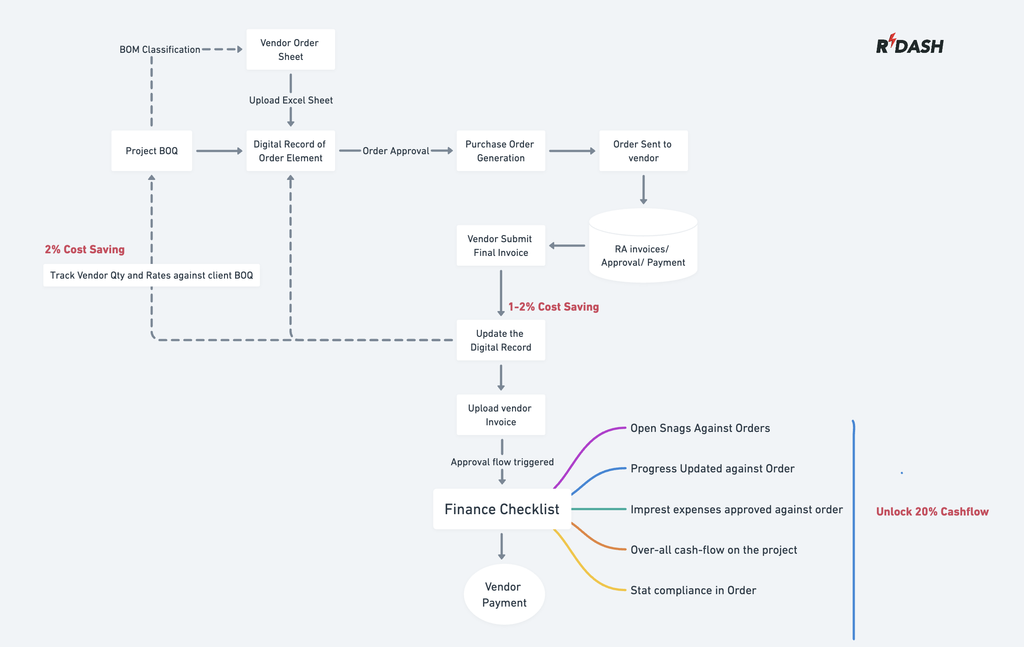
The Financial Control Workflows collectively represent a significant opportunity for cost savings – up to 5% of total project costs. These six critical workflows (Vendor POs, Final Vendor Invoice, Vendor Descoping and Change Orders, Vendor Payments, Site Imprest, and NT Approvals and Billing) create a financial control system that prevents leakage at every transaction point. The savings materialize through multiple channels: preventing excess payments to vendors (1-1.5%), capturing all non-tendered items in client billing (1.5-2%), reducing administrative errors in invoice processing (0.5-1%), minimizing petty cash misuse (0.5%), and optimizing payment timing for better cash flow management (0.5-1%). When implemented systematically with proper digital tools, these workflows transform financial management from a reactive accounting function to a proactive cost control system that directly impacts project profitability.
Vendor POs
-
- Maker & Checker: Projects/Procurement & Finance
-
- Pain Points: Multiple approval threads, absence of digital records, vendor descoping issues, unnoticed vendor scope change payments affecting margins.
-
- How to Fix: Standardize approval processes digitally, automate PO creation, and maintain digital records for clarity.
-
- Benefits: Enhanced cash flow control, prevents margin leakage, and streamlines descoping.
Final Vendor Invoice
-
- Maker & Checker: Projects/Procurement & Finance
-
- Pain Points: Missing documentation, margin leakage, ineffective change order management.
-
- How to Fix: Establish clear order tracking, manage invoices and documents digitally, track pending works comprehensively.
-
- Benefits: Up to 2% vendor cost savings by reducing unbilled items and price discrepancies.
Vendor Descoping and Change Orders
-
- Maker & Checker: Projects/Procurement & Finance
-
- Pain Points: Difficulty in tracking vendor scope, risk of double payments, reliance on initial vendor.
-
- How to Fix: Digitally track item-level changes, communicate changes automatically, maintain modification logs.
-
- Benefits: Improved transparency, reduced operational risk, and smoother decision-making processes.
Vendor Payments
-
- Maker & Checker: Projects/Procurement & Finance
-
- Pain Points: Excess payments, favouritism due to lack of oversight.
-
- How to Fix: Introduce structured payment approvals, link payments to open snags and documentation.
-
- Benefits: Enhanced cash flow management, reduced risk of overpayments.
Site Imprest
-
- Maker & Checker: Projects/Procurement & Finance
-
- Pain Points: Lack of petty cash accountability, delays in reimbursements, unclear project expenses.
-
- How to Fix: Digitize and tag expenses to projects, automate petty cash management.
-
- Benefits: Better expense tracking and accountability, approximately 1% cost savings.
NT Approvals and Billing
-
- Maker & Checker: Projects/Sales & Finance
-
- Pain Points: Revenue leakage due to undocumented scope changes, client invoicing mismatches.
-
- How to Fix: Automatically document scope changes digitally and link extra vendor payments directly to client invoicing.
-
- Benefits: Up to 2% cost savings, prevents revenue leakage.
Procurement Workflows: additional 3% cost saving
Master BOQ
-
- Maker & Checker: Design & Procurement
-
- Pain Points: Inconsistent quotations, extra effort in procurement, poor client experience.
-
- How to Fix: Standardize master BOQ digitally with detailed references, enabling vendors to easily understand and quote.
-
- Benefits: Improved procurement efficiency, enhanced client interactions, easier scaling of operations.
Rate Contracts
-
- Maker & Checker: Procurement & Finance
-
- Pain Points: Delay in mobilization, inadequate cost control mechanisms.
-
- How to Fix: Digitally automate rate contracts with predefined supplier rates and payment terms.
-
- Benefits: Accelerated project mobilization, reduced costs (around 2%), improved cost predictability.
Across many teams we’ve worked with, a common early challenge is limited visibility into true project margins-vendor invoices keep coming in, but profitability is unclear until late in the cycle (or even after closure). Teams that then fixate on implementing these workflows deeply and consistently typically see a meaningful improvement in gross margins and working-capital discipline over the next 12-24 months.
These essential workflows, from controlling purchase orders and payments, managing site imprest, claiming non-tendered items, and linking cash flows to installed progress in real-time, act as the invisible scaffolding behind efficient, cash-positive construction sites. While these foundational workflows are essential, they don’t cover all digitisation opportunities. Additional workflows like BOM material classification, Material budgeting norms, equipment productivity tracker, design-to-BOQ quantification, and site inventory management are equally crucial for achieving project management excellence. However, given the current state of digitisation in construction, a step-by-step approach makes more sense. The foundational workflows serve as a logical starting point for teams beginning their digital transformation journey. After all, these core workflows create the foundation needed to reach operational excellence.
About the Author
Amit Bansal is the CEO of RDash, a construction technology company focused on simplifying how construction projects are planned, executed, and managed.
With a focus on bringing technology and AI into construction workflows, Amit works closely with construction teams and leadership to address challenges around project visibility, coordination, execution, and decision-making.
Through his work at RDash, he writes about construction technology, project management, AI, and the future of digital construction.