


Key Takeaways
- Working capital is the size of your financial buffer; cash flow is the timing of money moving in and out. Healthy working capital can still coincide with an empty bank account mid-month.
- Construction inverts the normal cash cycle. You pay for labour, materials, and mobilisation first, then collect in arrears through progress billing minus retention. The gap is structural, not mismanagement.
- Retention commonly withheld at 5–10% on every bill is earned revenue you cannot spend, often for a year or more. Track it as a scheduled receivable, not a footnote.
- Billing speed is the highest-leverage lever contractors control. Submit clean, complete bills on the earliest allowable date every cycle; late or disputed bills push the whole collection chain further out.
- Forecast cash by project, not just company-wide. A single bank balance hides which jobs are quietly funding others and which one has become a cash drain.
- India’s MSMED Act, 2006 caps payment to registered micro and small suppliers at 45 days and charges 3× the RBI bank rate on delays but only for those with clean records.
- Match financing to the gap: revolving credit for payroll timing, project-linked funding for one large job. Never borrow to avoid billing on time.
Construction companies manage working capital and cash flow by closing the gap between when money leaves the business and when it comes back in. In practice, that means five habits: bill early and often, track retention and unbilled work as recoverable assets, forecast cash by project rather than company-wide, match financing to how each job actually pays, and negotiate cash terms before signing.
In a sector where you spend before you earn on almost every contract, managing that timing, not profitability on paper, is what keeps a company solvent. It’s the reason so many contractors who look profitable on a project report still miss payroll.
This guide breaks down why the problem is structural, how to measure it, and the specific practices that protect liquidity. It’s written for developers, contractors, EPC firms, interior fit-out companies, and PMCs in markets like India and the UAE where retention, running-account billing, and long approval chains define the cash cycle.
Why Cash Flow Works Backwards In Construction
In a normal business, the cash cycle is short and forward-facing: buy inventory, sell the product, collect payment. Construction runs the sequence in reverse and stretches every step.
You commit money before a single rupee arrives. Mobilisation, early-stage materials, equipment, and labour all hit your account before the first bill goes out. On a large project, that outlay can run into weeks or months of spend before the first payment is even certified. As Procore notes in its contractor guide to working capital, until a contractor generates an invoice or payment application, they are only accumulating liabilities on a job, actively reducing working capital until billing catches up.
Then the collection chain adds its own friction. A typical progress-billing cycle runs: you complete work, submit a running-account (RA) bill or pay application, the bill is reviewed and certified, it moves up to the client or owner for approval, and only then is payment released, usually minus retention. Each handoff introduces delay, and each missing document or unresolved variation gives the payer a reason to hold the whole bill.
Three features of the industry make this worse than a simple timing lag:
- Long contract cycles. Projects run for months or years, so cash from one phase has to carry the next. A delay in one milestone ripples across everything downstream.
- Retention. Clients withhold a percentage of every certified bill, commonly 5–10% as security against defects, releasing it only after completion and the defect-liability period. That is real, earned money sitting outside your reach, often for a year or longer.
- High, front-loaded costs. Materials, plant, and crews get paid on their own schedules crews often weekly, suppliers on 30–60-day terms while your billing cycle is monthly and your collections are slower still. The mismatch compounds with every additional active site.
This is why growth feels like drowning. A company running one project has manageable gaps. The same company running four projects with the same payment patterns and no cash system is carrying a far larger working-capital requirement at any given moment, which is exactly why so many expanding contractors feel perpetually short of cash even while their project reports show a profit.
The scale of the timing problem is visible at the national level. India’s Ministry of Statistics and Programme Implementation (MoSPI) tracks large central-sector infrastructure projects worth ₹150 crore and above. Its monthly report for June 2026 monitored 1,847 ongoing projects whose original cost of about ₹35.62 lakh crore had risen to a revised ₹40.54 lakh crore, a cumulative overrun of nearly ₹4.93 lakh crore.
These figures shift every month as projects are added, revised, and commissioned, so treat any single report as a snapshot rather than a fixed benchmark. The point is not the exact number; it’s the persistence of the pattern. Cost and time overruns are not abstractions; every escalation and delayed milestone lands somewhere in the payment chain as stretched working capital for the firms doing the work.
Working Capital Vs. Cash Flow: The Distinction That Sinks Contractors
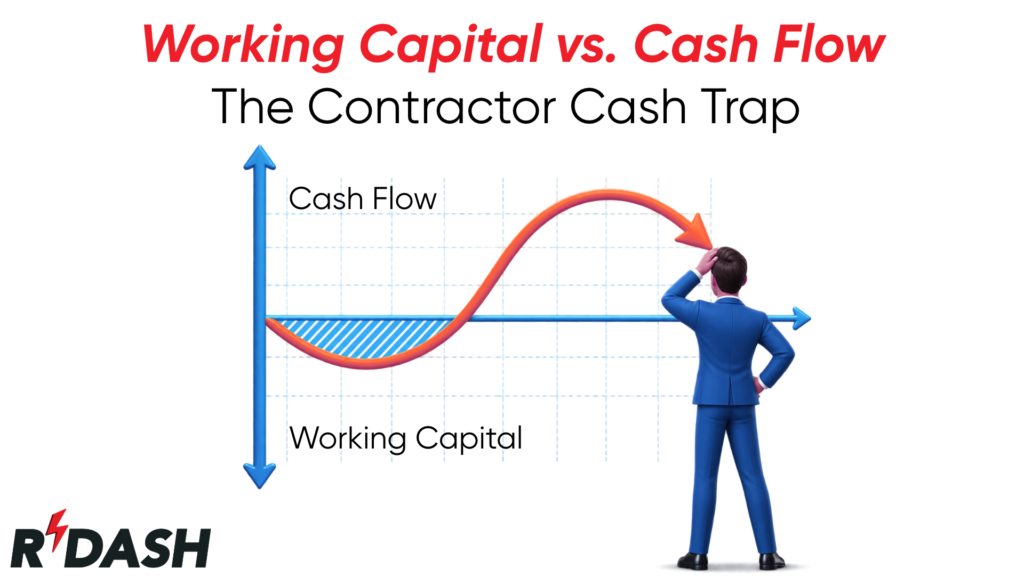
Treating these two terms as interchangeable is one of the most expensive mistakes in construction finance. In short: working capital is how much cushion you have; cash flow is whether that cushion is available when a bill falls due. They measure different things.
Working capital lives on your balance sheet:
Working Capital = Current Assets − Current Liabilities
Current assets are anything that is, or will convert to, cash within twelve months: cash on hand, accounts receivable, retention receivable, and costs incurred in excess of billings (work done but not yet billed). Current liabilities are anything due within a year: payroll, supplier bills, taxes, short-term borrowings, and billings in excess of costs (money collected for work not yet done).
Positive working capital means you can, in principle, cover near-term obligations. Negative working capital means you’re running the business on borrowed money.
Cash flow is about timing. It tracks the actual movement of money in and out of your projects when it arrives and when it leaves. You can be profitable on paper and cash-negative this week if your receivables are stuck and your payables are due.
The cleanest way to hold the difference in your head: cash flow is the fuel in the tank; working capital is the size of the tank. One tells you whether you can keep moving right now; the other tells you how much room you have before you need to refuel. A firm that knows only one of the two numbers is operating without a real view of its financial health.
Working capital | Cash flow | |
What it measures | The size of your buffer at a point in time | The timing of money moving in and out |
Where it lives | Balance sheet | Bank account, week to week |
Formula/view | Current assets − current liabilities | Cash in − cash out, over a period |
What it warns you about | Whether you can carry more work | Whether you can pay this week’s bills |
Fails when | Assets can’t convert to cash (e.g. locked retention) | Receivables stall while payables come due |
There is a subtlety in the working-capital formula that catches contractors out. It assumes current assets convert to cash quickly, but in construction, some don’t. Retention receivable is technically a current asset (collectible within a year), yet contractors routinely wait a year or more to actually collect it, depending on the contract and defect-liability terms. So your reported working capital can look healthier than your spendable position genuinely is. This is why a sophisticated read of working capital one that discounts the assets you can’t easily convert matters more than the headline number.
How To Measure Whether Your Cash Position Is Actually Healthy
You cannot manage what you don’t measure, and “the bank balance looks fine” is not a measurement. A handful of metrics tell you the truth about your cash position and, reviewed monthly, warn you before a squeeze becomes a crisis. Run consistently alongside a discipline like cost value reconciliation, which compares committed costs against earned value per job; they turn financial reporting from a month-end autopsy into an early-warning system.
Working capital ratio (current ratio): Current assets divided by current liabilities. Above 1.0 means current assets exceed current liabilities. Track it monthly and watch the trend; not just the absolute number. A ratio drifting downward over several months is an early warning even while it’s still above 1.0.
Days Sales Outstanding (DSO): The average number of days from completing and billing work to collecting payment is the single most actionable cash metric in construction. A DSO creeping upward signals a collections or client-approval problem that needs attention before it compounds. Shortening it even by a couple of weeks pulls forward cash you’ve already earned, freeing up capital without borrowing a rupee.
Retention receivable, tracked as its own line: Most contractors bury retention inside general receivables and lose sight of it. Break it out. Know exactly how much is held, by which client, and when each tranche is contractually due for release. Untracked retention is the most common form of quietly written-down cash in the industry.
Costs and earnings in excess of billings (unbilled work): This is work you’ve performed but haven’t yet billed. It is a current asset, but it is also a signal: a large or growing balance means you are financing the client’s project out of your own pocket. A monthly work-in-progress (WIP) report is the standard tool for surfacing this; it measures the gap between costs incurred, work billed, and stage of completion across every active job. The fix is faster billing, not more borrowing.
Backlog-to-working-capital relationship: Your working capital sets a ceiling on how much work you can actually carry. This is not just an internal metric; it’s how sureties think. Bonding capacity is typically assessed as a multiple of adjusted working capital, and Dannible & McKee note that surety analysts commonly work in the range of 10 to 20 times adjusted working capital. If you win more work than your working capital can support, you don’t grow; you create cash drains that limit growth.
Seven Practices That Actually Protect Liquidity
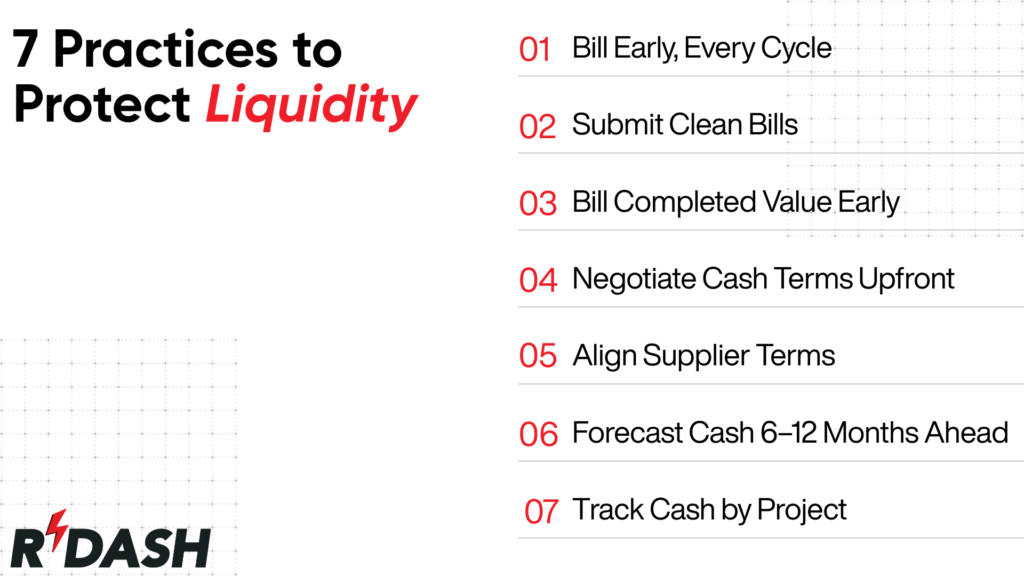
Measurement tells you where you stand. These practices change where you stand. They are ordered roughly from highest leverage and lowest cost to more structural moves.
1. Bill on the earliest allowable date, every cycle, without exception
Many firms treat billing as administrative paperwork to finish when someone has time. That habit destroys working capital. Submit every RA bill or pay application on the earliest date the contract permits, every period, the moment the work is materially complete and the bill is contract-compliant. A bill submitted a week late doesn’t just delay one payment; it pushes the entire downstream approval and release cycle back, and those delays stack across every project.
2. Make every bill clean enough that there’s no excuse to hold it
Speed is worthless if the bill bounces back. Incomplete documentation, unclear variation support, or sloppy quantity tracking hands the payer a legitimate reason to delay the whole application or raise queries that eat weeks. The time you spend making applications complete and accurate the first time pays back directly in faster collections. Clean bills get certified; messy bills get parked.
3. Structure your schedule of values to move money early
Within the bounds of your contract, sequence your billing schedule so value is recognised and billed as early as legitimately possible against completed work. Front-loading (weighting early line items) has long been used to soften the absence of a proper deposit, though the CFMA cautions that with today’s thinner margins, front-loaded costs no longer reliably cover what retention holds back. The durable version of this practice isn’t aggressive front-loading; it’s designing a schedule of values that bills genuine, completed value promptly rather than back-ending recognition.
4. Negotiate cash terms at the bid stage, not after the squeeze
The best contractors bid with payment timing in mind. Retention percentage, mobilisation advances, billing frequency, and release milestones are all negotiable but only before you sign. Push for a mobilisation advance to cover front-money costs. Argue for lower retention or earlier partial release. Ask for bi-weekly rather than monthly billing where the contract allows; shortening the billing cycle directly shortens the collection cycle. Once the contract is executed, this leverage is gone.
5. Match your supplier terms to your collection reality
Working capital has two sides. You can grow current assets, or you can reduce current liabilities. Procore frames these as the only two ways to increase working capital. On the payables side, extend supplier terms deliberately (net-45 or net-60 where you can negotiate it) so your outflows sit closer to your inflows, without damaging supplier relationships you depend on. The goal is to stop paying for materials weeks before you’re paid for installing them.
6. Forecast cash rolling, six to twelve months out, and review it monthly
A cash forecast that projects collections and outflows payroll, suppliers, subcontractors six months to a year ahead, reviewed and adjusted monthly, is one of the most effective tools for predicting and averting a squeeze. It turns cash management from reactive (checking the balance and hoping) into proactive (seeing the payroll-heavy month or the seasonal dip before it arrives). The forecast doesn’t need to be perfect to be useful; it needs to flag the gap early enough to act.
7. Forecast at the project level, not just company-wide
This is the practice that separates firms that scale from firms that stall. A single company-wide cash view masks which projects are cash-positive and which are quietly consuming the cash the winners generate. When you forecast and track cash by project inflows and outflows per job, you can see the specific contract that has become a cash drain and intervene: accelerate its billing, resolve its stuck variations, or renegotiate its terms. Manage the portfolio project by project, and a single bad job stays a single bad job instead of pulling down everything around it.
Financing The Gap: Matching The Instrument To The Job
Even a well-run contractor with disciplined billing will face genuine working-capital gaps, because the industry’s timing mismatch is structural. Financing is a legitimate tool; the mistake is using the wrong instrument, or reaching for financing to paper over an operational problem that faster billing would solve.
The principle is simple: match the financing structure to how the cash actually behaves. Fund short-term timing gaps with short-term, flexible instruments; fund long-term assets with long-term financing. Using a term loan to cover a payroll gap, or paying cash for equipment that ties up your operating line, are both mismatches that create new pressure.
Instrument | Best suited for | What to watch |
Revolving line of credit | The recurring gap between weekly payroll and monthly draws; short-term, fluctuating needs | Size it to the payroll/mobilisation gap, not to total contract value; sanction depends on your balance sheet and financials |
Project / PO-linked financing | A single large job or purchase order that would otherwise strain the whole balance sheet | Tied to a specific contract; keeps one big job from consuming company-wide capacity |
Invoice/receivables financing | Bridging certified-but-unpaid bills, including in India via the TReDS platform | Cost of discounting vs. the value of pulling cash forward |
Equipment financing (kept separate) | Long-term assets: plant, vehicles, machinery | Finance on the asset’s own terms so it doesn’t eat the operating line that payroll and materials depend on |
Long-term financing | Major fixed assets, facilities; growth-linked capital | Payback over years; the asset itself is usually the collateral |
Two things make financing work. First, a strong balance sheet gets you better terms. Banks and NBFCs review working capital to assess creditworthiness, and healthy working capital is a common covenant in borrowing arrangements, so the firms that need financing least get it cheapest. Second, financing should smooth a timing gap you’ve already measured, never substitute for the billing discipline in the previous section. Borrowing to cover slow collections you could have accelerated is paying interest to avoid sending an invoice on time.
For contractors operating across India and the Middle East, ecosystem models increasingly combine execution and capital; for example, RDash’s embedded financing engine, RFin, extends project-linked capital alongside the management platform, so financing decisions sit next to the live project and cost data that justify them rather than in a disconnected process.
The India-Specific Layer: Retention, RA Billing, and the MSMED Act
Most working-capital advice in circulation is written for the US market: retainage, bonding, sureties, AIA pay applications. The mechanics rhyme in India and the UAE, but the specifics that determine your cash position are different, and getting them right is where local contractors win or lose.
Retention and RA billing are the spine of the cash cycle. Indian construction runs on running-account bills certified periodically, with retention withheld on each and released after completion plus the defect-liability period. Because retention sits outside your reach for so long, tracking it as a distinct, scheduled receivable, not a vague number buried in debtors, is disproportionately valuable. Every tranche has a contractual release trigger; knowing those dates turns retention from forgotten money into a forecastable inflow.
The MSMED Act gives registered suppliers genuine leverage. Under the Micro, Small and Medium Enterprises Development Act, 2006 (Sections 15–16), a buyer must pay a registered micro or small enterprise within the agreed period, capped at 45 days from acceptance, with any longer contractual term void to that extent. Delayed payment attracts compound interest, with monthly rests, at three times the RBI bank rate, a rate materially higher than ordinary commercial interest. Disputes can be filed on the MSME Samadhaan portal and are referred to the Micro and Small Enterprise Facilitation Council in the buyer’s state.
The teeth were sharpened further by Section 43B(h) of the Income-tax Act, effective from FY 2024–25: a buyer generally cannot claim a tax deduction for the purchase until the MSME supplier is actually paid within the statutory window, turning prompt payment into a tax question for your clients, not just a contractual courtesy.
The catch is documentation. These rights only work if you can prove the acceptance date and the invoice date cleanly. A supplier with disciplined records dated acceptance, clean invoices, and tracked due dates can invoke real statutory leverage. A supplier whose paperwork is scattered across email, spreadsheets, and messaging apps often can’t establish the appointed day well enough to enforce anything. (The Act and its associated rates change periodically, so verify current provisions before acting on a specific claim.)
A structural reality worth naming: construction in India is largely self-financed. Unlike a tech company, a contractor rarely raises equity from venture capital or public markets to fund growth. Ongoing working capital comes overwhelmingly from retained earnings, owner capital, and borrowing.
That makes internal cash discipline existential; there is no external equity round waiting to bail out a badly managed cash cycle. Every rupee of working capital you free up through faster billing or better retention tracking is a rupee you didn’t have to borrow or inject.
How RDash Helps Construction Companies Manage Working Capital and Cash Flow
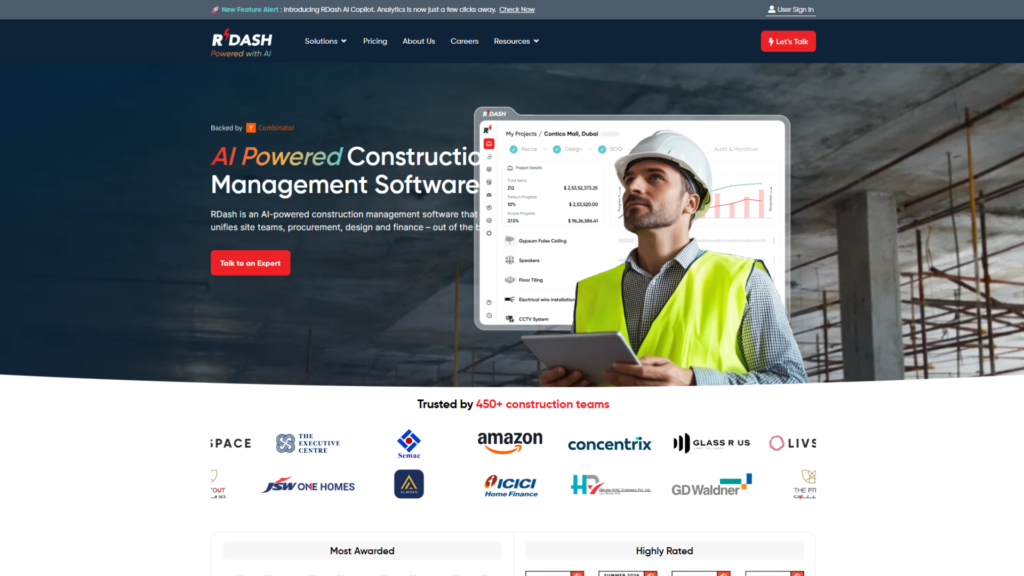
Every practice in this guide shares one dependency: it only works if you can see your cash position clearly and in near-real time. RDash is a construction management platform built for developers, contractors, EPC firms, interior fit-out companies, and PMCs across India and the UAE, and it closes that visibility gap by connecting site progress, procurement, billing, and finance in a single system so cash blockages surface while you can still act on them.
The common alternative approvals over WhatsApp, BOQs and progress in spreadsheets, drawings in cloud folders, and accounting in a disconnected tool produces exactly the failure this article is about. When project progress lives in one place and finance in another, the gap between billed and unbilled work stays invisible until it has already become unfunded working capital.
Here is how RDash maps to the specific cash levers covered above:
- It ties invoicing to installed value, not guesswork: RDash tracks the real installed value of work against client invoicing and cash flows, so you bill for what’s genuinely complete and see your exposure on each project directly attacking the unbilled-work gap that quietly finances your client’s project out of your pocket.
- It gives item-level P&L and margin control on the BOQ: Budget guardrails and margin-bleed flags at the BOQ-item level mean a job turning into a cash drain shows up early, not at month-end reconciliation.
- It surfaces cash and P&L in real time. Invoices, billing, cash flows, and P&L update live against project progress across every active site; the project-level visibility that stops one bad job from sinking the others.
- It puts approvals and payment requests on rails. Configurable approval workflows for orders, invoices, and payment requests with WhatsApp notifications linked to in-app actions keep billing and collections moving instead of stalling in someone’s inbox.
- It works with the accounting stack you already run. Standard integrations with Tally, Zoho, Odoo, SAP, Microsoft Business Central, and Oracle mean finance data stays connected rather than re-keyed, which is where reconciliation errors and blind spots creep in.
The tool is not the strategy. The strategy is billing discipline, retention tracking, and project-level forecasting. But a connected system is what makes that strategy executable across more than one site at a time, which is the difference between knowing these practices and actually running on them.
Conclusion: Manage Timing, Not Just Profit
The contractors who survive downturns and fund their own growth are not necessarily the ones with the fattest margins on paper. They are the ones who treat the timing of cash as the core discipline of the business because in construction, you spend before you earn on almost every job, and the gap between those two events is where companies quietly fail.
That discipline is learnable, and it is specific. Know the difference between your working capital and your cash flow, and track both monthly. Bill early, bill clean, and negotiate cash terms before you sign. Break retention and unbilled work out of the shadows and forecast them as the recoverable assets they are. Forecast cash job by job, so one bad project never becomes a company-wide crisis. Match financing to the shape of the gap, and never let it substitute for sending an invoice on time. And in India, keep the records clean enough that the MSMED Act’s protections actually work for you.
None of this requires a bigger balance sheet to start. It requires seeing your cash position clearly and acting on what you see the point at which disciplined process and the systems that make it visible across every site stop being overhead and become the reason you’re still standing when the cycle turns. Getting the fundamentals right, from budget management and project finance reconciliation to retention tracking, is what turns cash from a monthly scramble into a managed number.
See your project cash position in real time
If your working capital is trapped in spreadsheets and disconnected accounting, you’re managing cash blind. RDash connects site progress, billing, and finance so you can bill on installed value, track retention, and catch cash drains before they spread across every project, in one place.
Book a free RDash demo to see it on your own projects, or start free and put these practices to work this week.

Frequently Asked Questions
What is the difference between working capital and cash flow in construction?
Working capital is a balance-sheet measure: current assets minus current liabilities, showing the size of your financial buffer at a point in time. Cash flow is about timing: the actual movement of money in and out of your projects. A construction company can show positive working capital and still run out of spendable cash if its receivables are stuck and its bills are due. You need to track both.
Why do profitable construction companies still run out of cash?
Because construction inverts the normal cash cycle. You pay for labour, materials, and mobilisation before you collect, and you collect in arrears through progress billing minus retention. A job can be profitable on its final report while consuming cash for months during execution. Profit is measured over the life of a project; cash is measured week to week, and it’s the weekly number that pays the crew.
How much working capital does a construction company need?
There’s no universal figure; it depends on your project mix, billing cycles, retention terms, and how fast you collect. A practical anchor is that your working capital sets a ceiling on the volume of work you can carry. Sureties often assess bonding capacity as a multiple of adjusted working capital, commonly in the range of 10 to 20 times, which gives a sense of how much work a given working-capital base can responsibly support.
What is retention (retention money) and why does it matter for cash flow?
Retention is a percentage of each certified bill, commonly 5–10%, that the client withholds as security against defects, releasing it only after completion and the defect-liability period. It matters because it’s earned revenue you can’t spend, sometimes for a year or more. Contractors who track retention as a distinct, scheduled receivable and chase each release on its contractual date recover cash that others quietly write off.
What is the single most effective way to improve construction cash flow?
Bill on the earliest allowable date, every cycle, with clean and complete documentation. You can’t force a client to pay faster, but late or disputed bills push the entire approval-and-release chain further out and compound across projects. Faster, cleaner billing is the highest-leverage lever most contractors fully control.
How does the MSMED Act help Indian contractors and suppliers with delayed payments?
Under the MSMED Act, 2006, buyers must pay registered micro and small enterprises within the agreed term, capped at 45 days from acceptance, or face compound interest at three times the RBI bank rate. Disputes can be filed on the MSME Samadhaan portal. Section 43B(h) of the Income-tax Act adds that buyers generally can’t claim a tax deduction until they’ve actually paid the MSME supplier. These protections only work if you document acceptance and invoice dates cleanly, so verify current provisions before acting on a claim.
Should construction companies use financing to manage working capital?
Yes, when it’s matched to the need: a revolving line of credit for the recurring payroll-to-draw gap, project-linked financing for a single large job, receivables financing to bridge certified-but-unpaid bills, and separate equipment financing for long-term assets. The mistake is using financing to cover slow collections you could have accelerated. Borrowing to avoid billing on time means paying interest to solve a problem an invoice would have solved.
How do you calculate the working capital cycle for a construction company?
The working capital cycle is the time between paying for costs (labour, materials, mobilisation) and collecting payment for that work. In construction, it runs longer than most industries because of progress billing, approval chains, and retention held after completion. Shorten it by billing sooner, submitting clean applications, and tracking retention as a scheduled receivable rather than letting it sit uncollected.
What is the best way to track retention and unbilled work in construction?
Break both out as their own line items instead of burying them in general receivables. For retention, record how much is held, by which client, and each contractual release date. For unbilled work, run a monthly work-in-progress report comparing costs incurred against work billed. Construction platforms like RDash track installed value against invoicing automatically, so both numbers stay visible without manual reconciliation.
Can construction management software improve cash flow?
Yes, indirectly but significantly. Software doesn’t collect payments for you, but it removes the visibility gaps that cause cash problems: it flags unbilled work, ties invoicing to installed value, surfaces margin bleed at the item level, and keeps approvals moving. When site progress and finance read from the same data, you bill faster and spot cash drains earlier, which is where most avoidable working-capital pressure comes from.
How does RDash help manage construction cash flow and working capital?
RDash connects site progress, procurement, billing, and finance in one platform, so cash issues surface early. It tracks real installed value against client invoicing, flags margin bleed at the BOQ-item level, shows invoices, cash flows, and P&L in real time across projects, and integrates with accounting tools like Tally, Zoho, and SAP. That connected view is what lets contractors bill on time, track retention, and manage cash by project. You can book a demo to see it applied to your own jobs.