

Key Takeaways
- Construction bid management is the process of soliciting, comparing, and awarding competitive quotes from subcontractors and suppliers for a defined scope of work.
- The costliest failure is not collecting bids; it is the manual handoff from “bid awarded” to “contract, budget, and payment tracked correctly.”
- Procurement accounts for 40 to 70 per cent of total construction spend (McKinsey), so bid software disconnected from procurement and finance addresses only a small part of the cost problem.
- The best construction bid management software links bid and RFQ flows to rate contracts, purchase orders, approvals, and real-time cost tracking, so a winning bid becomes an executable order without re-entry.
- RDash unifies bidding, rate contracts, vendor orders, approvals, and live cost visibility in one platform, built for contractors, PMCs, and developers running BOQ-linked procurement.
The best construction bid management software lets you build a bid from your actual project scope, invite vendors or subcontractors to quote against it, compare those quotes on equal terms, and convert the winning bid directly into a contract, purchase order, and live budget, without re-keying a single line item. In other words, the bid is not a standalone task. It is the front door to procurement, and procurement is where most of the money in a construction project is either protected or lost.
That framing matters, because most tools sold under the “bid management” label are judged on how well they collect and compare quotes. That part is table stakes. If you have ever run a bid on spreadsheets and WhatsApp, you already know the process rarely breaks during the bid itself. It breaks the morning after, when the winning quote has to become a real contract, and someone has to match it back to the BOQ by hand, chase an approval, and hope the rates have not drifted by the time the order goes out. RDash is built around closing exactly that gap.
What Is Construction Bid Management?
Construction bid management is the process a contractor, PMC, or developer uses to solicit, collect, compare, and award competitive quotes from subcontractors, vendors, or suppliers for a defined scope of work. It runs from preparing the bid package and inviting qualified parties, through levelling the quotes on a like-for-like basis, negotiating final terms, and converting the accepted bid into a binding order.
Bidding to win work vs. bidding to award work
There are two very different activities people lump under “bidding,” and confusing them is the fastest way to buy the wrong software.
The first is tendering or estimating, where a contractor bids to win a project from an owner or developer. That is a sales-side activity, and it lives with your estimating team.
The second is procurement-side bidding, where a contractor who has already won the project now solicits quotes from subcontractors and material suppliers to actually execute the scope. This is the internal, cost-control side of bidding, and it is where the recurring, day-to-day pain sits, because a single mid-size project might run this cycle dozens of times across trade packages, material orders, and rate contracts. RDash is purpose-built for this second scenario, which is the one general contractors, EPC firms, interior fit-out companies, and PMCs handle constantly.
What Features Should Construction Bid Management Software Have?
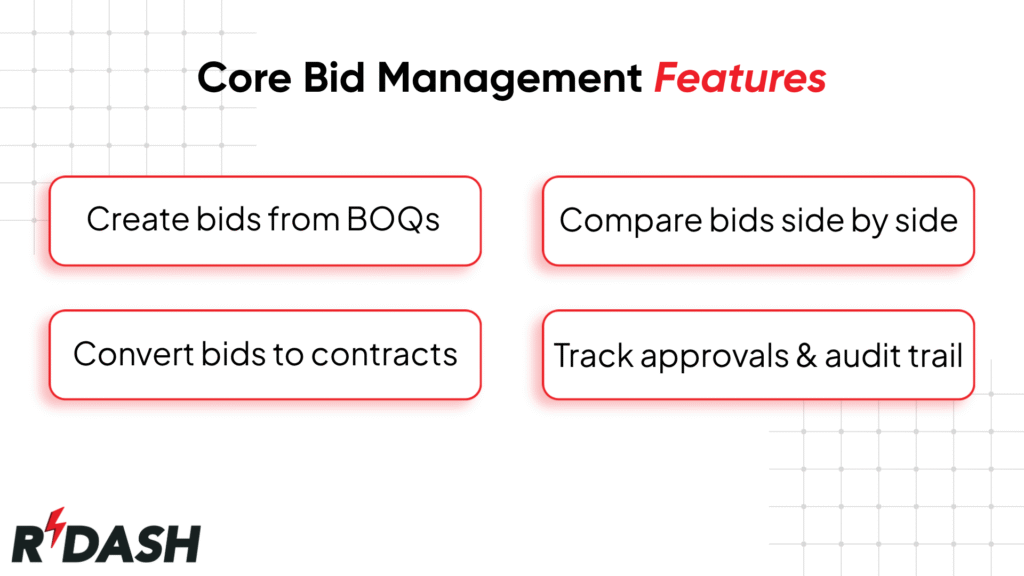
A bid management platform earns its place in your stack if it handles four things well. Everything else is packaging.
Build Bids Directly From Your BOQ
A bid request should pull directly from your BOQ or element library, not be retyped as a new document every time. This is where manual processes quietly lose accuracy. The moment a scope item is copied into a fresh sheet for bidding, it starts drifting from the approved BOQ, and that drift compounds through every quote you collect against it.
Level and Compare Bids Side by Side
Once quotes arrive, you need to see them side by side against the same line items, quantities, and terms, not as five PDFs in five different formats. Bid levelling is what turns “who quoted the lowest number” into “who actually offered the best value once taxes, delivery, and terms are normalised.” A cheaper headline rate with worse payment terms is often the more expensive bid.
Convert a Winning Bid Into a Contract
This is the step nearly every generic bidding tool leaves as a manual handoff, and it is the most costly one to leave unautomated. Once you accept a bid, it should become a rate contract or purchase order without anyone re-entering rates, item codes, or vendor details.
Track Approvals With a Built-In Audit Trail
Who approved this vendor, at this rate, and when? On any regulated or investor-backed project, that is not a nice-to-have. Bid management software should log approvals against your existing hierarchy rather than depend on someone forwarding an email chain.
For reference, Procore’s guidance on bid management, citing Software Advice, lists a similar core set of features to look for: contact management, a custom form builder, a shared project calendar, a subcontractor portal, and a communication log. Those are the mechanics. What separates a genuinely useful platform is whether it connects those mechanics to what happens after the bid is awarded.
Where Does Construction Bid Management Cost You the Most?
Here is the part contractors underestimate, and it is the strongest reason to evaluate bidding as one stage inside a connected procurement system rather than as a standalone tool.
Procurement is not a side activity in construction. McKinsey’s research found that procurement typically accounts for 40 to 70 per cent of a construction company’s total spending, and that firms with best-in-class procurement practices report margins five to ten percentage points higher than procurement laggards. Separately, McKinsey’s analysis of contracting and capital procurement puts the potential cost improvement at 5 to 15 per cent on large capital projects. A bid tool that stops at “vendor selected” is only touching the smallest, cheapest part of that equation.
The higher cost sits downstream: rate drift between what was bid and what gets invoiced, duplicate data entry between the bidding sheet and the accounting system, and no clear view of what has actually been committed versus what has been paid. That is the leakage a connected system is designed to prevent, and it is the specific problem RDash sets out to solve.
How Does RDash Handle Bid Management, Rate Contracts, and Vendor Orders?
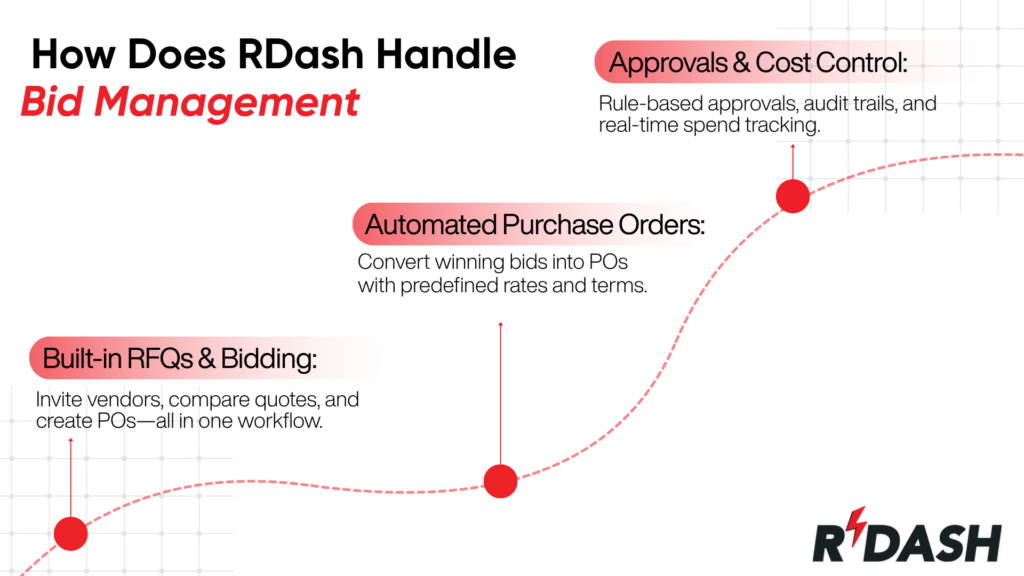
RDash treats bidding as one stage inside a single procurement and finance workflow, not as an isolated module. That design choice is what lets a bid flow cleanly into an executable, trackable order.
Bidding and RFQs Built Into Vendor Orders
Within Vendor Orders and Invoice, RDash supports a reverse-bidding and RFQ flow, so you can invite multiple vendors to quote against a defined item list and compare their responses before committing. Because this sits inside the same module that creates the purchase order, there is no separate bidding tool to reconcile against your procurement records later. Item lists can be uploaded from Excel or imported directly from the BOQ, an element library, or a previous project, so the scope you bid stays tied to the scope you approved.
From Winning Bid to Purchase Order, Automatically
Instead of renegotiating from scratch on every order, RDash lets you set up supplier rate contracts linked to an element library, track their expiry and renewal, and import those rates into a vendor order in a single step. When a bid is accepted, RDash carries it into a purchase order using a configured PO template, applies item-level and PO-level tax with country-specific configuration, and sets payment milestones. The commercial terms you bid are the terms that get executed, by design rather than by manual reconciliation.
Approvals, Audit Trail, and Real-Time Cost Tracking
Vendor orders, invoices, payment requests, and site-expense reimbursements all run through a rule-based approval hierarchy you configure once, giving you a documented trail from “vendor invited to bid” through “invoice paid.” And because bidding, rate contracts, and vendor orders sit alongside installed-progress tracking, RDash gives project and finance teams a real-time view of committed costs, actual spends, and pending liabilities, rather than a month-end reconciliation that reveals a trade package went over budget after the fact. Vendor KYC, blacklists, and consolidated vendor ledgers live in the same place, so the party you are bidding to carries a documented track record inside the system.

Standalone Bid Tools vs. Integrated Procurement Software
|
Standalone bid / plan-room tools |
RDash (integrated) |
|
|
Bid or RFQ creation |
Built from a fresh document or template |
Imported from BOQ, element library, or a prior project |
|
Bid comparison |
Manual or semi-automated levelling |
Compared within the vendor order flow |
|
Award to contract |
Manual re-entry into accounting or ERP |
Bid converts into a rate contract or PO |
|
Vendor history |
Often tracked separately |
KYC, ledgers, and blacklists in the same system |
|
Cost visibility after award |
Needs separate reporting |
Real-time committed cost, spend, and liabilities |
|
Best suited for |
Sourcing new subcontractor networks and leads |
Contractors running BOQ-linked procurement end to end |
This is not a case of one category being better across the board. If your priority is discovering new subcontractors or tapping a large bid-invitation network, a marketplace-style plan room does that job well. If your priority is running bids against your own vendor base and having the outcome flow into contracts, budgets, and cash flow without rework, that is the problem RDash is built to solve.
Who Should Use RDash for Construction Bid Management?
RDash is built for owners, main contractors, subcontractors, design studios, and PMCs working on commercial interiors and other construction projects, particularly teams running several projects at once where BOQ accuracy and rate consistency matter more than the size of an external vendor directory. It suits organisations that have outgrown Excel-and-WhatsApp procurement but do not want to run a separate bidding tool alongside their project and finance systems. RDash is a Y Combinator-backed platform, and its pricing is offered across three plans: RDash Lite, RDash Pro, and RDash Enterprise, structured around team size and project scale.
The Bottom Line
Bid management software is measured on the wrong thing when it is judged only on how well it collects and compares quotes. That work is the baseline. What actually protects your margin is what happens the moment a bid is accepted: whether it becomes a contract, a budget line, and a payment schedule on its own, or turns into another re-entry job for someone on your team. RDash is built around that second question, connecting bid and RFQ flows to rate contracts, vendor orders, approvals, and real-time cost visibility, so the number you bid is the number you pay against.
If bid-to-contract leakage is the problem you are trying to solve, that is the gap RDash was designed to close. You can see how the rate contracts and vendor orders workflow fits together, or book a demo and walk through it against your own BOQ.
Frequently Asked Questions
What is construction bid management software?
Construction bid management software helps contractors, PMCs, and developers solicit, compare, and award competitive bids from subcontractors and suppliers for a defined scope of work, then track each award through to contract and payment. The strongest tools connect bidding directly to procurement and finance.
What features should construction bid management software have?
Look for five core capabilities: BOQ-linked bid or RFQ creation, side-by-side bid levelling, one-step conversion of a winning bid into a contract or purchase order, a built-in approval and audit trail, and real-time visibility into committed versus actual cost.
What is the difference between bid management and tendering?
Tendering, or estimating, is when a contractor bids to win a project from an owner, which is a sales-side activity. Bid management, in the procurement sense, is what a contractor does after winning: soliciting competitive quotes from subcontractors and vendors to execute the scope.
What is the difference between an RFQ and a bid?
An RFQ (request for quotation) is the document used to solicit a bid; it defines scope, quantities, and deadlines. The bid is the vendor’s response: their price, terms, and delivery commitment against that RFQ.
What is reverse bidding in construction?
Reverse bidding is when multiple vendors compete to offer their best price against a single, clearly defined requirement, with the buyer controlling the process and comparing responses in one place, instead of negotiating with each vendor separately.
Why don’t construction bids match the final invoice?
Usually because the bid was captured in one system, a spreadsheet or email, and the purchase order or invoice was created in another. Every manual re-entry between the two is a chance for a rate, quantity, or tax line to drift.
Does construction bid management software connect to your BOQ?
It should. If bid requests are built from a separate document instead of pulling from the approved BOQ or element library, you carry scope-accuracy risk into every quote you collect. RDash imports order items directly from the BOQ, element library, or a previous project.
How much does construction bid management software cost?
Pricing usually depends on team size, number of active projects, and the modules you need. RDash is offered across three plans: RDash Lite, RDash Pro, and RDash Enterprise, with current details on its pricing page.
Does RDash support rate contracts as well as one-off bids?
Yes. RDash lets you set up standing supplier rate contracts linked to your element library, track their expiry and renewal, and import those rates into vendor orders, alongside reverse-bidding and RFQ flows for one-off scopes.
How does RDash handle procurement approvals?
RDash runs vendor orders, invoices, payment requests, and site-expense reimbursements through a configurable, rule-based approval hierarchy, so every award and payment carries a documented sign-off trail.
Is RDash only for large contractors?
No. RDash serves owners, main contractors, subcontractors, design studios, and PMCs across small and large teams, on an unlimited-user model, and is used on commercial interiors and construction projects, particularly by teams running several projects at once.
Does RDash give real-time visibility into procurement costs?
Yes. Because rate contracts, vendor orders, and installed-progress tracking sit in one system, project and finance teams can see committed costs, actual spends, and pending liabilities without waiting on a manual reconciliation.