
Key Takeaways
- Running projects on Excel and WhatsApp works until you scale; then the gaps quietly eat your margin and cash flow.
- Even India’s largest, closely monitored projects overrun by lakhs of crores (MoSPI, April 2026); smaller firms on thinner margins are more exposed, not less.
- Construction project management software unifies scheduling, BOQs, site progress, procurement, costs, and approvals in one real-time system.
- For Indian SMEs, the must-haves are a real mobile site app, BOQ/change-order control, procurement and cost tracking, approvals, and ERP integration.
- Choose by your biggest leak first, insist on mobile adoption, confirm construction-specific fit, and always pilot on one live site.
- RDash is a purpose-built, AI-powered platform that maps to this exact reality: mobile-first, unlimited users, Tally/Zoho/SAP integrations, and fast go-live with a 90-day deployment guarantee.
Walk onto almost any small or mid-sized construction site in India, and you’ll find the same operating system running the entire project: a WhatsApp group, a few Excel sheets, and the owner’s phone. The site engineer drops twenty photos into the group at 7 PM. A vendor’s bill is approved over a call. The BOQ lives in a file named something like BOQ_final_v3_revised_FINAL.xlsx, and nobody is fully sure it’s the latest one.
It works right up until it doesn’t. A material order gets missed because the message scrolled past. A change in scope never makes it into the costing. The client asks for a progress update, and the answer is “I’ll check and revert.” Multiply that across three or four live sites and the gaps stop being annoyances and start eating your margin.
This guide is about fixing that. Not with another app to add to the pile, but with construction project management software for small businesses, a single place to plan work, track site progress, control costs, manage vendors, and keep the office and the site looking at the same information. We’ll cover what this software actually does, why smaller construction firms in India now need it, how to evaluate it without getting lost in feature lists, and where a purpose-built platform like RDash fits in.
The Real Cost of Running Projects on Spreadsheets and WhatsApp
Cost and time overruns aren’t a small-builder problem. They’re an everyone problem. According to the Ministry of Statistics and Programme Implementation (MoSPI), the April 2026 Flash Report on Central Sector Infrastructure Projects tracked 1,981 ongoing projects worth ₹150 crore and above. Their original sanctioned cost was about ₹37.12 lakh crore; the revised cost had climbed to roughly ₹42.78 lakh crore, with a cumulative overrun of around ₹5.66 lakh crore.
Read that again. These are the largest, most closely monitored projects in the country, with dedicated project management units and government oversight, and they still bleed lakhs of crores to overruns. Now think about a small contractor running four residential sites with a couple of supervisors, a manual BOQ, and approvals that depend on whoever picks up the phone. If the well-resourced giants struggle to hold the line, the smaller firm working on thinner margins and tighter cash flow is far more exposed, not less.
Where small firms lose the most
The everyday version of this looks familiar to anyone who has run an Indian site:
- The office-to-site gap: head office plans one thing, the site does another, and the difference only surfaces at billing.
- Delayed approvals: a purchase request or a drawing revision sits in someone’s inbox or chat while work either stalls or proceeds incorrectly.
- BOQ drift: actuals quietly move away from the estimate, and there’s no live view of where the project P&L really stands.
- Material and vendor chaos: orders, GRNs, and vendor bills tracked across registers and chat threads, with no single source of truth.
- Reporting that eats the day: supervisors spend evenings compiling photos and updates that should have been captured once, on site.
None of these is caused by bad people. They’re caused by a manual system that was never designed to coordinate multiple teams across multiple sites in real time.
What is Construction Project-Management Software?
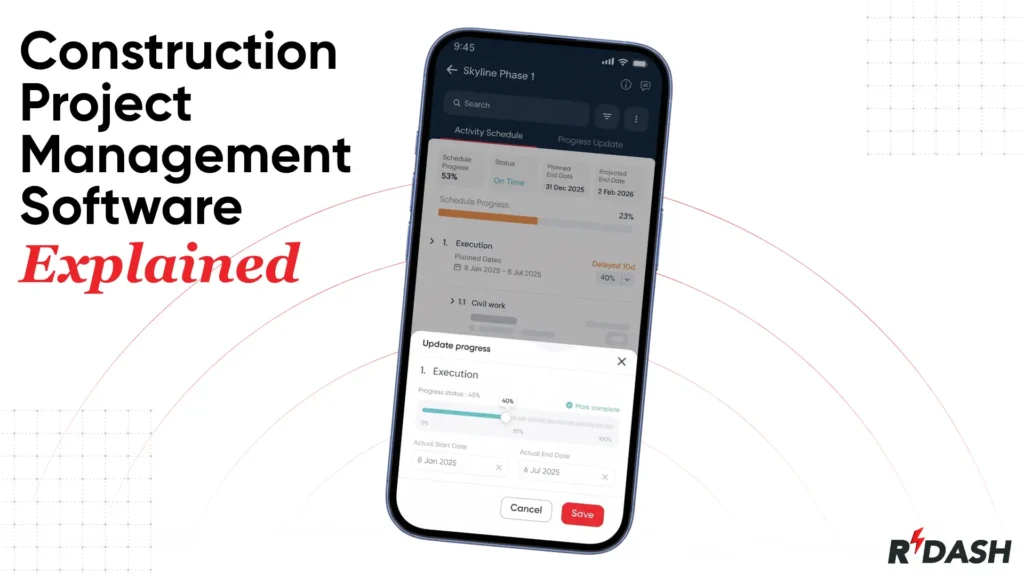
Construction project management software is a digital platform that helps construction companies plan, schedule, budget, track, and coordinate projects from a single system, replacing scattered spreadsheets, chat groups, and paperwork with one shared, real-time view of every project.
In practical terms, it brings together the things you currently juggle separately: the project schedule and activities, the BOQ and change orders, daily progress from site, material and vendor management, approvals, costs, and reporting. Instead of asking “where is that file/message/bill?”, everyone- owner, project manager, site engineer, purchase team, accounts- works off the same data.
The better platforms are purpose-built for construction, not generic project tools bent into shape. That distinction matters, because construction has its own grammar: BOQs, rate contracts, GRNs, RA bills, snag lists, DPRs, retention, and the constant tension between what was planned, what’s installed, and what’s been paid.
Why do Small Construction Businesses in India Need Project-Management Software?
Small construction businesses need project management software because manual tracking can’t keep pace with multiple sites, tight margins, and delayed approvals, and the cost of every missed update, untracked expense, and slow decision falls directly on a small firm’s profit and cash flow.
A large EPC company can absorb a project manager dedicated to chasing information. A small builder or contractor usually cannot. The owner is the project manager, the head of procurement, and often the one approving payments at midnight. Software doesn’t replace that person’s judgement; it removes the busywork around it so the judgement is applied to real, current information instead of week-old guesses.
The pressures stacking up on Indian SMEs
For Indian SME construction firms specifically, the pressures stack up:
- Multiple concurrent sites with the same two or three key people stretched across all of them.
- Labour-intensive operations where productivity is hard to see without standing on site.
- Vendor coordination across cement, steel, tiles, electricals, and dozens of specialised suppliers.
- Material procurement that has to be timed against site readiness and cash availability.
- BOQ and budget tracking where a 5–10% slippage can wipe out the entire margin.
- Client and owner reporting that increasingly happens over WhatsApp, with no record and no structure.
This isn’t about going “digital” for its own sake. It’s about making sure that a residential builder doing villas in Pune, a commercial fit-out contractor in Gurugram, or an MEP subcontractor on an infrastructure package can all see what’s actually happening before it costs them money.
How does Construction Project Management Software Reduce Project Delays?
Construction project management software reduces delays by giving every team real-time visibility, automating approvals, and surfacing problems early so issues are caught and decided in hours instead of being discovered at billing or handover.
Where delay actually creeps in
Delays rarely come from a single dramatic event. They accumulate from small, invisible waits: a drawing pending approval, a material that wasn’t ordered in time, a dependency nobody flagged. Software attacks delay at exactly these points:
- A shared schedule with dependencies. Everyone sees what has to finish before the next activity can start, so sequencing problems show up on a plan rather than on site.
- Approvals that move, not sit. Purchase requests, change orders, and payments run through a defined approval hierarchy with notifications, instead of waiting in a chat thread.
- Daily progress captured at source. Site teams log progress and photos from a mobile app, so head office isn’t waiting until evening or until the next site visit to know where things stand.
- Early risk flags. Modern platforms analyse project activity and highlight where a timeline or a budget is slipping, so you intervene while it’s still cheap to fix.
- One version of the truth. When the BOQ, the drawings, and the site update all live together, the costly back-and-forth of “which file is current?” simply disappears.
The compounding effect is the point. Shaving a day off each of a dozen small waits, across four sites, adds up to weeks over a project.
How can Software Help Control Construction Costs?
Software controls construction costs by tracking the BOQ, budget, scope changes, and actual spend in real time so owners can see their project P&L continuously and catch overruns while they can still be corrected, not after the money is gone.
Making cost control live, not retrospective
The classic SME failure mode is finding out the project lost money only when the final accounts are tallied. By then, every decision that caused the loss is in the past. Cost control works when it’s live:
- BOQ vs. actuals maintained continuously, so variances are visible the day they appear.
- Change orders documented and approved before work proceeds, so scope creep is priced, not absorbed.
- Site expenses captured on the spot from a mobile app, instead of reconstructed from memory at month-end.
- Procurement tied to the BOQ, so what you order maps back to what was estimated and approved.
- Installed-progress measurement, where billing and cash flow are anchored to the value of work actually installed- not just material delivered or invoices raised.
That last one is where a lot of small firms quietly lose cash flow. RDash, for example, ties receivables and payables to installed work progress; on its own figures, the company reports this can unlock around 20% of project cash flow and contribute to roughly 10% cost reduction. Treat those as RDash’s reported outcomes rather than guarantees, but the underlying principle is sound: you control costs and cash by measuring the right thing, in real time.
How can Construction Firms Improve Project Visibility Across Office and Site?
Construction firms improve visibility by replacing photos-in-WhatsApp and update-by-call with a single platform where site progress, costs, approvals, and reporting are captured once and visible to everyone instantly.
Visibility is really an information-architecture problem. Right now, information about a project is scattered across people’s phones, inboxes, and registers, and it has to be manually assembled every time someone asks a question. A unified platform inverts that: information is captured once at the point it happens and is available to everyone who needs it, immediately.
For the owner travelling between sites, that’s the difference between calling three supervisors to piece together a picture and opening one dashboard. For the client, it’s the difference between “we’ll send an update” and a transparent, structured daily progress report. Visibility, in the end, is what makes every other improvement faster decisions, tighter costs, fewer delays actually possible.
What Features Should a Small-Construction Business Look For?
You don’t need every feature on the market. You need the ones that map to how an Indian SME construction business actually runs.
The feature checklist
Use this as a checklist when you evaluate any platform:
- A mobile-first site app that works for non-technical supervisors on a basic Android phone, with geo-tagged photos and offline-friendly capture.
- Daily Progress Reports (DPRs) that are generated from site input, not retyped at head office.
- BOQ and change-order management that keeps estimate, scope, and actuals connected.
- Procurement and vendor management: purchase requests, POs, GRNs, and vendor invoices in one flow.
- Cost and cash-flow tracking, ideally tied to installed progress, so your project P&L is always current.
- An approval hierarchy so POs, payments, and changes are controlled, not informal.
- Multi-project visibility in a single dashboard, because you’re never running just one site.
- Document and design version control, so the site always builds from the current drawing.
- Snag and quality tracking to close defects before handover, ideally tied back to the responsible vendor or order.
- Integrations with the tools you already use- Tally, Zoho, Odoo, SAP, MS Business Central so accounts and ERP stay in sync.
- Reporting and analytics that turn site data into decisions without manual MIS work.
- An unlimited-user model, so adding site staff and stakeholders doesn’t inflate your bill or tempt you to leave people off the system.
Manual stack vs. purpose-built software
A quick way to see why this matters: the manual stack versus a purpose-built platform:
|
What you’re doing now |
What it quietly costs you |
With purpose-built construction software |
|
Progress photos and updates in WhatsApp |
Updates get buried; no record; office is always a step behind |
Geo-tagged DPRs captured once on site, visible instantly to all |
|
BOQ and costs in Excel, emailed around |
Version confusion; variances surface only at billing |
Live BOQ vs. actuals with a continuously updated project P&L |
|
Approvals over calls and chat |
Work stalls or proceeds wrongly while requests wait |
A defined approval hierarchy with notifications and an audit trail |
|
Vendor bills and materials in registers |
Missed orders, duplicate payments, no single source of truth |
Purchase requests, POs, GRNs, and invoices in one connected flow |
|
Reporting to the owner/client by phone |
Hours lost compiling; no transparency for the client |
Structured, real-time dashboards and shareable client reports |
A Simple Framework for Choosing the Right Software
It’s easy to be dazzled by feature lists. This six-step framework keeps the decision grounded in your business:
- Map your biggest leak first. Is it billing delays, cost overruns, material wastage, or slow approvals? Pick the platform that fixes your primary pain, not the one with the longest feature list.
- Insist on a real mobile experience. If your site supervisors won’t use it on their phones, nothing else matters. Test the app with an actual supervisor before you buy.
- Check construction fit, not generic project fit. Confirm it speaks BOQ, GRN, RA billing, DPR, and change orders natively, not as bolt-ons.
- Verify it connects to your accounting/ERP. Tally, Zoho, Odoo, or SAP integration prevents your finance data from splitting into two worlds.
- Pressure-test rollout and support. Ask how fast a team like yours goes live, who handles onboarding, and what migrating your existing BOQs and data looks like.
- Pilot on one live site. Run it on a single real project for a few weeks before rolling it out. Adoption on the ground is the only test that counts.
Where RDash Fits for Small-Construction Businesses
Most of this guide is deliberately vendor-neutral, because the principles hold regardless of which tool you choose. But it helps to see those principles in a real platform.
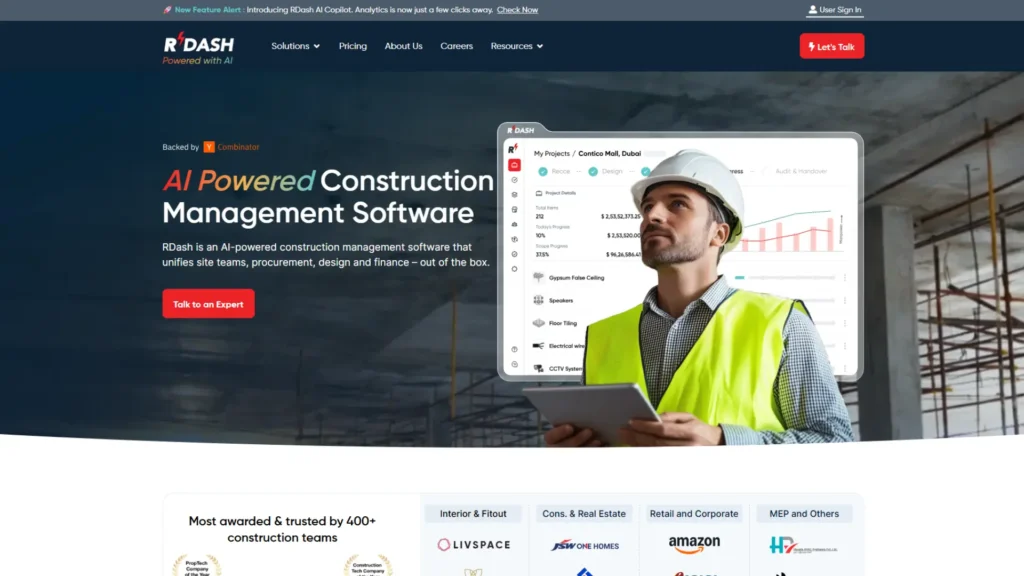
RDash is an AI-powered construction management software built specifically for the construction and fit-out industry, designed to unify site teams, procurement, design, and finance in one system, and to replace the WhatsApp-plus-Excel-plus-Drive stack that most teams are stuck with. It’s used by 400+ construction teams across India and the UAE, spanning interiors and fit-out, real estate, MEP, industrial, and corporate projects, and it’s backed by Y Combinator.
Why it suits a small construction business
These are the capabilities that map directly to how a smaller firm runs:
- It’s purpose-built, not generic. Pre-sales/CRM, activity schedules with dependencies, design version control, BOQ and change orders, automated 360° DPRs, site surveys, and snag management all live in one connected workflow covering a project from lead to handover.
- Procurement and finance are in the same system. Rate contracts, purchase requests, vendor POs and invoices, material GRN and issuance, site expense capture from a mobile app, and installed-progress tracking keep cost and cash flow tight and on-ground.
- The mobile app is built for the site. Available on Android and iOS, so supervisors capture progress, expenses, and surveys directly from the floor rather than reporting to head office after hours.
- AI does the watching for you. The RDash AI Co-pilot offers prompt-based analytics that flag margin leakages and time lags early, remembers project context, and renders insights as tables and graphs, useful precisely when you don’t have a dedicated MIS team.
- It connects to what you already run. Out-of-the-box integrations with Tally, Zoho, Odoo, MS Business Central, and SAP keep accounts and ERP aligned.
- Pricing and rollout suit smaller teams. RDash offers three plans: Lite, Pro, and Enterprise with an unlimited-user model, so every stakeholder can be on the platform without per-seat penalties. (Plan-wise pricing is published on the RDash pricing page.) On implementation, most teams go live within days, supported by structured onboarding and a 90-day deployment guarantee with dedicated account management.
Proof from the field
The proof shows up in how teams actually use it. Semac Construction, a Gurugram EPC firm running several large projects at once, used RDash’s approval hierarchy to tame hundreds of vendor POs that had been scattered across emails and folders, reporting 15% better project visibility, 10% faster approvals, and a 4% cost saving. A coworking operator with 35 properties across 14 cities built a real-time control tower and cut construction costs by around 12%. A residential interiors firm, Spacify Interiors in Tamil Nadu, brought constantly changing client scope under control and trimmed margin bleed by 15%. Different segments, same underlying win: control and visibility replacing scattered files and chat threads.
Being honest about fit
To be clear-eyed about fit: RDash is a serious construction platform rather than a bare-bones ₹500-a-month utility, and it shines for firms that run real BOQs, real vendor flows, and multiple sites. If that’s your business and for most growing Indian builders, contractors, and developers, it’s built for exactly your operating reality.
What Rollout Actually Looks Like
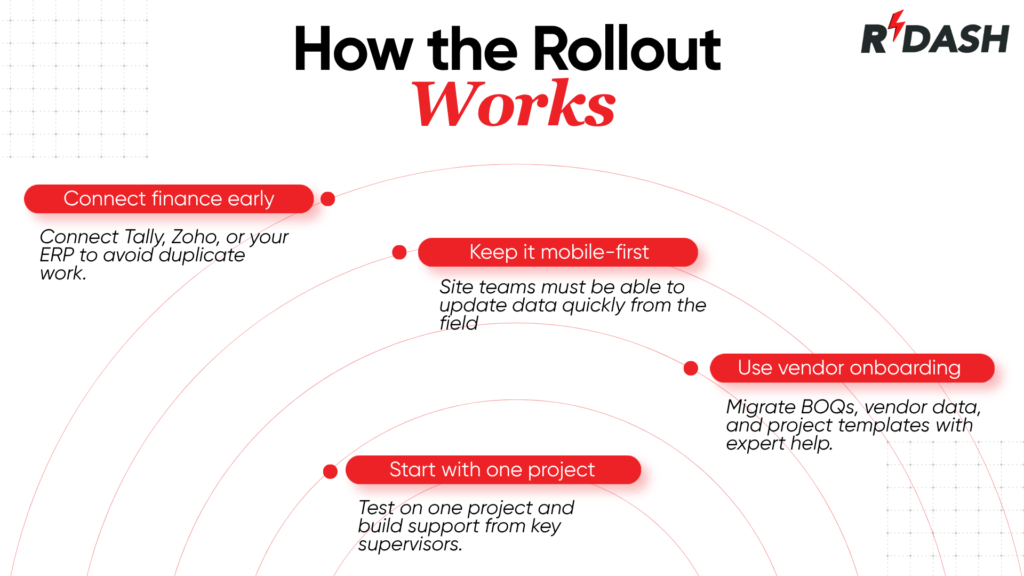
The most common reason software fails on Indian sites isn’t the software; it’s adoption.
Planning for adoption
A few realities worth planning for:
- Start with one site, then expand. Prove the workflow on a single live project, win over one or two supervisors, and let them become your internal champions.
- Onboarding is part of the product, not an afterthought. Lean on the vendor’s onboarding and account-management support to migrate your BOQ templates, vendor lists, and project structures.
- Mobile-first is non-negotiable. If the site app is too complex, it won’t be used. The whole value depends on supervisors actually capturing data on the floor.
- Keep finance connected. Wire up your Tally/Zoho/ERP integration early, so your accounts team isn’t maintaining a parallel universe.
Done this way, “going live within days” is realistic for a small team, with the deeper rollout maturing over the following weeks.
Conclusion: From Firefighting to Control
Running a small construction business in India has never been about a shortage of effort; it’s about visibility. The firms that fall behind aren’t working less; they’re working blind, piecing together the state of each project from chat threads and half-updated spreadsheets while costs drift and approvals stall. The ones that pull ahead simply see their projects more clearly, and act sooner.
Construction project management software is what closes that gap. It won’t pour the concrete or negotiate with your vendor, but it makes sure every decision you take is based on what’s actually happening on site today across every project at once. For a business running on thin margins, that shift from firefighting to control is often the line between a project that makes money and one that merely gets finished.
The honest way to find out whether it works for you is to try it on a single live site and watch what changes.
Ready to see it on your own project?
Book a free RDash demo and run it on one live site; see how site progress, BOQs, costs, approvals, and vendor payments come together in a single view, then scale it across the rest of your projects. Talk to the RDash team for a walkthrough, or explore plan-wise pricing to find the plan that fits your team size.
Frequently Asked Questions
- How much does construction project management software cost for a small business in India?
Pricing varies widely from lightweight tools to full platforms, and most vendors price by plan tier and team size rather than a single figure. RDash, for instance, offers Lite, Pro, and Enterprise plans with an unlimited-user model, so adding site staff doesn’t increase your bill. Always check published plan-wise pricing and confirm what’s included before committing. - How long does it take to implement?
For a small team, basic usage can begin within days. RDash backs this with structured onboarding and a 90-day deployment guarantee for a full rollout. A sensible approach is to pilot on one live site first, then expand. Data migration of existing BOQs and vendor lists is the main variable in timelines. - Can my site supervisors actually use it on a basic smartphone?
Yes, this is the single most important feature to test. A good construction app runs on a mid-range Android phone, supports geo-tagged photo uploads and on-site data capture, and is simple enough for non-technical supervisors. RDash is available on both Android and iOS for exactly this reason. - Does it help manage contractors and vendors?
Directly. Purpose-built platforms handle purchase requests, vendor purchase orders, invoices, material GRNs, and rate contracts in one flow, with an approval hierarchy so nothing is paid or ordered informally. RDash also lets you create third-party logins so suppliers and clients can update documentation and provide approvals. - How does it track site progress?
Through Daily Progress Reports captured on a mobile app rather than retyped at head office. Site teams log progress, photos, and surveys from the floor, and the office sees it in real time. RDash automates 360° DPRs and ties progress to installed value of work for accurate billing and cash flow. - What reporting and analytics should I expect?
At minimum, live dashboards for cost, progress, and cash flow, plus client-ready reports without manual MIS work. RDash provides 50+ ready dashboards and an AI Co-pilot that answers prompt-based queries, flags margin leakages and time lags, and renders insights as tables and graphs. - Will it scale as my business grows?
A good platform should handle one site or many without forcing a migration. RDash is used by teams ranging from around 10 people to several thousand, with plans (Lite/Pro/Enterprise) that grow with you and an unlimited-user model that avoids per-seat penalties as your stakeholder list expands. - What kind of ROI can a small construction firm expect?
ROI comes mainly from prevented overruns, reduced material wastage, faster billing, and less administrative time. RDash reports outcomes such as roughly 10% cost reduction and around 20% cash-flow unlock by linking receivables and payables to installed progress; treat these as the vendor’s reported figures, and validate against your own pilot. - Does it integrate with Tally and other accounting/ERP tools?
It should; otherwise, your finance data splits in two. RDash integrates out of the box with Tally, Zoho, Odoo, MS Business Central, and SAP, keeping accounts and ERP in sync with site and procurement data. - How is this different from using Excel, WhatsApp, and a generic ERP?
Excel and WhatsApp aren’t connected, aren’t real-time, and keep no reliable audit trail; generic ERPs aren’t built for construction’s BOQ/GRN/DPR/RA-billing reality. A purpose-built platform like RDash brings tasks, BOQs, site updates, approvals, and cost tracking together without the data loss and miscommunication of stitched-together tools. - Is my business data safe on cloud-based construction software?
Reputable cloud platforms use strong encryption and automated backups, which is considerably safer than Excel files or paper records that can be lost, corrupted, or stranded on one person’s laptop. Confirm the vendor’s security and backup practices as part of your evaluation. - Can it handle multiple sites at once?
Yes, and for most Indian SME builders that’s the core requirement. Look for a single multi-project dashboard that shows progress, costs, and approvals across every site, so the same two or three key people aren’t stretched blind across locations.