
Quick Answer: Design Development (DD) defines what gets built, finalising layouts, materials, and systems coordination. Construction Documents (CD) define exactly how it gets built, issuing detailed, often contractual drawings and specifications used for permits, tendering, procurement, and site execution. DD reduces design risk; CD reduces build risk.
Key Takeaways
- The core distinction is accountability: The main difference is that DD finalises the design, while CD converts that finalised design into detailed buildable instructions.
- Cost leverage is highest during DD. The MacLeamy Curve indicates that changes made to construction design at the DD stage are less costly.
- Skipping or rushing DD doesn’t save time; it transfers unresolved problems to the site, where they return as RFIs, rework, and change orders.
- A tender-grade Bill of Quantities (BOQ) can only be produced after CD. Using a preliminary DD BOQ to run procurement is one of the most common and costly mistakes in construction.
- The DD-to-CD handover is where coordination failures most often originate: version drift, misaligned BOQs, and unapproved revisions reaching the site.
- Connected project management platforms reduce handover risk by keeping design, BOQs, approvals, and procurement in a single governed workspace.
Why the Distinction Matters
On many projects, the trail of RFIs, change orders, and procurement delays leads back to one quiet decision made months earlier: someone treated Design Development drawings as if they were Construction Documents. A set that looked complete got handed to a procurement team or a contractor, and the gaps it carried, missing assembly details, clashing services, a BOQ that no longer matched the drawings surfaced on site, where they are most expensive to fix.
The two phases are not just different levels of detail. Each phase serves a different purpose. DD helps control cost and scope, while CD helps ensure accurate procurement and construction. When teams blur them, the cost reappears later as rework, change orders, procurement delays, and schedule slippage exactly the failures that erode margins on otherwise well-managed projects.
McKinsey’s research on large capital projects found they typically run around 20% over schedule and up to 80% over budget. A meaningful share of that overrun traces back not to site execution but to design decisions that were never properly resolved before detailed documentation began. Autodesk’s Construction Disconnected research attributed roughly 48% of all rework on US jobsites to poor project data and miscommunication, approximately USD 31.3 billion in a single year (2018 figures).
What follows is a practitioner-oriented account of what each phase actually delivers, where the boundary between them sits, and how project teams, general contractors, design-build firms, architects, fit-out companies, project managers, owners, and EPC contractors can manage both stages without losing control of cost or coordination.
Design Development vs Construction Documents: At a Glance
|
Design Development (DD) |
Construction Documents (CD) |
|
Core question: What are we building? |
Core question: How do we build it, with what, to what standard? |
|
Coordinated design-intent drawings |
Issued-for-construction (IFC) drawings + full specifications |
|
Systems and materials defined; not fully detailed at assembly level |
Assemblies, dimensions, tolerances, and methods fully detailed |
|
Preliminary BOQ for budgeting and cost planning |
Tender-grade BOQ tied to finalised scope and measurable quantities |
|
Not buildable informs early sourcing only |
Buildable: the primary site reference |
|
Highest leverage to influence final cost |
Errors surface as rework, RFIs, and change orders |
|
Lower revision cost changes are redraws |
Higher revision cost changes ripple across drawings, specs, and BOQ |
What Is Design Development?
Definition: Design Development is the architectural design phase that turns an approved schematic concept into a coordinated, technically resolved design, fixing layouts, materials, and the integration of structural and MEP (mechanical, electrical, plumbing) systems before detailed documentation begins.
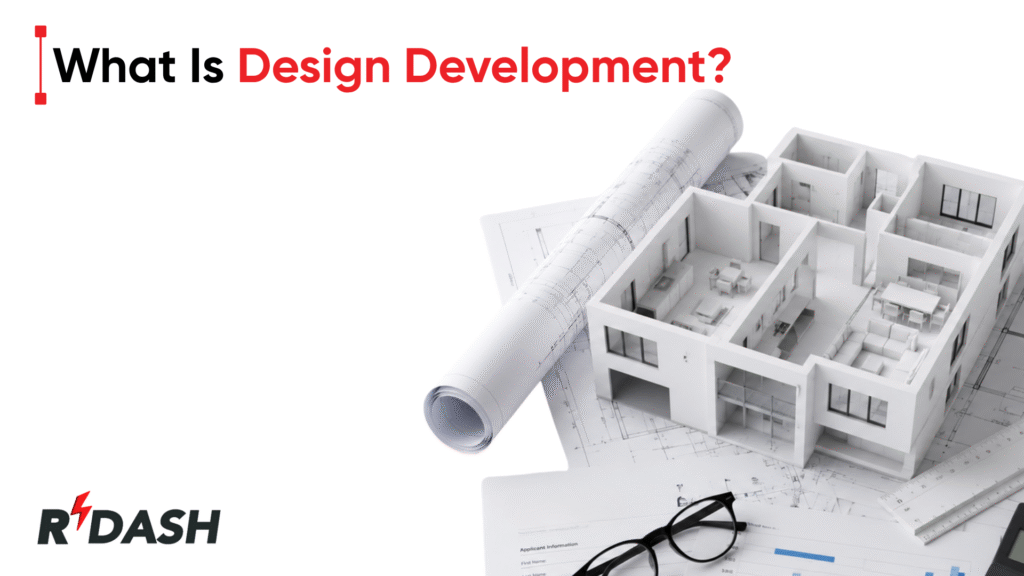
The American Institute of Architects (AIA) organises an architect’s basic services into five phases under AIA Document B101-2017: Schematic Design, Design Development, Construction Documents, Procurement, and Construction Administration. Design Development bridges the gap between schematic design and detailed construction documentation. The AIA frames DD documents as both an interim step toward Construction Documents and an end in themselves, commonly used for owner approvals, board or lender reviews, and early permitting applications.
What Design Development Is Meant to Achieve
- Finalise spatial layouts, controlling dimensions, and building geometry
- Select materials, finishes, and key product specifications
- Coordinate structural, mechanical, electrical, and plumbing (MEP) systems with the architecture
- Surface design conflicts between disciplines before they reach the site
- Establish construction cost direction and lock design intent
- Produce a preliminary Bill of Quantities sufficient for budgeting and value engineering
Who Is Involved
Design Development relies heavily on multi-disciplinary coordination. Architects lead the process, working alongside structural and MEP engineers, interior designers, cost consultants, and key stakeholders. On design-build and EPC contracts, contractors typically join the DD phase early so the design is shaped within real construction and procurement constraints, a practice the MacLeamy Curve supports as the most cost-efficient allocation of effort.
How Design Development Looks in Practice
- Commercial construction: A developer’s office tower moves from “glass facade, open floors” to defined floor-to-floor heights, curtain-wall systems, core layouts, and HVAC zoning.
- Interior fit-outs: A retail brand’s concept becomes specified flooring, ceiling systems, joinery details, lighting layouts, and partition types ready for cost planning.
- Residential projects: A home’s massing turns into resolved room layouts, window schedules, a structural approach, and finish selections the owner can review and formally approve.
By the end of DD, the project should be technically feasible, broadly costed, and stable enough that the next phase is about documentation, not redesign.
What Are Construction Documents?
Definition: Construction Documents are the detailed, often contractual drawings and specifications that tell every party exactly how to build the project; the issued-for-construction (IFC) set used for permits, tendering, procurement, and on-site execution.
While Design Development establishes the design solution, Construction Documents explain exactly how that solution will be executed and documented for construction. In the AIA process, this is the phase where architects and engineers prepare working drawings, complete full multi-disciplinary coordination, and assemble the documentation needed to obtain building permits. Contractors then use the set to price (tender) the work, and site teams reference it as the issued-for-construction baseline throughout construction.
Legal and Contractual Importance
Construction Documents are not purely technical deliverables. They are frequently contractual documents, forming part of the agreement between owner and contractor and defining scope, quality, and the obligations of each party. Because they govern what is owed and what is delivered, they sit at the centre of claims, disputes, and change-order management. Any missing information or ambiguity in the CD set typically resurfaces during construction, often resulting in RFIs, delays, additional coordination, or variation claims.
How the Design-to-Construction Process Works
Design Development and Construction Documents do not exist in isolation. They sit within a larger sequence that moves from concept to built asset. Understanding that sequence clarifies why the boundary between the two phases deserves discipline.
|
Stage |
What It Produces |
Key Decisions |
|
Concept Design |
Project vision, broad feasibility, rough budget |
Goals, scale, programme |
|
Schematic Design (SD) |
Overall form, layout direction, massing, preliminary systems |
Layout direction, massing, preliminary systems |
|
Design Development (DD) |
Coordinated layouts, materials, MEP integration, preliminary BOQ |
Materials, systems integration, finalised layouts |
|
Construction Documents (CD) |
IFC drawings, full specifications, schedules, tender-grade BOQ |
Exact details, assemblies, tolerances |
|
Procurement / Tendering |
Bid packages, contractor pricing, award |
Vendors, rates, lead times, contracts |
|
Construction Execution & Administration |
The built asset |
Sequencing, quality control, change management |
As the project progresses, fewer major decisions remain open and the design becomes increasingly fixed. The further the project travels, the more expensive it becomes to reverse a choice, which is exactly why the DD-to-CD boundary deserves careful governance, not just a drawing-revision number.
Where DD and CD Sit Within AIA Project Phases
The AIA’s five basic-service phases provide a shared vocabulary for where each deliverable belongs. Activities such as programming and concept design precede the AIA basic services and are typically scoped as Additional Services rather than one of the five basic phases, a distinction that matters when negotiating fees and responsibilities.
|
Phase |
AIA Classification |
What It Produces |
DD / CD Position |
|
Programming |
Pre-design (Additional Service) |
Space needs, project brief, budget framework |
Before DD |
|
Concept Design |
Pre-design / early SD |
Vision, feasibility, massing options |
Before DD |
|
Schematic Design |
Basic service 1 |
Overall form, organisation, preliminary systems |
Leads into DD |
|
Design Development |
Basic service 2 |
Coordinated layouts, materials, MEP integration, preliminary BOQ |
DD |
|
Construction Documents |
Basic service 3 |
IFC drawings, full specs, schedules, tender-grade BOQ |
CD |
|
Procurement (Bidding / Negotiation) |
Basic service 4 |
Bid packages, contractor pricing, award |
After CD |
|
Construction Administration |
Basic service 5 |
Site execution, RFIs, submittals, change orders |
After CD |
Source: AIA Document B101-2017, Standard Form of Agreement Between Owner and Architect.
Design Development vs Construction Documents: Full Parameter Comparison
|
Parameter |
Design Development (DD) |
Construction Documents (CD) |
|
Purpose |
Refine and coordinate the design into a feasible solution |
Translate the design into buildable instructions |
|
Level of detail |
Intermediate systems and materials defined, not fully detailed at assembly level |
High assemblies, dimensions, tolerances, and methods fully detailed |
|
Drawings |
Coordinated design-intent drawings showing systems integration |
Working / issued-for-construction (IFC) drawings with full detailing |
|
Specifications |
Outline or preliminary performance-level specifications |
Detailed product- and performance-level specifications with acceptance criteria |
|
BOQ accuracy |
Preliminary BOQ for cost planning and budgeting |
Tender-grade BOQ tied to finalised scope and measurable quantities |
|
Procurement readiness |
Not procurement-ready; informs early sourcing only |
Procurement-ready; supports tendering and award |
|
Construction readiness |
Not buildable on its own |
Buildable; the primary site reference |
|
Cost impact |
Decisions here have the largest leverage on final cost |
Errors here surface as rework, RFIs, and change orders |
|
Risk exposure |
Risk of carrying unresolved design issues forward |
Risk of contractual disputes and execution failures |
What a DD Drawing Set Looks Like vs a CD Drawing Set
The same drawing tells a very different story depending on the phase. This is where the abstract distinction becomes concrete.
|
Area |
DD Drawing |
CD Drawing |
|
Wall details |
Wall type indicated (e.g. “200mm blockwork + finish”) |
Full assembly layers, insulation, fixings, fire rating, junction details |
|
MEP layouts |
Major routes and plant rooms located; clash zones flagged |
Coordinated, dimensioned routing with sizes, supports, and penetrations resolved |
|
Schedules |
Outline schedules preliminary door and window types |
Complete door, window, finish, fixture, and equipment schedules |
|
Dimensions |
Key controlling dimensions only |
Fully dimensioned for setting out and fabrication |
|
Specifications |
Outline / performance-level specs |
Product-level specs with acceptance criteria and tolerances |
|
BOQ accuracy |
Preliminary quantities for budgeting |
Tender-grade, measurable quantities tied to documented scope |
|
Procurement readiness |
Informs long-lead sourcing only |
Ready to issue for tender, award, and fabrication |

The MacLeamy Curve: Why DD Is the Last Cheap Window
What Is the MacLeamy Curve? The MacLeamy Curve is a framework showing that the ability to influence cost and performance is highest early in a project, while the cost of making changes rises sharply as the project moves toward construction. Design Development is generally the final stage where significant design revisions can still be made without substantial downstream cost implications.
The curve is credited to Patrick MacLeamy, FAIA, developed during his time leading the global architecture firm HOK. He originally called it the “Effort Curve,” introducing it in a 2004 Construction Users Roundtable (CURT) white paper and presenting it at the 2005 AIA National Convention, work that helped catalyse the AIA’s Integrated Project Delivery (IPD) movement and the wider shift toward Building Information Modelling (BIM).
What the Curve Shows
- The ability to influence cost and function is highest at the start and falls steadily. Early in the project, adding a storey or relocating a core is a sketch.
- The cost of design changes is the mirror image, rising sharply over time. The later a change lands, the more it costs.
- Traditional effort distribution peaks late, during Construction Documents, when flexibility is already gone.
- Preferred (integrated) effort distribution shifts work deliberately earlier, into Schematic Design and Design Development, where decisions are cheap, and design influence is still strong.
By the end of Design Development, the project’s major cost is effectively committed even though almost nothing has been built. Moving a wall in DD is a redraw. Moving it during execution means demolition, rework, lost productivity, and a change order. The curve is the mathematical case for front-loading coordination, and the reason a rushed DD phase is one of the most expensive economies a team can make.
The Cost of Change by Phase
|
Stage |
Cost to Change a Major Decision |
|
Concept / Schematic |
Lowest: a decision is a sketch; nothing is committed |
|
Design Development |
Low: last cheap window; a change is a redraw and re-coordination |
|
Construction Documents |
Moderate and rising: changes ripple across drawings, specs, and BOQ |
|
Procurement |
High: re-quoting, re-tendering, and lead-time loss begin |
|
Construction |
Highest: demolition, rework, RFIs, lost productivity, and claims |
What Deliverables Are Included in Design Development?
Each DD deliverable exists to remove a specific risk. Leaving any incomplete means that risk travels forward, compounding in cost.
|
Deliverable |
Purpose |
Risk removed |
If incomplete |
|
Architectural drawings |
Fix layout, dimensions, and design intent |
Spatial conflicts and rework from late layout changes |
CD detailing proceeds on an unstable base, guaranteeing revisions mid-documentation |
|
Structural coordination |
Align framing and spans with the architecture |
Members that clash with services or cannot carry intended loads |
Structural changes mid-CD force MEP and architectural redraws |
|
MEP coordination |
Resolve major routing and equipment locations against building geometry |
The single largest source of field clashes and RFIs |
Services collide on site, generating costly clash-related RFIs that cannot be resolved cheaply |
|
Material & finish selections |
Choose and document finishes, systems, and key products |
Pricing drift and substitution disputes |
Cost estimates cannot firm up and procurement stalls on unconfirmed specifications |
|
Preliminary BOQ |
Support budgeting and value engineering |
Surprise long-lead items and budget shocks |
Procurement teams plan against quantities that will not hold once the CD set diverges |
|
Design review packages |
Secure owner, lender, or authority sign-off |
Approval gaps that resurface as late-stage rework |
Unapproved assumptions carry into CD and get challenged when correction is far more expensive |
What Deliverables Are Included in Construction Documents?
A complete CD package makes the project buildable and procurable. Every element in it contributes directly to site execution or contractual certainty.
- General notes project-wide standards, codes, and conventions that govern the whole set
- Issued-for-construction (IFC) architectural drawings the detailed working drawings site teams build from
- Structural drawings fully detailed framing, connections, and reinforcement
- MEP drawings coordinated, sized, and supported services routing
- Detailed specifications product, material, and performance requirements that define quality and acceptance criteria
- Schedules door, window, finish, fixture, and equipment schedules that remove on-site ambiguity
- Permit / building-permit documents the compliance information authorities review before issuing consent
- Tender (bid) packages drawings, specifications, and tender-grade BOQ assembled for bidding and contract award
- Construction notes annotations and instructions that guide correct execution on site
Specifications and schedules let suppliers quote accurately. The tender package and BOQ tie purchasing directly to documented scope. Permit documents keep the project legal and inspectable. Missing or inconsistent information often creates coordination issues that only become apparent during procurement or construction.
Who Uses DD vs CD Documents and Why
Different stakeholders rely on these sets for very different reasons. Understanding who consumes what makes the handover discipline tangible.
|
Stakeholder |
Primary Use of DD |
Primary Use of CD |
|
Owners / Developers |
Approve design intent and budget direction |
Confirm scope and quality being procured and contracted |
|
Architects |
Coordinate and resolve the design across disciplines |
Detail and issue the buildable set for permits and tendering |
|
Structural / MEP Engineers |
Integrate systems, begin clash detection |
Finalise sizing, routing, and assembly details |
|
Contractors / EPC Firms |
Early constructability review and preliminary pricing input |
Price the tender and build from the IFC set |
|
Procurement Teams |
Flag long-lead items, begin sourcing strategy |
Tender, evaluate, and award against the tender-grade BOQ |
|
Authorities (AHJ) |
Early or outline permit review in some jurisdictions |
Issue building permits against the full CD set |
Common Challenges at the DD-to-CD Handover
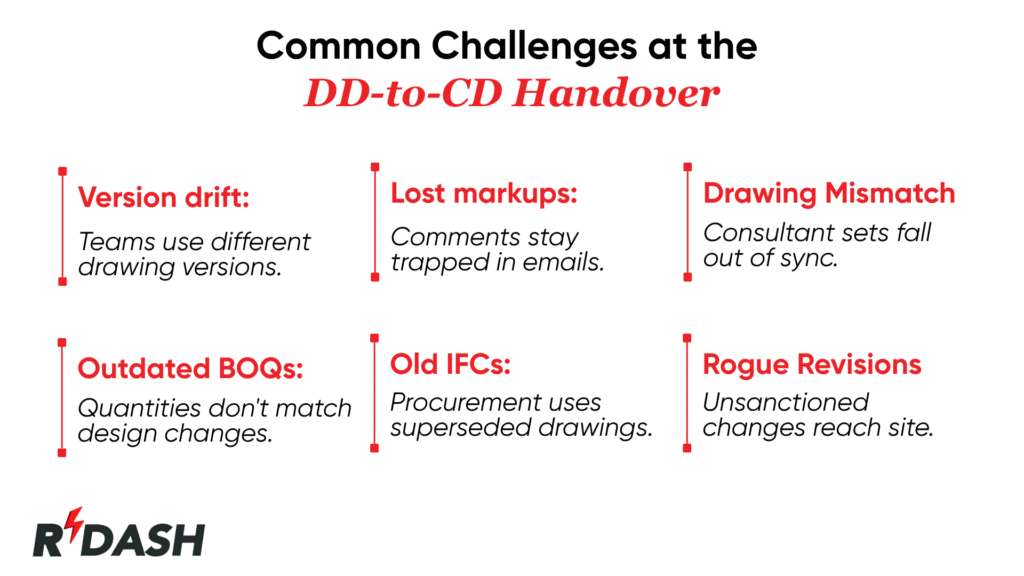
Most handover problems arise from coordination and document management issues rather than design capability. They are about coordination and information control, and they appear consistently across project types and organisation sizes.
- Version drift: Multiple disciplines revise drawings in parallel without a shared coordination mechanism, making it genuinely hard to identify which version is current. Two consultants can each be “right” about different versions.
- Markups trapped in email: Critical review comments live in inboxes, and PDF annotations that never make it back into the coordinated drawing set, so the same issue resurfaces three reviews later.
- Consultants reviewing different drawing versions: Architectural, structural, and MEP sets drift out of alignment when there is no single source of record. Clash detection then runs against stale geometry.
- BOQ revisions not matching drawings: Quantities fall out of date the moment the design changes, quietly undermining cost and procurement accuracy without anyone noticing until a variation order lands.
- Procurement using outdated IFC sets: Buying teams quote and award against a superseded set, locking in the wrong scope at the contract stage.
- Unapproved revisions reaching site: Without locked version control, a change that was never signed off gets built the most expensive coordination failure of all.
Top 10 RFIs Caused by Weak Design Development
Most field RFIs are not field problems; they are unresolved DD questions arriving late. The table below maps the most common ones to the coordination gap that caused them.
|
RFI Raised on Site |
DD Gap That Caused It |
|
Duct clashes with beam reroute? |
MEP and structural coordination incomplete at DD |
|
Which wall type applies here? |
Wall assemblies not finalised before CD began |
|
Confirm finish for this area |
Material selections left open past DD |
|
Ceiling height does not allow services |
Floor-to-floor height and plenum depth not coordinated |
|
BOQ quantity does not match drawing |
Preliminary BOQ never reconciled to finalised design |
|
Door schedule missing this opening |
Schedules carried forward incomplete from DD |
|
No detail at this junction |
Key details deferred past DD rather than resolved |
|
Structural opening not shown for MEP |
Penetrations not coordinated between disciplines in DD |
|
Spec conflicts with drawing |
Outline specs never reconciled to design changes in DD |
|
Which revision is current? |
Version control and approval trail not established at DD sign-off |
How Technology Reduces Risk at the DD-to-CD Handover
Many of the issues discussed above stem from information being distributed across multiple systems, files, and communication channels. When drawings, BOQs, approvals, and procurement live in separate tools and email threads, coordination breaks down structurally, not because the team is disorganised, but because the system makes drift inevitable.
Connected construction project management platforms address this at the system level, not with another layer of process.
- Centralised design management: A single source of record means every stakeholder works from the latest coordinated set, not last week’s PDF.
- Version control: Automatic versioning shows who changed what and when. Teams never build from a superseded drawing because the history is visible.
- BOQ tracking linked to live design: Quantities and costs travel with the drawings rather than living in a parallel spreadsheet that drifts the moment a revision is issued.
- Structured approvals: Formal workflows replace scattered email chains, creating an auditable decision trail and ensuring changes are approved before they reach the site.
- Procurement gating: Tying procurement releases to approved documents ensures vendors quote and supply against the right scope, eliminating the “outdated IFC” problem.
- Real-time visibility: Dashboards give owners, contractors, and project managers a live view of progress, approvals, and financial exposure.
Platforms like RDash are built specifically around this problem, holding design, BOQ, procurement, finance, and site execution in one connected workspace so that the transition from DD to CD follows a controlled and traceable process.
Conclusion
The line between Design Development and Construction Documents is not a formality. It is the line between design risk and build risk, and allowing those two categories to blur is where a significant portion of the industry’s chronic overruns originate.
Design Development is where cost is most efficiently controlled. It is the last phase where major decisions are inexpensive to change, where MEP coordination can happen as a redline rather than an RFI, and where a BOQ can be revised without triggering a variation order. Skipping it, rushing it, or treating its outputs as construction-ready does not save time. It transfers unresolved problems forward, at compounding cost.
Construction Documents are where execution certainty is built. A complete, coordinated CD set lets procurement proceed accurately, gives site teams an unambiguous reference, and provides the contractual baseline that makes change orders manageable rather than disputed.
The teams that manage the handover between the two phases with a locked version, a signed approval, and an aligned BOQ are the ones that finish projects closer to budget and schedule than the industry average. That discipline does not require complexity. It requires treating the handover as a controlled event rather than an informal progression.
Frequently Asked Questions
What is the difference between Design Development and Construction Documents?
Design Development refines an approved concept into a coordinated, technically feasible design answering what you are building. Construction Documents turn that design into detailed, often contractual drawings and specifications answering how to build it, with what materials, and to what standard. DD defines the design; CD defines the method of construction.
Can construction start after Design Development?
Generally no. Design Development lacks the assembly-level detail, finalised specifications, and permit-ready documentation needed to build safely and accurately. Construction should begin only after Construction Documents are complete and building permits are secured. DD drawings are not buildable on their own; they are a coordinated design intent, not an issued-for-construction set.
Who prepares Construction Documents?
The architect leads the Construction Documents phase, coordinating with structural and MEP engineers and specialist consultants. On design-build or EPC projects, contractors contribute constructability and procurement input early, and specialist trades later produce shop drawings derived from the issued-for-construction set.
What comes after Design Development?
The Construction Documents phase follows Design Development, converting the coordinated design into detailed, buildable documentation. After Construction Documents come Procurement (Bidding or Negotiation) and then Construction Administration, the fourth and fifth of the AIA’s five basic-service phases.
Why are Construction Documents Important?
Construction Documents are the project’s single source of truth, defining what to build and to what quality standard. Because they are frequently contractual, they govern scope, permitting, procurement, quality control, and change-order management. Errors or gaps in the CD set do not disappear; they surface on site as costly disputes, rework, and variation orders.
How detailed should Design Development drawings be?
Detailed enough to fix layouts, dimensions, materials, and structural or MEP integration but not to full assembly detail. The benchmark is a feasible, costable design that is stable enough for owner and authority review, so the Construction Documents phase becomes documentation rather than redesign. If the team is still resolving fundamental layout questions, DD is not complete.
What is the MacLeamy Curve, and why does it matter?
The MacLeamy Curve, developed by architect Patrick MacLeamy at HOK and introduced in a 2004 CURT white paper, shows that the ability to influence project cost is highest early in design while the cost of making changes rises sharply over time. It matters because Design Development is the last phase where major decisions remain inexpensive, making it the most cost-critical phase for cost control.
What is a Bill of Quantities (BOQ) and when does it become tender-grade?
A Bill of Quantities is a structured document listing materials, labour, and other costs for a construction project. A preliminary BOQ produced in Design Development is used for budgeting and value engineering but is not precise enough to support tendering or contract award. A tender-grade BOQ is produced during Construction Documents, tied to finalised scope and measurable quantities. Confusing the two is one of the most common causes of procurement disputes.
What is an issued-for-construction (IFC) drawing set?
An IFC drawing set is the Construction Documents package formally released as the authoritative reference for site execution. It has been coordinated across all disciplines, reviewed for clashes, approved by the design team and relevant authorities, and assigned a revision status indicating it is cleared for building. Procurement, quality control, and change-order management all reference the current IFC set.
Why do so many RFIs originate in Design Development?
Most field RFIs are not field problems; they are unresolved Design Development questions arriving late. When DD ends with services roughly located, wall types not finalised, or BOQ quantities not reconciled to drawings, those gaps travel forward into Construction Documents and ultimately to site, where answering them costs far more than resolving them during coordination.
What software helps manage the DD-to-CD handover?
Construction project management platforms that centralise drawings, version control, BOQs, and approvals significantly reduce handover risk. The key capability is structural integration not just document storage, but linking design changes automatically to quantities and procurement so that a revision in DD propagates to the BOQ and triggers the right approval workflow rather than drifting silently.
What is the difference between Design Development and Schematic Design?
Schematic Design establishes the overall form, organisation, and key spatial relationships of a project; it is primarily conceptual and directional. Design Development takes the approved schematic and resolves it technically, coordinating structure and MEP against the architecture, selecting materials, and producing a preliminary BOQ. Schematic Design answers “what should this project be?” DD answers “can it actually be built this way, and at what cost?”