
Key Takeaways
- In India, construction is the second most hazardous sector and the second-largest employer (70M+ workers). An estimated 38 fatal accidents happen every day, and construction accounts for roughly 24% of all occupational fatalities, with the real toll widely believed to be undercounted.
- In the UAE, falls from height and falling objects cause nearly half of all fatal construction injuries in Abu Dhabi (HAAD, 2024), and construction dominates workplace accidents across the Emirates, with heat and a migrant, multilingual workforce adding risk that a generic checklist misses.
- OSHA’s globally used “Fatal Four” falls, struck-by, caught-in/between, and electrocution account for close to 60% of construction deaths and are overwhelmingly preventable. Falls lead the list in India, the UAE, and worldwide.
- Effective safety programs pay for themselves: employers save an estimated $4 to $6 for every $1 invested, and structured programs measurably shorten schedules and lift project ROI.
- A good construction safety management system isn’t a folder of PDFs; it’s a living cycle of hazard identification, control, training, and monitoring. Platforms like RDash exist to make that cycle real-time instead of reactive.
Almost every contractor says they take safety seriously and most mean it. The hard hats are on, the policy is signed, the induction slides get shown. Yet across an entire decade of that effort, construction’s fatality numbers have barely moved. That stubbornness is the real story: it tells you the problem was never a shortage of good intentions. It’s the quiet gap between having a safety policy a document that states what should happen and running a safety system that makes it happen on-site, every shift, even when no one’s watching. Close that gap and the numbers move. This guide is about what a real system looks like, and how to build one.
Why “We Have A Safety Policy” Is Not The Same As Being Safe
A safety policy sitting in a folder does not stop a scaffold from collapsing. A PPE poster in the site office does not catch the live wire a new subcontractor’s crew didn’t know was there. What actually prevents incidents is a structured, continuously running system one that finds hazards before they become injuries, tracks whether controls are being followed, and feeds what it learns back into how the next project is planned.
That system has a name: a Safety Management System (SMS). And it is the single clearest line between a site that reacts to accidents and one that prevents them. The distinction matters because the data shows an industry that has plateaued not for lack of caring, but for lack of a working system connecting good intentions to daily behavior on the ground.
This guide breaks down what a good construction safety management system actually looks like, the verified data behind why it matters on India and UAE sites specifically, and how modern construction management software brings that system out of paper binders and into something site teams use every day.
What Is A Construction Safety Management System (SMS)?
A safety management system is the structured, documented, continuously operating process an organization uses to identify hazards, control risk, and maintain compliance across a project’s full lifecycle. It is not a single document. It is a framework that touches hiring, induction, daily site operations, equipment checks, incident reporting, and post-incident review, all working together rather than sitting in separate silos.
The important word is system. A policy states intent: “workers must wear PPE at all times.” A system makes that intent operational; it defines who checks PPE compliance, how often, what happens when a violation is found, how that observation is logged, and how repeated violations trigger a broader review of training or supervision. Most sites have plenty of policies. Far fewer have a functioning system linking them together.
The one-line test: If a near-miss reported on your site this morning cannot change what happens on the same site this afternoon, you have a policy, not a system.
How Dangerous Is Construction? India and UAE by the Numbers
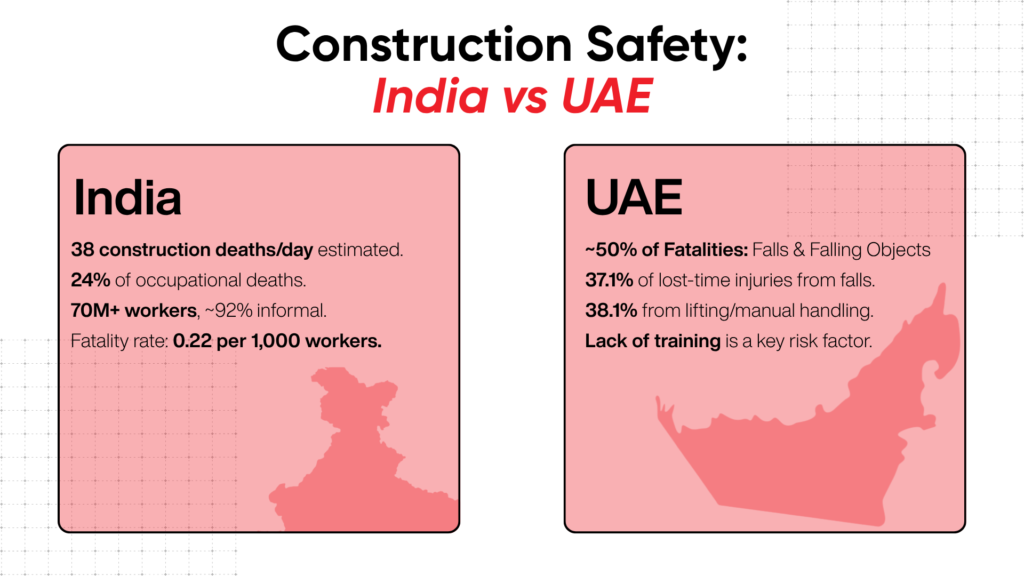
It’s worth sitting with the numbers, because they make the case better than any argument.
India: a plateau hidden by underreporting
Construction is India’s second-largest employer after agriculture, with over 70 million workers as of 2023 and roughly 9–11% of GDP riding on it. It is also the country’s second most hazardous employment sector, described by the British Safety Council as averaging around 38 fatal accidents a day.
That daily figure comes from a widely cited 2016 study by Patel and Jha of NIT Surat and IIT Delhi, which estimated a minimum of 11,614 construction fatalities annually out of roughly 48,000 total workplace deaths, meaning construction accounts for about 24% of all occupational fatalities in India. The authors themselves flagged this as conservative, estimating the true toll likely sits between 11,614 and 22,080, since many fatal and delayed-death injuries go unrecorded. Underreporting is the norm, not the exception; cases are routinely dismissed as “small” or “part of the job.”
Figure | What it represents |
~38/day | Estimated fatal construction accidents in India (min. 11,614/year) |
~24% | Construction’s share of all occupational deaths in India |
0.22 | Fatal accidents per 1,000 workers vs 0.02 in the UK, 0.05 in Singapore |
70M+ | Workers in the sector 2nd-largest employer, ~92% informal |
Why the gap matters: Patel and Jha put India’s construction fatality rate at roughly 0.22 per 1,000 workers, more than ten times the UK’s. Any SMS built for Indian sites has to assume the recorded numbers understate the real risk.
UAE: falls dominate a high-rise, high-heat market
The UAE’s risk profile is distinct: a construction boom of skyscrapers and megaprojects, built at speed, by a migrant workforce in extreme heat. The single deadliest hazard is unambiguous. The Health Authority – Abu Dhabi confirmed in 2024 that falls from height and falling objects were responsible for nearly 50% of all fatal construction injuries in the emirate, a direct consequence of the region’s vertical, fast-build ecosystem.
The most rigorous local data comes from a peer-reviewed cross-sectional study of construction workers in Al Ain, Abu Dhabi. It documented the mechanics of injury on UAE sites and, tellingly, found that 67% of the workers studied were Indian nationals, followed by Nepal, Pakistan, and Bangladesh, which is why the India and UAE safety pictures are so tightly linked. Its breakdown of what actually causes lost-time injuries maps almost exactly onto the Fatal Four:
Cause of lost-time injury (Al Ain study) | Share |
Lifting and manual handling | 38.1% |
Falls from height | 37.1% |
Struck by objects | 7.6% |
Electrocution | 5.7% |
Slips | 5.3% |
Caught between two objects | 3.8% |
The study also flagged the structural drivers: manual work, certain nationalities, and, critically, a lack of safety training were independent risk factors for injury. That last point is the whole argument for a real system in one line: where induction is thin or inconsistent, people get hurt.
The global benchmark
For scale, the U.S., which publishes the most complete data of any construction market, recorded 1,034 construction fatalities in 2024, the most of any private industry, at a rate of 9.2 per 100,000 workers that has barely moved in a decade. The pattern that holds across all three markets: falls are the leading killer, the hazards are predictable, and the fatality curve flattens only where a genuine safety system is enforced, not merely where a policy exists.
The ROI Of Construction Safety: Why It Pays For Itself
This is the part that moves budgets even when the human cost somehow doesn’t, and that’s worth being honest about.
Start with the money already leaving the building. OSHA estimates that U.S. employers pay almost $1 billion per week in direct workers’ compensation costs alone. But direct costs are only the visible tip. Workers’ comp covers medical expenses, lost wages, and disability payments; it does not touch the indirect costs, which land entirely on the employer: lost productivity, retraining a replacement crew, project delays, equipment repair, investigation time, and reputational damage.
Those indirect costs are not a rounding error. OSHA’s own Safety Pays estimator uses a sliding scale in which a smaller injury can carry indirect costs of 4.5 times its direct cost. The counterintuitive lesson: the less “serious” the injury looks on paper, the higher the ratio of hidden cost to visible cost.
Now the return. Multiple analyses of OSHA and Liberty Mutual data converge on the same headline figure: employers save $4 to $6 for every $1 invested in an effective safety program. And the benefits extend well past avoided claims. The Dodge Construction Network’s SmartMarket Report on safety management, drawing on responses from general contractors and subcontractors, found that firms with a genuinely inclusive safety program reported measurable business gains:
Business outcome | Contractors reporting the benefit |
Higher project ROI: 73% of them expecting a 1%+ increase | 51% |
Faster project schedule: half expecting savings of a week or more | 43% |
Lower project budget: 73% expecting a 1%+ decrease | 39% |
Improved company reputation: helping win work and attract talent | 82% |
Source: Dodge / CPWR SmartMarket Report.
Safety isn’t a cost center competing with your project margin. Done properly, it is your project margin because the incidents a good SMS prevents are exactly the events that blow up budgets and timelines hardest.
The 5 Core Components Of A Construction Safety Management System
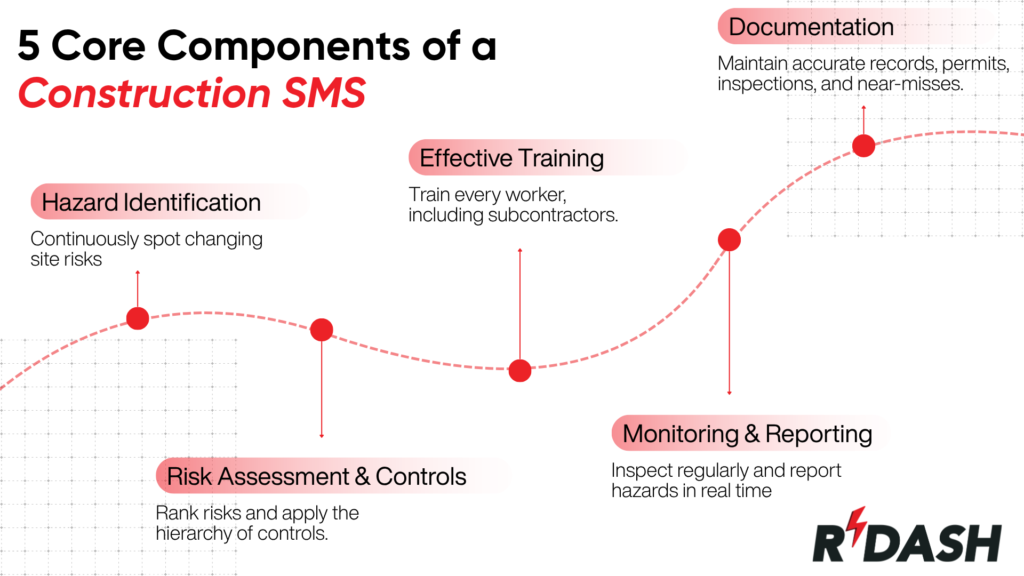
Strip away the jargon and a functional system is built from a handful of interlocking parts. Miss one and the whole thing weakens.
A great inspection process means little if hazard findings never get tracked to closure. Great training means little if it isn’t refreshed as site conditions change. The components below only work as a loop, which is the whole point.
1. Hazard identification: continuous, not one-and-done
This is the starting point for everything else, and it has to be ongoing rather than a single pre-mobilization survey. Hazards on an active site change daily: new equipment arrives, weather shifts ground conditions, a new subcontractor crew brings unfamiliar risks. As one BLS analysis of the Fatal Four put it, a site that’s safe in the morning can become a minefield by the afternoon: new crews arrive, heavy equipment moves in and out, openings get uncovered, trenches shift, and loads swing overhead. A system that checks hazards once at kickoff is already outdated by week two.
2. Risk assessment and the hierarchy of controls
Once a hazard is identified, it has to be ranked by severity (how bad is the outcome) and likelihood (how probable is it). From there, the globally accepted approach is the hierarchy of controls, and the order is not optional. Too many sites jump straight to PPE, when PPE should be the last layer, not the first.
Level | What it means | Construction example |
Eliminate | Remove the hazard entirely | Prefabricate at ground level so no one works at height |
Substitute | Replace it with something less dangerous | Swap a solvent-based product for a water-based one |
Engineering | Isolate people from the hazard | Guardrails, hole covers, trench shoring, machine guards |
Administrative | Change how people work | Permits, exclusion zones, signage, rotation, training |
PPE | Protect the individual as a last resort | Harnesses, hard hats, hi-vis, cut-resistant gloves |
The hierarchy of controls, most effective at the top. PPE is the safety net behind every other layer, not a substitute for them.
3. Training that actually sticks
The Fatal Four are largely preventable, which is exactly why training carries so much weight. These deaths are not accidents of bad luck; they are the predictable consequences of identifiable hazards that were not controlled and workers who were not adequately trained. Given how consistently falls top the statistics, fall protection, scaffold inspection, and safe systems of work at height should be the highest-priority elements of any program. In India and the UAE alike, induction cannot be a one-time event for permanent staff; it has to reach every new migrant and subcontractor crew, however short their engagement. In the UAE, it must also be documented, dated, and signed, because those records are the first thing inspectors examine after an incident.
4. Monitoring, inspection, and real-time reporting
A system is only as strong as its feedback loop. Structured audits on a routine cadence, not the occasional surprise walk-through, are what catch hazards before they cause harm. This is also where technology earns its place: wearables, mobile inspection apps, and compliance-tracking tools turn a periodic manual chore into a continuous signal, so a flagged issue reaches a decision-maker in minutes rather than at the next monthly review.
5. Documentation that doesn’t disappear
A near-miss scribbled on paper and never entered into any system might as well not have happened, from the standpoint of preventing the next one. Good document management is what turns scattered individual observations into a pattern a safety officer can act on. Accurate, version-controlled records of permits, inspections, and safety protocols are the raw material of every other component; without them, hazard identification has no memory.
OSHA’s “Fatal Four” Hazards: And How They Show Up In India And The UAE
Generic “be safe” training doesn’t map cleanly onto real hazards. These do.
Together, OSHA’s Fatal Four account for close to 60% of construction deaths, and the pattern holds well beyond the U.S. Falls lead the fatality count in India, the UAE, and globally. Building your system around the specific mechanics of each hazard is far more useful than a blanket safety briefing.
Hazard | What the data shows | What your SMS needs |
Falls | The single largest killer everywhere. In Abu Dhabi, falls and falling objects cause nearly half of all fatal construction injuries; in a UAE field study, falls from height drove 37% of lost-time injuries. UAE rules require fall protection above 1.8 m. | Fall protection at height, guardrails and covers as engineering controls, compliant scaffolding (BS 1139 / EN 12811), ladder and scaffold inspection built into daily checks. |
Struck-by | Being hit by a vehicle, falling object, or swinging load the second-leading cause globally. Dense, fast-build urban sites concentrate the risk. | Exclusion zones around moving plant, secured loads and tool tethering, traffic-management plans, hi-vis discipline. |
Caught-in / between | Excavation collapse and machinery entanglement. In India’s Delhi FIR study, building collapse was a leading cause of death; crane incidents are a notable subset worldwide. | Trench shoring and protective systems, lift plans and exclusion zones during crane ops, machine guarding, lockout/tagout. |
Electrocution | Overhead lines or poorly maintained temporary site wiring. In India, electrocution is repeatedly among the top three causes of construction death; it also appears in UAE injury data. | Overhead-line spotting and clearance, RCD/GFCI protection, inspection of temporary supplies, de-energize-and-verify procedures. |
The hazard both markets share: heat. In the UAE, extreme summer heat is deadly enough that the midday-break rule (Ministerial Resolution No. 44 of 2022) bans outdoor work from 12:30–3:00 pm between 15 June and 15 September, now backed by Wet Bulb Globe Temperature (WBGT) monitoring requirements. In India, summer heat compounds an already informal workforce with little shade or hydration provision. Globally, the risk is well-evidenced: construction workers accounted for 285 heat-related deaths in the U.S. from 1992–2016, 36% of all occupational heat fatalities, ~75% of them in summer. Any SMS for India or the Gulf must treat heat as a named, planned-for hazard, not an afterthought.
Building An Sms For India and UAE Sites: What’s Different
A system copy-pasted from a Western framework without adaptation will miss real gaps.
Both target markets share one defining feature: a large, migrant, often informal workforce, but their regulatory environments differ sharply. A system that works has to be built around each.
India: informal labor and the monsoon
India’s construction workforce is overwhelmingly informal and transient. The informal/unorganised sector covers roughly 92% of India’s total workforce, and site-level studies bear out how this plays out in construction: one field study of construction workers found that nearly 93% of its sample were temporary contractual workers, many returning to their native villages for weeks at a time. Heavy reliance on subcontracted, short-term labor dilutes accountability when no single employer feels fully responsible for a transient crew; safety induction and supervision fall through the cracks.
India’s Building and Other Construction Workers (BOCW) Act, 1996, was enacted precisely to protect this vulnerable pool, entitling registered workers to benefits like medical reimbursement and post-accident assistance. But enforcement is inconsistent, and registration itself is patchy.
The seasonal and causal pattern is also distinct. A cross-sectional study analysing First Information Reports from the Delhi Police for 2016–2018 identified 929 recorded construction-site accidents in that window, injuring 1,217 workers, 29% of them fatal. The most frequent causes were the collapse of old buildings, the collapse of new buildings under construction, and electric shocks. Crucially, most incidents occurred during the rainy season, a seasonal risk factor an Indian SMS needs to plan for explicitly, from monsoon shoring standards to electrical safety in wet conditions.
UAE: a strict, multi-regulator rulebook
The UAE runs one of the more demanding compliance environments in the region, and it is tightening. Workplace safety sits on Federal Decree-Law No. 33 of 2021 (in force since February 2022), enforced by the Ministry of Human Resources and Emiratisation (MoHRE), with emirate-level layers on top:
- Abu Dhabi operates the comprehensive OSHAD-SF framework (Abu Dhabi Occupational Safety and Health System Framework), whose inspectors can shut down non-compliant sites.
- Dubai enforces the Dubai Municipality Construction Safety Code, with new requirements arriving under Law No. 7 of 2025 from January 2026.
- Across all emirates, employers must report any workplace accident causing injury or death to MoHRE and police within 24 hours, and penalties for serious violations can run from AED 5,000 to AED 1,000,000 per affected worker.
Two features make documentation non-negotiable here: training must be documented, dated, and signed (the first thing inspectors and courts examine after an incident), and the midday-break rule plus new WBGT heat-monitoring obligations create specific, auditable duties. In the UAE, an SMS isn’t just good practice; it’s the evidence trail that determines liability.
Design implication: An SMS for India or the UAE has to be built around the actual labor structure, climate, and enforcement environment, not a generic checklist. For India, that means induction reaching every new subcontractor crew and monsoon-specific controls. For the UAE, it means emirate-specific compliance (OSHAD vs Dubai Municipality), 24-hour incident reporting, and signed, retrievable training records. Both demand heat planning as a first-class hazard.
How Rdash Puts Safety Management Into Daily Site Practice
Most of the framework above stays theoretical without a practical way to run it day to day. That’s the gap a construction management platform closes.
RDash is an AI-powered construction management platform that unifies site teams, procurement, design, and finance in one place. It doesn’t sell “safety software” as a bolt-on; it treats safety as one of the central, ongoing responsibilities of the construction manager throughout the active build phase, which is exactly when risk is highest. Here’s how that shows up in practice.
- Safety embedded in the core workflow, not run in parallel. Safety tracking lives inside the same system managing tasks, approvals, and site progress, so it’s part of how work gets executed, not a separate compliance exercise nobody references.
- Centralized, version-controlled documentation. Permits, inspection records, and safety protocols sit in one place with version control, which is precisely what stops an outdated protocol from being followed on-site because someone was working off an old copy.
- Real-time visibility across every stakeholder. Because site, procurement, design, and finance share one workspace, a hazard flagged in the field doesn’t sit isolated in one inbox. It surfaces to whoever can act as a manager reallocating resources, or procurement expediting a safety-equipment order.
- AI Copilot that flags risk before it escalates. RDash’s AI Copilot reads across projects to coordinate, follow up, and surface what needs attention a capability that extends naturally to safety signals like recurring near-misses or overdue inspections, instead of a safety officer manually digging through logs to spot a pattern.
- Field-tested guidance, not just features. The RDash blog offers grounded, practical advice, such as 10 Tips for Construction Site Safety and Workers, covering tidy debris-free workspaces, routine audits, a genuine speak-up culture, and worker-fatigue management (a hazard directly tied to reduced situational awareness).
The efficiency and safety cases reinforce each other. Fewer incidents mean fewer of the disruptive, schedule-shattering events that a project timeline absorbs worst, which is why tightening safety and tightening delivery tend to move together.
5 Common Safety Management System Mistakes To Avoid
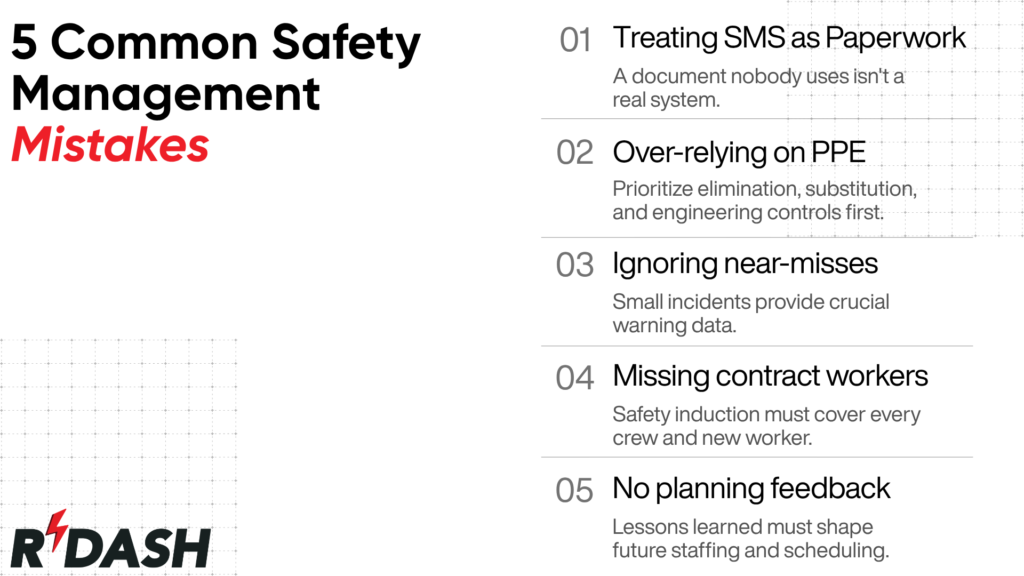
Even organizations that genuinely want to do this well fall into a few recurring traps:
- Treating the SMS as a document, not a process. A binder nobody references during daily operations isn’t a system; it’s paperwork satisfying an audit.
- Relying on PPE as the primary control. Over-reliance on PPE almost always signals that elimination, substitution, and engineering controls were never seriously considered.
- Under-reporting near-misses. Dismissing injuries as “small” or “part of the job” quietly erodes the exact data a system needs to spot patterns before they turn fatal.
- Ignoring the contractual-labor gap. Where much of the workforce is subcontracted, induction can’t stop at permanent staff; it has to extend to every new crew, every time.
- No feedback loop into planning. Without lessons flowing back into how the next project is staffed and scheduled, the same categories of incident repeat, job after job.
How To Choose A Construction Safety Management System: A 6-Point Checklist
Whether you’re building internally or evaluating supporting software, these six criteria separate a genuinely effective system from a compliance-only checkbox.
- [ ] Continuous hazard identification, not a single pre-project survey, because site conditions change daily.
- [ ] An enforced hierarchy of controls, rather than defaulting straight to PPE as the primary safeguard.
- [ ] Real-time reporting and visibility, so a flagged hazard reaches a decision-maker in minutes, not days.
- [ ] Centralized, version-controlled documentation, so outdated protocols can’t be followed by accident.
- [ ] Context-specific design for the actual labor structure, climate, and regulatory environment of the market you operate in.
- [ ] A genuine feedback loop, where incident and near-miss data actively shapes training, staffing, and planning on future projects.
The Bottom Line
The fatality numbers haven’t moved because caring was never the missing piece. A signed policy, a wall of PPE posters, a one-time induction none of it closes the loop between spotting a hazard and fixing it before someone gets hurt. That loop is what separates a document from a system.
In India and the UAE, the gap costs more. A migrant, contractual workforce means safety knowledge leaves the site with every crew rotation. Heat and monsoons turn the calendar itself into a hazard. And in the UAE, a patchy paper trail becomes a liability the moment an inspector or court asks for signed, dated records.
None of this needs reinventing; it’s the same six components (hazard ID, controls, training, monitoring, documentation, feedback) run as a continuous cycle instead of a quarterly binder update. That’s the gap RDash is built to close: turning the cycle into something site, procurement, and finance teams run together, every shift.
Start with one piece: real-time hazard reporting, unified permit records, or a near-miss feedback loop. The contractors pulling ahead are simply the ones who started.
Turn Your Safety Policy Into A System That Runs Itself
RDash brings hazard tracking, inspections, permits, and real-time visibility into one platform your site, procurement, and finance teams already use, so a near-miss flagged this morning changes what happens this afternoon.

Frequently Asked Questions
What is a safety management system in construction?
It’s the structured, continuously operating process a construction company uses to identify hazards, assess and control risk, train workers, and monitor compliance across a project. It differs from a safety policy document because it turns intent into daily practice, defining who does what, how often, and what happens when something goes wrong. Platforms like RDash support this by embedding safety tracking directly into the broader project workflow rather than treating it as a standalone task.
Why do construction sites have such high accident rates?
Construction combines heavy machinery, complex logistics, work at height, and a large, frequently changing workforce a hazard landscape that shifts by the hour. In markets like India and the UAE, it’s compounded by heavy reliance on migrant, contractual labor and extreme heat, which dilute safety accountability and add environmental risk. That’s why continuous hazard identification and consistent, documented induction matter so much.
What are OSHA’s “Fatal Four” construction hazards?
Falls, struck-by incidents, caught-in/between accidents, and electrocutions. Though defined by the U.S. OSHA, they’re used as a global framework and account for close to 60% of construction deaths. Falls are the largest single category in India, the UAE, and worldwide. In Abu Dhabi, falls and falling objects alone cause nearly half of all fatal construction injuries, so fall protection is the highest-priority control on almost any site.
Does investing in construction safety actually pay off financially?
Yes. Employers save an estimated $4 to $6 for every $1 invested in an effective safety program. Beyond avoided claims, contractors with inclusive programs report higher project ROI, faster schedules, lower budgets, and stronger reputations (Dodge SmartMarket data). Indirect incident costs that workers’ comp doesn’t cover can run several times the direct cost.
How many construction workers die on the job each year?
In India, the most-cited estimate puts it at a minimum of 11,614 deaths a year, about 38 a day, or roughly 24% of all occupational fatalities, with the true figure widely believed to be higher because reporting is incomplete. In the UAE, national totals aren’t published comprehensively, but falls alone cause nearly half of fatal construction injuries in Abu Dhabi. For global scale, the U.S. recorded 1,034 construction deaths in 2024.
How does RDash help construction teams manage safety?
RDash embeds safety-related tracking into its broader construction management platform: centralized, version-controlled document management for permits and inspection records; real-time visibility across site, procurement, design, and finance teams; and an AI Copilot that flags risks needing attention. It also publishes practical field guidance, including its 10 tips for construction site safety.
What are the main construction safety regulations in the UAE?
UAE workplace safety runs on Federal Decree-Law No. 33 of 2021, enforced by MoHRE, with emirate-level layers: OSHAD-SF in Abu Dhabi and the Dubai Municipality Construction Safety Code (updated by Law No. 7 of 2025 from January 2026). Key duties include fall protection above 1.8 m, the summer midday-break rule (12:30–3:00 pm, 15 June–15 September), documented and signed training, and reporting any injury or death to authorities within 24 hours.