
Key Takeaways
- Roughly nine in ten construction projects run over budget, with an average cost overrun of 28% across a dataset spanning 20 countries and 70 years.
- Large capital programmes run hotter still: a 2022 McKinsey analysis of 532 projects found average cost overruns of 79% and schedule overruns of 52%.
- An estimated 95% of all data captured in construction and engineering goes unused, according to FMI, leaving most rollout teams flying blind between reporting cycles.
- India’s retail leasing reached a three-year high in 2025 and stayed strong into 2026, with foreign brand leasing up 48% year on year in the first quarter, raising the stakes on rollout discipline.
- A repeatable rollout is a system, not a series of projects: it runs on a locked prototype, a shared vendor network, centralised procurement, and a single source of truth rather than twenty parallel builds.
- Platforms built for the full construction lifecycle, such as RDash, are what let a brand run one dashboard per portfolio instead of chasing twenty separate site updates.
Picture two coffee chains, both opening 40 new outlets this year. One treats every store as its own independent project: a fresh floor plan, a fresh vendor hunt, a fresh set of surprises each time. The other treats all 40 as a single programme running on one prototype, a locked vendor network, and a live view of every site’s status.
Eighteen months on, the first chain is still finishing store number 22, has blown its capital budget by nearly a third, and has regional managers arguing about why the tile in the Pune outlet does not match the one in Bengaluru. The second opened on schedule, on budget, with every store true to the brand.
That gap is what multi-site fit-out management decides, and it is measured in crores, in months, and in brand trust. This guide breaks down how disciplined brands close it: what a rollout actually is, why it is harder than it looks, what it costs to get wrong, and the operating system the strongest programmes run on.
What a Multi-Site Fit-Out Rollout Actually Means
A multi-site fit-out rollout is a coordinated construction programme that delivers one consistent design, prototype, or brand refresh across many locations using standardised scopes, shared schedules, and centralised management, rather than treating each site as an isolated build. A fit-out is the work of making an interior space ready for occupation, from flooring and ceilings to fixtures, services, and finishes.
Firms that specialise in this end-to-end work are often called turnkey fit-out companies, and understanding how they package standard versus custom scope is useful background for any brand planning a rollout.
What a rollout typically covers
A multi-site fit-out programme usually spans one or more of the following:
- New store build-outs in raw or shell spaces.
- Remodels or refreshes of existing locations.
- A prototype change deployed brand-wide across the portfolio.
- Fixture or technology upgrades rolled out to every site at once.
What ties these together is a shared operational spine: site evaluation, design adaptation, landlord and lease coordination, permitting, procurement, construction, inspections, merchandising, and handover.
Retail vs corporate fit-outs: the same mechanics, a different goal
Retail and corporate fit-outs share almost the same operational machinery but optimise for different outcomes.
Aspect | Retail fit-out | Corporate / office fit-out |
Engineered around | Sales efficiency and shopper experience | Workflow and headcount density |
Success metric | Footfall, conversion, dwell time | Utilisation, seat count, adjacencies |
Filtering data | Catchment and footfall projections | Headcount and utilisation forecasts |
Shared mechanics | Site evaluation, design adaptation, procurement, construction, handover | Same |
Both hit the same wall the moment they scale: every location sits inside a different shell, yet the finished result has to look and feel identical to the brand.
Why Multi-Site Rollouts Are Harder Than Single-Site Projects
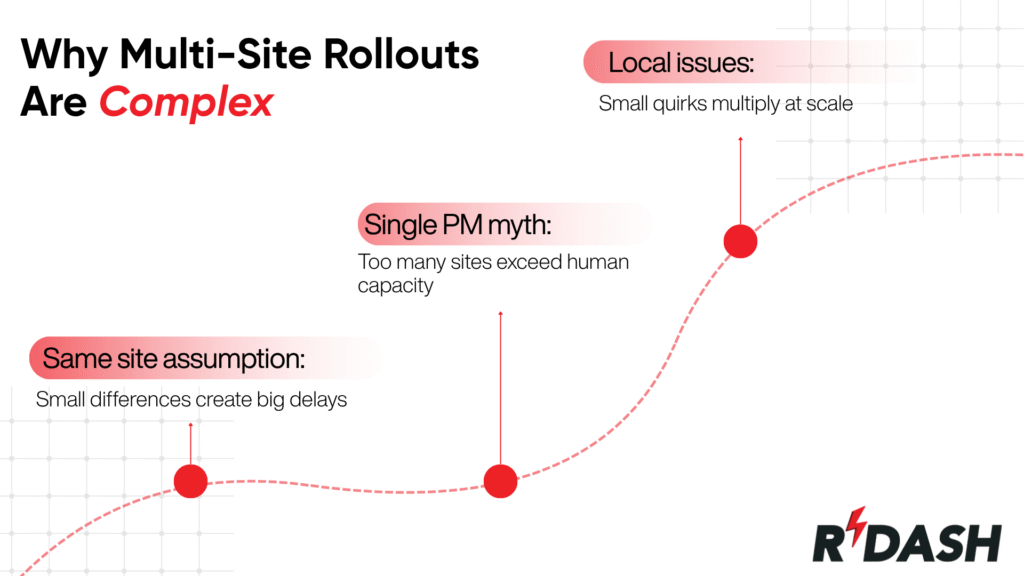
Managing one site is an operational task; managing twenty, fifty, or a hundred at once is a logistical one. The difficulty is not the individual construction work; it is coordinating variable shells, many stakeholders, and concurrent schedules, which no single project manager or spreadsheet can hold together past three or four sites.
The three assumptions that break rollouts
Most rollouts drift for the same three reasons, all of them assumptions that do not survive contact with reality:
- That every site is basically the same. Ceiling heights, wall conditions, access hours, and local codes all differ, and small variations compound into real delays across dozens of sites.
- That one project manager can hold a dozen job sites in their head. Human working memory does not scale to concurrent programmes.
- That local quirks will not add up. They do, especially once many landlords, general contractors, vendors, and municipal authorities enter the same programme.
The specialist fixture-rollout firm Agility Retail identifies the same failure pattern from the manufacturing side, warning that most programmes fail by underestimating the time the design and engineering phases require, and that vague briefs produce vague proposals and inaccurate timelines. The fix is not heroics from a single PM. It is treating coordination as its own discipline with its own system.
The Real Cost of Getting Multi-Site Rollouts Wrong
Construction has one of the worst delivery records of any major sector. Roughly nine in ten projects run over budget at an average of 28%, large programmes average 79% overruns, and the leaks trace mainly to estimating errors, communication breakdowns, and cost data that arrives too late to act on.
What the data says
The overrun problem is remarkably consistent across decades and geographies:
Metric | Figure | Source |
Projects over budget | ~90% | |
Average cost overrun | 28% | 20-country, 70-year dataset |
Average overrun, large programmes (532 projects) | 79% cost / 52% schedule | |
Megaprojects over budget by 30%+ | 98% | |
Megaprojects at least 40% late | 77% | McKinsey, 2015 |
Project failures caused by poor communication | ~1 in 3 | PMI, via Propeller Aero |
Where the money leaks
A large share of overruns traces to estimating errors, with the rest split between communication breakdowns and delayed cost visibility. A Project Management Institute study found poor communication behind roughly one in three construction project failures, where failure meant a cost or schedule overrun or both. That number scales painfully once a team coordinates a dozen sites instead of one, because every additional stakeholder is another line of communication that can break. RDash’s guide to essential construction communication is a useful companion read on this specific failure mode.
The size of the prize
The upside of fixing this is enormous. The McKinsey Global Institute estimates that if construction-sector productivity caught up with the total economy, it would boost the sector’s value added by roughly $1.6 trillion, about 2% of the global economy. Very little of that requires exotic technology. Much of it is simply the difference between a coordinated programme and twenty disconnected ones.
The Six-Stage Multi-Site Rollout Framework
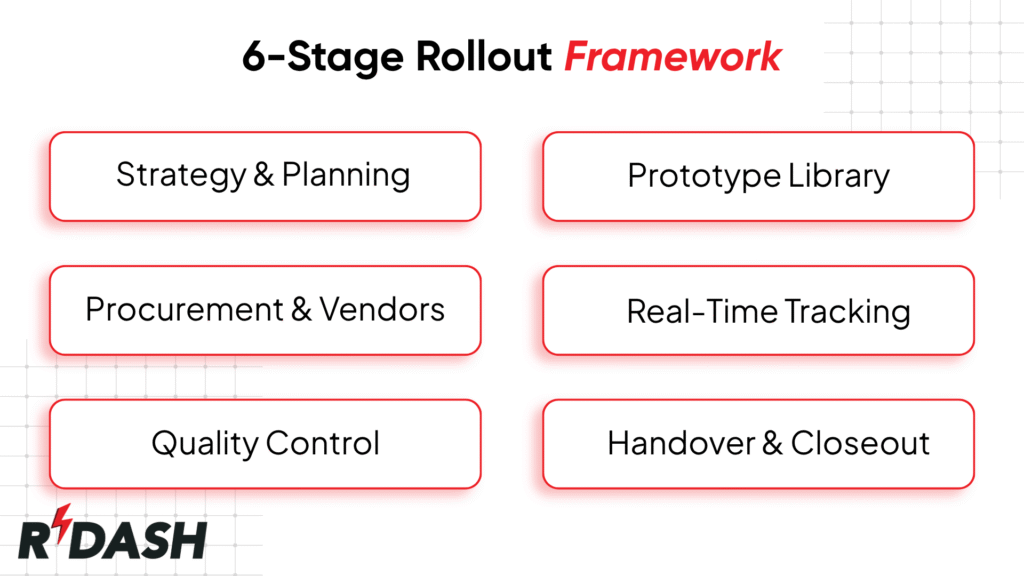
A repeatable rollout runs through six stages in order: strategy and portfolio planning, prototype and approved-alternatives library, centralised procurement and vendor network, real-time visibility, quality control and snag management, and handover. Skipping or rushing any one stage is where cost and timeline drift begins.
Stage | Core question it answers | Primary output |
Strategy and portfolio planning | Why are we rolling out, and where? | Written strategy document |
Prototype and approved-alternatives library | What is the tested template, and what can flex? | Locked prototype + alternatives library |
Centralised procurement and vendor network | How do we buy once and deploy many? | Rate contracts + multi-city vendor network |
Real-time visibility | How do we know every site’s true status? | Live dashboard and daily progress reports |
Quality control and snag management | Does every store match the brand? | Checklist walkthroughs + snag tracking |
Handover and closeout | Is the site fully signed off and billed? | Clean snag closure and final billing |
The sections below break down the stages that most often decide whether a programme holds together.
Stage 1: Strategy and Portfolio Planning Before Ground Breaks
Every rollout that stays on track begins with a written strategy document, not a construction schedule. It fixes the purpose, target markets, sequence, opening dates, capital budget, return benchmarks, and non-negotiable brand standards before a single site is signed.
What the strategy document must lock down
Before any site work begins, ownership needs clarity on:
- Purpose and target markets for the rollout.
- Rollout sequence and business-critical opening dates.
- Capital budget and return benchmarks per site.
- Non-negotiable brand standards every location must honour.
- Exit criteria for underperforming locations, defined in advance.
The standardise-versus-customise decision
A real strategic choice hides inside that document: how much to standardise versus how much to customise. Many retailers take a portfolio approach, testing a small urban format, a suburban format, and an e-commerce-linked format at once, then scaling whichever performs best.
The market itself now rewards this. As Rahul Arora, Head of Office Leasing and Retail Services at JLL India, describes the shift, successful expansion today demands a multi-format approach that balances aspirational enclosed destinations with street-level accessibility. Corporate fit-out programmes run an almost identical filtering exercise, simply measured against headcount and utilisation data instead of footfall.
Stage 2: Standardisation, the Prototype and Approved-Alternatives Library
The prototype is a fully resolved reference store that the rollout replicates. Because no template survives every shell unchanged, the strongest programmes pair it with a controlled library of pre-approved alternatives, so a familiar site constraint gets a tested answer instead of a fresh design from zero.
How standardisation cuts cost twice
Standardisation attacks the budget on two distinct fronts:
- It removes the “first-store penalty.” Circulation paths, service zones, and operational adjacencies get designed once as repeatable components rather than reworked project by project.
- It enables fixture value engineering. Reviewing the materials and manufacturing methods of one standard fixture package, without compromising design intent, brings per-unit cost down across every location it deploys to.
Where to draw the standard-versus-flex line
Standardisation is not about forcing every site into an identical box. It is about drawing a clean line between the true brand requirements that never move and the details local teams may adjust, then documenting that boundary in a construction package precise enough for local designers, contractors, and landlords to follow without ambiguity. Get that line right, and the rollout gains both consistency and the flexibility to absorb whatever a given shell throws at it.
Stage 3: Centralised Procurement and Vendor Network Management
Design standardisation only pays off if procurement is standardised alongside it. Supplier rate contracts, a shared catalogue of pre-agreed rates, let every site price against the same specs instead of each contractor sourcing and re-quoting the same materials independently.
Rate contracts and a single source of specs
On RDash’s procurement platform, rate contracts are linked to a central element library, which lets teams generate a bill of quantities (a BOQ, the itemised schedule of materials, labour, and quantities with unit rates) directly from approved specs rather than rebuilding it site by site.
Build the schedule backwards from opening day
A multi-city vendor and contractor network is the second half of the equation. Coverage across markets lets a rollout team balance standardisation against the flexibility each site demands, absorbing different landlord requirements, utility conditions, and local codes without breaking the standard.
The best-practice sequence, drawn from firms that run national rollouts, is to build each schedule backward from the store’s opening date. Agility Retail advises teams to start with the hard constraints, a lease date, grand opening, or seasonal window, and work backward through installation, delivery, production, engineering, and design, aligning procurement, construction, and store operations before going to market, because misalignments that surface during production are far more expensive to resolve.
Protecting cash flow across the portfolio
Centralising procurement also protects the finances. When BOQs, purchase orders, vendor invoicing, and installed-progress tracking all run through one system instead of parallel spreadsheets per site, portfolio-level cash flow and profit-and-loss visibility finally becomes possible. Measuring the installed value of work, rather than what has merely been delivered or invoiced, is what keeps cash control tight across a fast-moving programme.
Stage 4: Technology and Real-Time Visibility Across Every Site
According to FMI, an estimated 95% of the data captured on construction projects goes unused. A reporting cycle that closes even a week late can leave a project manager acting on information that is already 30 to 45 days old, long enough for a moderate variance on one site to harden into a serious overrun.
Three ways real-time tooling closes the gap
Modern construction platforms turn scattered site data into timely decisions in three concrete ways:
- Live activity schedules with dependency tracking show at a glance which concurrent sites are on plan and which are drifting, without waiting for a weekly call.
- Daily progress reporting from the field, with photos, percentage-complete against milestones, and flagged snags, replaces the delayed, inconsistent updates that plague spreadsheet-run programmes.
- Digital BOQ and change-order workflows create an automatic audit trail, which becomes critical the moment a rollout runs concurrent change requests across several markets.
This shift from manual chasing to a connected system is increasingly augmented by AI, which flags risks and anomalies across a portfolio before they surface as overruns. The core move is the same: managing a rollout as a single connected system rather than project by project.
Stage 5: Quality Control, Brand Consistency, and Snag Management
None of the planning, standardisation, or technology matters if the finished stores do not look and feel consistent when a customer walks in. Quality control at rollout scale needs a repeatable, checklist-driven walkthrough applied identically at every site, plus snag management handled at two distinct levels.
The two levels of snag management
Snags are best separated into two streams so the brand owner’s list does not fill up with routine trade fixes:
- Client-level snags are surfaced to the brand owner for visibility and sign-off.
- Contractor-level snags stay between the general contractor and subcontractor to resolve internally.
Remote monitoring for multi-city rollouts
Remote monitoring has become essential for rollouts spanning several cities, where a brand’s design or operations team cannot attend every walkthrough in person. Photo and video-based progress verification, tied to the same milestone structure used in scheduling, lets a central quality team sign off on installed work without travelling to every location. Snags can be tagged directly to the supplier order responsible, so accountability is built into the record rather than chased over email.
How India’s Retail Boom Is Raising the Stakes for Rollout Discipline
India’s retail market reached a three-year leasing peak in 2025 and stayed strong into 2026, with foreign-brand leasing up 48% year on year in Q1 2026 and a 46.1 million sq ft institutional-grade pipeline through 2030. That pace makes ad-hoc, spreadsheet-driven fit-out management untenable almost immediately.
The 2026 leasing numbers
Momentum carried firmly into 2026 across the major consultancies:
Metric | Figure | Source |
Q1 2026 gross retail leasing (top 7 cities) | 3.1 million sq ft | |
Foreign-brand leasing growth, Q1 2026 | +48% YoY | JLL |
Q2 2026 gross retail leasing (top 8 cities) | 2.4 million sq ft | |
Q2 2026 growth | +23.2% QoQ / +17.6% YoY | Cushman & Wakefield |
Institutional-grade pipeline through 2030 | 46.1 million sq ft | JLL |
Why this is structural, not a spike
The pipeline is what makes this durable. JLL points to a 46.1 million-square-foot institutional-grade retail pipeline through 2030, with demand consistently outpacing supply. For direct-to-consumer brands moving offline and international brands entering the country, a brand without a repeatable rollout system simply will not absorb this supply fast enough to capture share before a competitor does.
How RDash Powers Multi-Site Rollouts at Scale
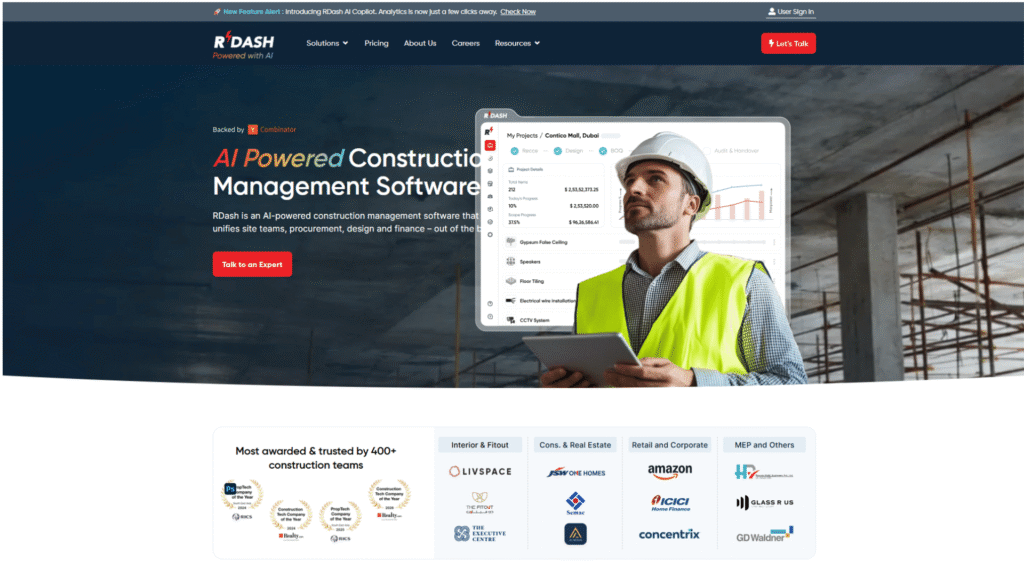
RDash centralises the entire rollout lifecycle, from pre-sales and scheduling through design version control, BOQ creation, procurement, daily progress reporting, and snag management, on one platform. For a brand running a multi-site programme, that means one dashboard per portfolio instead of twenty separate updates.
What RDash gives a rollout team
Everything above strategy, standardisation, procurement, visibility, and quality control is easy to describe on paper and hard to operate without a system holding it together. RDash closes that gap with:
- One dashboard per portfolio instead of twenty scattered updates.
- Shared catalogues for standardised specs across every site.
- Live schedule tracking with dependencies.
- Automated daily progress reports from the field.
- Approval hierarchies with clean audit trails on every purchase order and change request.
- Real-time BOQ, budget, and actual-cost tracking, so owners keep a live read on portfolio profit-and-loss and catch an overrun early rather than at closeout.
Built by people who ran fit-outs
This operating logic traces back to RDash’s own roots. Its sibling construction arm, 91Squarefeet, designed and built offices and retail stores at scale, and the company later wound it down entirely to focus on RDash and avoid competing with the platform’s own customers. In practice, that means the software was shaped by people who had personally run fit-out programmes and felt every failure mode described above. Brands can review pricing or book a free demo directly on the RDash site.
Bringing It All Together
Multi-site fit-out rollouts fail not because individual construction work is hard, but because coordination across many sites is not treated as its own discipline. Brands that scale smoothly lock a strategy first, standardise into a reusable prototype, centralise procurement, and give every stakeholder a real-time view of the whole portfolio.
Those four moves are the whole game, and they happen in order. Lock a written strategy before touching a single site. Standardise the design into a reusable prototype and approved-alternatives library. Centralise procurement instead of renegotiating it market by market. Then give every stakeholder a live view of the entire portfolio.
That last piece is where most programmes either hold together or come apart, and it is exactly what a purpose-built platform like RDash exists to provide: one connected system carrying scheduling, procurement, progress, and quality for an entire rollout, so a brand runs its expansion as a single programme rather than twenty separate acts of firefighting

Frequently Asked Questions
What is a multi-site fit-out rollout?
A multi-site fit-out rollout is a coordinated construction programme that delivers a consistent store or office design across many locations using a shared prototype and centralised management, rather than treating each location as an independent project. The scope typically covers new build-outs, remodels, brand-wide prototype changes, and portfolio-wide fixture or technology upgrades.
How is a retail fit-out different from a corporate fit-out?
A retail fit-out is engineered around sales efficiency and shopper experience, while a corporate or office fit-out is engineered around workflow and headcount density. The two share almost the same operational mechanics, site evaluation, design adaptation, procurement, construction, and handover, but optimise for different outcomes.
Why do multi-site rollouts go over budget so often?
Construction has a structural overrun problem: roughly nine in ten projects run over budget at an average of 28%, and large programmes have shown average overruns as high as 79%. On rollouts specifically, the drivers are estimating errors, communication breakdowns across many stakeholders, and cost data that arrives too late to act on, all of which compound as the number of concurrent sites grows.
How much can standardisation actually save on a rollout?
Standardisation attacks cost on two fronts. It removes the repeated “first-store penalty” by designing circulation, service zones, and fixtures once as reusable components, and it lets teams value-engineer a standard fixture package to bring per-unit cost down. The saving compounds with every additional site the prototype deploys to.
What role does technology play in managing multi-site rollouts?
With an estimated 95% of construction data going unused, the core job of technology is to turn scattered site data into timely decisions. Platforms that centralise scheduling, procurement, BOQs, and daily progress reporting give a rollout team real-time visibility across every active site, replacing month-old spreadsheet snapshots with a live view of which sites are on track and which are drifting.
How many sites should a brand pilot before scaling a rollout nationally?
Most successful programmes test their design and operating model across a small set of representative sites before locking the prototype and scaling, and they define clear exit criteria for underperforming locations in advance. Piloting first surfaces the constraints a shell will impose on the standard design while they are still cheap to fix.
What is the difference between a fit-out and a full construction build?
A fit-out is the interior work that makes an already-built shell ready for occupation, including flooring, ceilings, partitions, fixtures, services, and finishes. A full construction build includes the base structure and envelope. Most retail and corporate rollouts are fit-outs, because brands lease space inside existing developments.