

Key Takeaways
- “Best” is a matching problem, not a ranking problem. Diagnose your dominant procurement leak specification, sourcing, site control, or reconciliation before comparing tools.
- Materials are construction’s largest input. They typically account for more than half of total project cost (McKinsey), so a small procurement leak outweighs savings almost anywhere else.
- Procurement is a production system, not paperwork. Slow specification, sourcing, and approvals idle crews downstream, so front-end delays drive schedule slips (Supply Chain Management Review, 2025).
- The integration test beats the feature checklist. If a tool can’t link rate contracts, purchase requests, POs, and GRNs back to the BOQ, its feature count is irrelevant.
- Field adoption decides success, not features. If site teams won’t raise purchase requests from a phone, procurement stays informal, and your office data goes stale within weeks.
- Category matters more than brand. Standalone spend tools, construction point solutions, and full platforms solve different problems. Buy the category that matches your leak.
Quick answer: There is no single “best” procurement software for every construction company. The right choice depends on where your procurement actually leaks money: spec ambiguity, PO-to-budget drift, material shrinkage on site, or approvals that happen over WhatsApp. The best tool is the one that closes your biggest leak first and connects procurement to the BOQ, the schedule, and billing rather than running as an isolated purchasing module. For contractors and fit-out firms in India and the Gulf who need Bill of Quantities (BOQ)-to-Purchase Order (PO) reconciliation in one system, RDash is built for exactly that reconciliation problem.
If you searched this question hoping for a ranked list where one product wins, you’ve already found a dozen of those, and every one of them ranks the tool published by the company that wrote the article. This guide takes a different route. It shows you how to diagnose your own procurement failure mode, then match a category of software to it, so the shortlist you build is yours and not a vendor’s.
Why “What’s the Best Procurement Software?” Is the Wrong First Question
Ask a project executive where money slips away, and you’ll hear the familiar answers: labour shortages, change orders, weather. But trace most schedule slips back to their first domino, and you often land on materials how they were specified, sourced, approved, shipped, received, and staged. As Supply Chain Management Review put it in a 2025 analysis, material procurement is the quiet system underneath every job; when it is slow, noisy, or opaque, crews wait, sequencing unravels, and the budget leaks.
That reframing matters because it changes what “best” means. Software can’t fix a procurement process that leaks in four different places at once, but it can close the specific gap that’s costing you the most, provided you’ve identified it. Buying the highest-rated platform on a listicle without that diagnosis is like buying the most expensive medicine in the pharmacy without knowing what’s wrong.
Here’s the scale of what’s at stake. Materials usually account for more than half the total cost of a construction project, per McKinsey, and in aggregate, the global sector sourced roughly $3.9 trillion worth of inputs, largely materials and equipment, in 2014 alone.
When materials are your biggest input, a two-per cent leak in procurement outweighs a heroic saving in almost any other line item. That’s the real reason procurement software exists and the real reason getting the choice right is worth an afternoon of honest diagnosis rather than an afternoon of reading listicles.
First, Diagnose Your Procurement Failure Mode
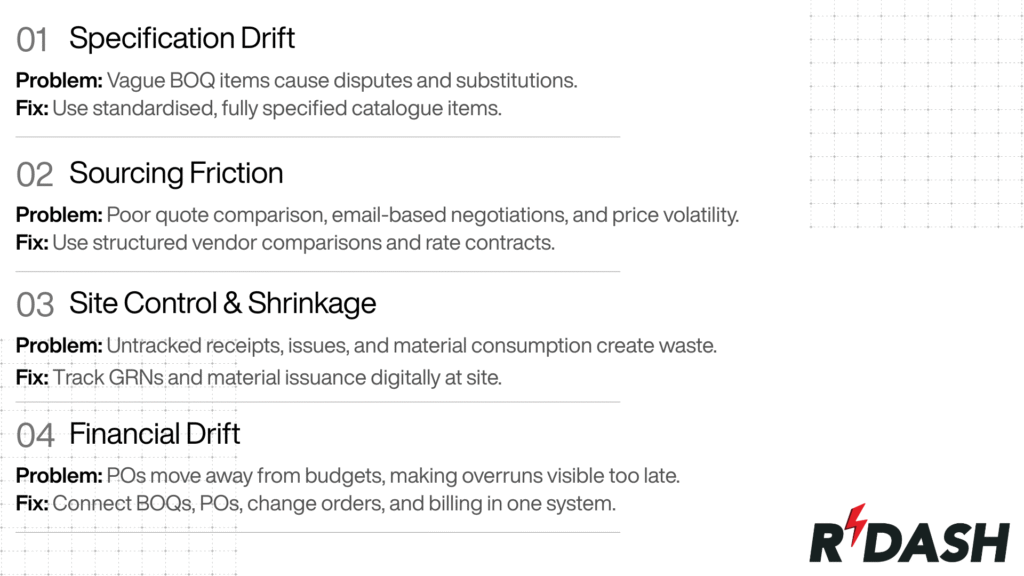
Before you look at a single product, work out which of four failure modes dominates your projects. Most firms have all four to some degree, but one usually costs the most. Name that one, and your shortlist writes itself.
Failure mode 1: Specification drift
The symptom: Vague line items and “or equal” requests trigger disputes and last-minute substitutions. The BOQ says “vitrified tiles” with no size, finish, or standard, and the argument over what was actually priced surfaces only when the material lands on site.
What it costs: Specification ambiguity is a leading cause of change-order disputes. When a description is loose, the gap gets filled by whoever is arguing, and it’s rarely filled in your favour.
What fixes it: A standardised element or catalogue master, so every BOQ line pulls from an approved, fully specified item rather than free text. Tools that enforce a catalogue at the point of estimation close this gap; generic purchasing tools that accept typed line items do not.
Failure mode 2: Sourcing and market friction
The symptom: You can’t compare vendor quotes on a like-for-like basis, rate negotiations live in email, and material prices move faster than your plans absorb them.
What it costs: Producer price indices for construction materials show that after the extreme spikes of 2021–2022, volatility became episodic rather than vanishing, with pockets of rapid movement in metals and mechanicals against a flatter backdrop. When procurement plans don’t capture lead-time variance and price bands, field teams absorb the shock as out-of-sequence work or expediting fees.
What fixes it: Rate contracts and structured vendor comparison, so pricing is locked against agreed rates and quotes are evaluated on the same basis. This is the sweet spot of dedicated e-procurement and sourcing platforms.
Failure mode 3: On-site control and shrinkage
The symptom: Materials arrive, but no one books them in properly; issuance from the site store is untracked; the quantity ordered and the quantity actually consumed never reconcile.
What it costs: Fragmentation across design, estimating, project management, field supervision, and accounting turns quietly into waste. The scale is stark: construction was the single largest source of waste in the EU, generating 38.4% of the total in 2022 (Eurostat). While much of that is demolition debris, over-ordering, damage, storage loss, and end-of-job surplus all feed the number, and every one of those is a procurement-control failure, not a design one.
What fixes it: Goods Receipt Note (GRN) and material issuance tracking at the site store, ideally through a mobile app the site team will actually use. This is where field-first execution tools earn their place.
Failure mode 4: Reconciliation and financial drift
The symptom: Purchase orders drift away from the budget. You discover a cost overrun at month-end instead of catching it while there’s still time to correct course. No one can answer “how much of this project’s procurement spend is reconciled against the BOQ?” without a week of spreadsheet archaeology.
What it costs: This is the failure mode that erodes margin invisibly. McKinsey’s analysis found average cost and time overruns of 70% and 61% respectively, relative to original budget and schedule, and separately reports that large projects across asset classes typically run up to 80% over budget and 20% longer than scheduled.
Unbilled change orders are a recognised driver of that gap: when scope changes aren’t valued against pre-agreed rates and documented against the original line, the cost lands but the recovery doesn’t. Procurement that’s disconnected from the BOQ is exactly where that leak forms.
What fixes it: A system where the BOQ is the spine where the same document that structures your budget also drives your POs, absorbs change orders against pre-agreed rates, and connects to billing. This is the defining strength of full construction management platforms, and it’s the failure mode most standalone procurement tools cannot touch, because they never see the BOQ at all.
Use this diagnosis to read every “best software” list differently. When a listicle ranks fifteen tools, it’s silently assuming your failure mode matches the one its favoured product solves. Now that you’ve named yours, you can ignore the ranking and look only at whether a tool addresses your gap.
The Three Categories of Procurement Software (and Who Each Is For)
Once you know your failure mode, the market sorts into three honest categories. Most confusion in “best procurement software” comparisons comes from treating tools in different categories as if they compete directly. They don’t.
Category | What it is | Best-fit failure mode | The catch |
Standalone spend/e-procurement | General-purpose purchasing and spend tools, not built for construction | Sourcing and spend (mode 2), generic non-project buying | No native BOQ, GRN, or RA-billing logic |
Construction point solutions | Focused tools for tendering, purchasing, or material delivery | One sharp, single leak (sourcing or site control) | You stitch several together; each seam leaks |
Full construction platforms | Procurement as one module inside a BOQ-to-billing workflow | Reconciliation and financial drift (mode 4) | Overkill if you only buy a few times a month |
1. Standalone spend and e-procurement platforms
These are general-purpose procurement and spend tools, enterprise sourcing suites, and mid-market purchasing apps not built for construction.
They fit companies whose dominant leak is sourcing and spend (failure mode 2) and whose buying is relatively generic: recurring supplies, indirect spend, and multi-department purchasing where the project isn’t the organising unit.
The catch for construction is structural. These tools are strong on requisitions, approvals, and spend analytics but blind to construction’s actual organising document: the BOQ. They don’t natively understand a rate contract linked to a scope item, a GRN at a site store, or Running Account (RA) billing. If your procurement is inseparable from your BOQ, a generic tool forces you to rebuild construction logic on top of a purchasing engine.
2. Construction-specific point solutions
These are focused tools that do one construction procurement job well: subcontractor tendering networks, purchasing modules, or material delivery and staging apps.
They fit firms with a single sharp failure mode: sourcing (a tendering network that connects builders to subcontractor databases) or on-site control (a delivery and staging app), but not both.
The catch is fragmentation in disguise. Because each tool is narrow, you often end up stitching two or three together, and every seam is a place for data to fall out. A tendering tool that doesn’t talk to your cost system re-creates the very fragmentation you were trying to solve, one layer up.
3. Full construction platforms with procurement built in
These are end-to-end platforms where procurement is one module inside a BOQ-to-billing workflow RDash, alongside enterprise systems aimed at large general contractors.
They fit contractors, fit-out firms, EPC contractors, and developers whose real problem is reconciliation and financial drift (failure mode 4), where procurement only makes sense connected to the BOQ, the schedule, progress, and billing.
The catch is scope. These are platforms, not utilities; they ask you to run more of your project in one system. That’s exactly the point if fragmentation is your problem, and overkill if you only need to compare three quotes a month.
How to Evaluate Any Construction Procurement Tool: A Practical Checklist
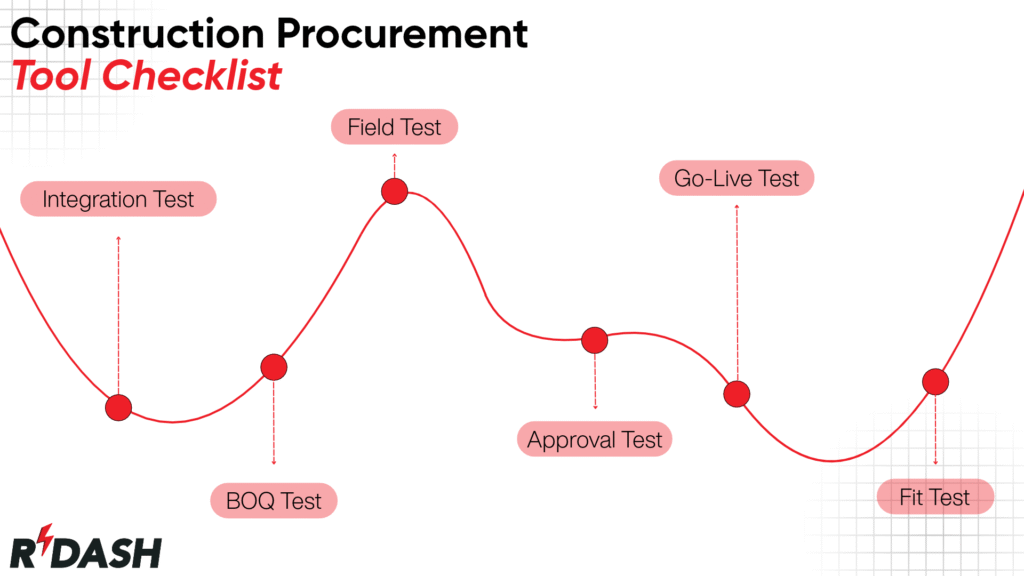
Feature lists are designed to look impressive and hide gaps. Replace the checklist with a small set of hard tests. If a tool fails these, its feature count is irrelevant.
The integration test (the one that matters most)
Can the tool hold a rate contract, raise a purchase request, issue a PO, book a GRN, and reconcile all of it back to the BOQ inside one system, without export-import gymnastics? This single test separates real construction procurement software from a purchasing app wearing a hard hat. If any step lives in a separate tool, that seam will leak.
The BOQ-linkage test
Does procurement start from the BOQ, or from a blank purchase order? A tool where the PO is generated against an approved scope line and where a change order is valued against pre-agreed rates and documented against the original item prevents the quiet margin erosion that unlinked procurement causes. A tool where you retype quantities into a fresh PO invites drift on day one.
The field-adoption test
Will the site team use it on a phone, in the field, with patchy signal? Construction software fails at the workface, not in the demo. If purchase requests can’t be raised from site with approval controls, procurement decisions keep happening informally, and informal procurement is unreconciled procurement.
The approval-hierarchy test
Is there a configurable, auditable approval chain for POs, invoices, and payments? “Maker-checker” controls are what stop a vendor from being paid for non-tendered items. Without an approval hierarchy, you have visibility but no control.
The go-live and migration test
How fast does a team like yours go live, and what does migrating your existing BOQs and vendor data look like? A platform that takes months to deploy loses the momentum that justified the purchase. Ask for a specific timeline and a specific migration path, not a reassurance.
The honest-fit test
Is this tool overbuilt or underbuilt for you? A full platform is the wrong answer for a two-person firm buying supplies monthly; a delivery-coordination app is the wrong answer for a contractor bleeding margin through BOQ-to-PO drift. Match the category to your failure mode and be honest about which one you are.
Where RDash Fits and Where It Doesn’t
RDash is a full construction management platform (category 3), and it’s built around a specific conviction: that procurement in construction only makes sense when it’s tied to the BOQ. On RDash, the same BOQ that structures your budget drives your procurement, tracks your change orders, and connects to your billing milestones. Procurement runs end-to-end from purchase requests raised on site, through rate contracts and vendor orders, to invoices, GRNs, and payments inside the same system that holds the scope.
RDash is a strong fit if your dominant failure mode is reconciliation and financial drift (failure mode 4), you operate in India or the Gulf, and you’re tired of a fragmented stack: WhatsApp for approvals, Excel for BOQs, Google Drive for drawings, disconnected accounting for finance.
It’s purpose-built for contractors, fit-out firms, EPC contractors, PMC consultants, and developers who need rate contracts, PO creation with country-specific tax rules, material GRN and issuance, and installed-value billing in one place, with an auditable approval hierarchy over every financial transaction. For how this connects to cost control specifically, RDash’s guide on cost control and procurement support in construction walks through the mechanics.
RDash is the wrong fit if: you only need a lightweight spend tool for generic, non-project purchasing (a standalone e-procurement app will be cheaper and simpler), or your single problem is a subcontractor tendering network and nothing else. A full platform is the right answer to fragmentation, not to a narrow, single-seam need. That’s the honest boundary, and naming it is part of choosing well.
The reason to make procurement inseparable from the BOQ isn’t a product preference; it’s the arithmetic of failure mode 4. When your PO is born from an approved scope line, and every change order is valued against a pre-agreed rate, drift has nowhere to hide. When procurement lives in a separate tool, drift is the default. RDash’s broader take on how AI is used across construction management, including matching vendor invoices to orders and catching quantity mismatches automatically, extends that same logic into the parts of procurement that are pure manual drudgery today.
A 30-Day Plan to Fix Procurement Before (or Alongside) Buying Software
Software makes a good process measurable; it doesn’t invent one. Adapting the production-system approach set out in Supply Chain Management Review, here’s a sequence that pays back whether or not you’ve picked a tool yet and that tells you exactly what your software needs to support.
Week 1: Build a procurement schedule beside your master schedule. For every long-lead and approval-sensitive item, log the spec, submittal due date, decision deadline, fabrication duration, ship date, on-site date, and receiving window. This alone surfaces which failure mode is really costing you.
Week 2: Standardise your language. Build a core catalogue of your top 100–200 recurring items, with approved alternates and full specifications. This is the single highest-leverage fix for specification drift (failure mode 1), and it’s what turns “vitrified tiles” into a line no one can argue about later.
Week 3: Measure what crews actually do. Track a few honest metrics: percentage of tasks that start with materials fully on hand, PO-to-dock lead time, and receiving first-time quality. These reveal whether your leak is upstream (sourcing) or on site (control).
Week 4: Plan logistics like a factory. Sequence deliveries to the look-ahead plan, plan laydown areas to prevent double-handling, and pre-book access windows for arriving loads. A constraint-aware plan beats blanket “just-in-time” dogma when prices and availability swing selectively.
Run this, and when you evaluate software, you’ll be testing it against a process you understand, not hoping a tool will hand you one.
The Bottom Line
The construction firms that win on procurement don’t start by asking which software is best. They start by finding out where their own procurement leaks, then buy the narrowest tool that closes that specific gap without opening new seams. Specification drift needs a catalogue master. Sourcing friction needs rate contracts and structured comparison. On-site shrinkage needs mobile GRN tracking. And financial drift, the quietest, most expensive leak of all, needs the BOQ to be the spine that procurement, change orders, and billing all hang from.
That last problem is the one most contractors underestimate, and the one standalone tools can’t reach, because they never see the BOQ. If that’s your leak, a platform built around BOQ-to-PO reconciliation isn’t a nice-to-have; it’s the whole point. Whichever direction your diagnosis sends you, make the decision the way a good quantity surveyor prices a job: from the specifics of what’s in front of you, not from a list someone else drew up to make their own answer the winner.
Ready to see how BOQ-linked procurement works in practice? Explore how RDash unifies procurement, BOQ, and finance in one platform.

Frequently Asked Questions
What is the best procurement software for construction companies?
There is no universal best. The right tool depends on your dominant procurement failure mode specification drift, sourcing friction, on-site control, or budget reconciliation and on your size and region. Firms whose procurement is inseparable from the BOQ are best served by a full construction platform that links POs to scope, change orders, and billing; firms with generic, non-project purchasing may be better off with a standalone spend tool. Diagnose your biggest leak first, then match a category to it.
What’s the difference between procurement software and a full construction management platform?
Standalone procurement software handles requisitions, purchase orders, vendor management, and spend analytics as a self-contained function. A full construction platform treats procurement as one module inside a BOQ-to-billing workflow, so a PO is generated against an approved scope line and reconciled back to the budget automatically. The distinction matters most when your procurement problem is financial drift rather than pure purchasing efficiency.
Do small construction firms need procurement software?
It depends on the leak, not the size. A small firm buying supplies occasionally may need nothing more than disciplined catalogues and a rate-contract habit. A small firm running fixed-price fit-out projects where BOQ-to-PO drift is quietly eroding margin needs the linkage a platform provides more than a large firm with a mature finance function does. Size is a weaker predictor of need than failure mode.
How is a BOQ different from a Bill of Materials (BOM) in procurement?
A Bill of Quantities prices installed work, materials, plus labour, plant, quantities, unit rates, and totals for contracts and finance. A Bill of Materials lists only the physical components to buy. Put simply: a BOM tells you what to buy; a BOQ tells you what to buy, what to do, how long it takes, and what it costs. Good procurement software understands both and keeps them distinct.
What single feature matters most in construction procurement software?
BOQ-to-PO reconciliation inside one system. If the tool can hold a rate contract, raise a purchase request, issue a PO, book a GRN, and tie all of it back to the BOQ without exporting to another system, it’s genuinely built for construction. If any of those steps live elsewhere, that seam is where your data and your margin will leak.
Should I buy procurement software or fix my process first?
Both, in that order, in the same month. Software makes a sound process measurable and enforceable, but it can’t invent one. Run a short process reset: procurement schedule, standardised catalogue, honest field metrics, and you’ll both improve immediately and know exactly what to demand from any tool you evaluate.