
Key Takeaways
- A hospital fit-out is not a commercial fit-out with extra paperwork. Infection control (ICRA) and life safety (ILSM) are legal gates that decide how work is sequenced; generic construction software has no native concept of either.
- Even in a good year, roughly one healthcare project in six is both over budget and behind schedule. The 2026 ASHE/HFM survey put on-budget-and-on-schedule delivery at 48% and both-over-and-behind at 16%.
- The rules changed on January 1, 2026. The Joint Commission’s Accreditation 360 merged the Environment of Care and Life Safety chapters into one Physical Environment (PE) chapter, so a single life safety finding now carries more weight.
- Occupied, phased construction is the default in healthcare, not the exception. Software must sequence work around active clinical departments, not just draw a linear timeline.
- Healthcare projects fail at the handoffs, not inside any one discipline. The break points are the seams between design, procurement, finance, and site execution the gap a unified platform closes.
- AI risk detection is a co-pilot, not an autopilot. It flags cost variance, vendor risk, and schedule slippage early, but a human decides whether a flag is a data error, a real overrun, or acceptable variance.
- Choose by fit, not feature count. The test is whether a platform matches how a healthcare fit-out actually runs: phased, compliance-heavy, and multi-stakeholder from day one.
A hospital renovation rarely gets the luxury of an empty site. Patients are being treated two walls away from the demolition crew. A nurses’ station runs its shift while ductwork is rerouted overhead. Every dust barrier, every system shutdown, every inspection has to happen without ever touching the one thing that cannot be paused: patient care.
That single constraint building inside a facility that never closes is what separates healthcare fit-out software from every other category of construction management tool. This guide is built to help you evaluate it on that basis, using primary-source data throughout, and to be honest about where any given tool, including RDash’s own, is and isn’t the right answer.
Why Healthcare Construction Needs Its Own Category Of Software
Most construction management tools are built around a linear assumption: a site, a schedule, a budget, and a team executing a plan that never has to negotiate with an operating emergency department next door. Healthcare fit-outs break that assumption. A trauma-bay expansion happens inside an active trauma center. An oncology suite renovation happens down the corridor from immunocompromised patients. Occupied, phased construction under continuous review isn’t an edge case in hospital work; it is close to the default condition, and it changes what the software actually has to do.
Three things make healthcare fit-out uniquely demanding compared with retail, office, or residential construction.
Infection control is a legal gate, not optional documentation: An Infection Control Risk Assessment (ICRA) is a required pre-construction process that crosses the type of construction activity against the patient population it will affect, producing a defined class of precautions that must be in place before work begins. It is embedded in the Facility Guidelines Institute (FGI) design guidelines adopted or referenced by most U.S. state licensing authorities and referenced in Joint Commission accreditation standards.
Life safety systems can’t be quietly compromised: Interim Life Safety Measures (ILSM) are temporary compensating protections a hospital must implement whenever construction impairs a fire-protection, egress, or compartmentation feature. The Joint Commission expects a documented ILSM policy, a risk assessment, and continuous, auditable evidence for the full duration of the impairment.
The facility doesn’t stop operating: Complex phasing to keep departments functional while adjacent spaces are renovated is one of the biggest operational risks in hospital construction, and it requires software that can show how each construction phase actually touches clinical operations, not just a flat timeline of trades and materials.
Every feature comparison, vendor category, and evaluation question below returns to one test: does this tool understand that the “site” is also someone’s workplace and someone else’s hospital bed?
What Actually Makes A Healthcare Fit-Out Different From Standard Construction
Vague appeals to “healthcare is complex” don’t help anyone choose a tool. Here is what “different” means in practice.
The regulatory load is heavier and, as of 2026, restructured
A single healthcare renovation answers to multiple regulators at once: the Joint Commission (or another CMS-approved accrediting organization), the Centers for Medicare & Medicaid Services (CMS), state health departments, and local Authorities Having Jurisdiction (AHJs).
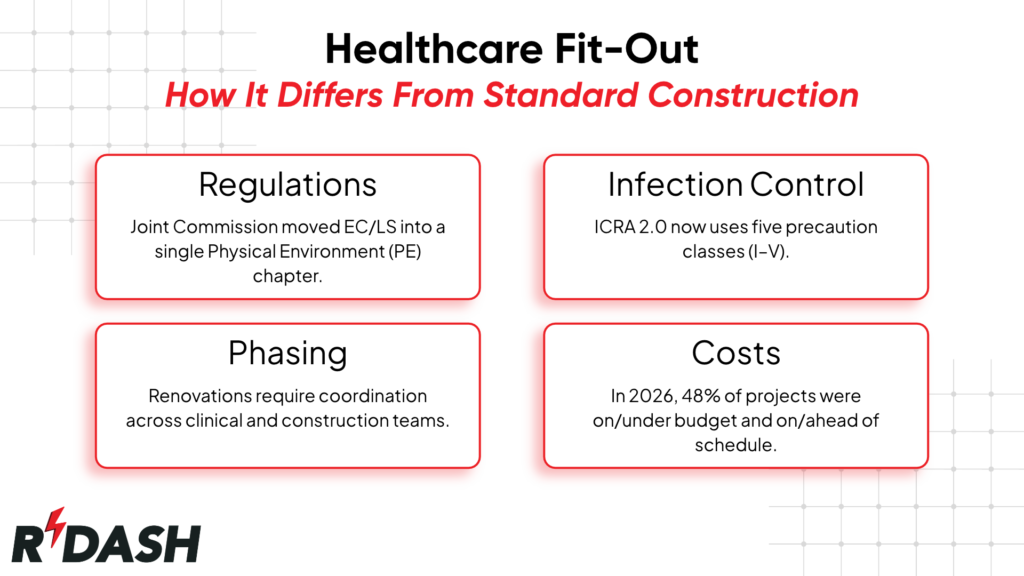
The framework changed on January 1, 2026. Under the Joint Commission’s Accreditation 360: The New Standard, the Environment of Care (EC) and Life Safety (LS) chapters were retired and replaced by a single Physical Environment (PE) chapter, aligning Joint Commission standards more closely with the CMS Conditions of Participation. The consolidation removed or merged more than 700 requirements and cut the total number of standards by roughly half.
Two practical consequences for construction teams:
- Life safety findings now score inside the PE chapter rather than a separate LS chapter, so a single life safety deficiency carries more weight against overall accreditation than it did before.
- Infection Control remains a standalone chapter; it was streamlined to align with the CoPs, not folded into PE. (A common misconception is that PE now “contains” infection control; it does not.) (HFM Magazine Joint Commission on Accreditation 360)
The takeaway isn’t that the rules got harder; the Joint Commission has said the core intent is largely intact. It’s that the reference structure changed, so any documentation, crosswalk, or software checklist still pointing at legacy EC/LS numbering is now out of date.
Infection control drives sequencing, not just paperwork.
Dust and moisture generated during construction can aerosolize fungal spores, notably Aspergillus, and other pathogens that pose a direct risk to immunocompromised and other vulnerable patients nearby. That is why ICRA classifications directly dictate how work gets barriered, sequenced, and monitored: it changes the construction plan itself, down to which HVAC returns must be isolated before a wall comes down.
One correction worth making, because a lot of older content gets it wrong: the current ASHE ICRA 2.0 matrix defines five classes of precautions (Class I–V), crossing four construction activity types (A–D) against patient risk groups. The older ASHE/APIC matrix used four classes (I–IV); if a tool or template still references a four-class matrix, it’s built on the previous version.
Phasing is a clinical coordination problem, not just a scheduling one.
Occupied-renovation planning has to bring infection prevention, facilities engineering, nursing leadership, environmental services, and security to the table alongside the general contractor coordinating phasing, safety, and communication as a genuinely cross-functional exercise. A construction schedule that only accounts for trades and materials, with no live view of which clinical spaces are affected in which sequence, is structurally incomplete for this environment.
The cost of getting it wrong is higher and more visible
Construction runs over budget everywhere. A widely cited study spanning 20 countries and 70 years found roughly nine in ten projects exceed their budgets, with an average overrun near 28%, and McKinsey found large projects can run up to 80% over. (Cylinders Inc. summary of McKinsey / Propeller Aero data)
Healthcare’s own numbers are sobering enough that you don’t need to inflate them. The ASHE / Health Facilities Management Hospital Construction Survey tracks delivery performance every year, and the trend is real but slow. In the 2025 survey, only 47% of health systems reported projects completed both on/under budget and on/ahead of schedule, while 24% reported projects that were both over budget and behind schedule.
The 2026 survey showed modest improvement: 48% on/under budget and on/ahead of schedule, with the both-over-and-behind group falling to 16%, but respondents note that this is still below the pre-pandemic norm, when 50–60% of projects came in on/under budget and on/ahead of schedule. In other words: even in a good year, roughly one healthcare project in six misses on both cost and schedule at once.
A note on a statistic you’ll see everywhere. A number circulating across vendor blogs claims healthcare projects “see average budget increases of 15–20% when proper controls aren’t in place, according to Dodge Data and Analytics.” We could not trace that figure to a primary Dodge publication; it appears to originate from secondary vendor content citing itself. We’ve left it out and used the ASHE survey data above instead, which is primary, current, and specific to healthcare. If you’re building a business case, cite the source you can actually stand behind.
And the compliance failure modes are concrete. When CMS adopted the 2012 edition of NFPA 101 (the Life Safety Code) in 2016, high-rise health care buildings were given 12 years to become fully sprinklered. As ASHE’s Leah Hummel has noted, a full-building sprinkler retrofit is a major undertaking that can take months or years, requires AHJ plan review that runs up to nine months in some states, and critically “will involve phasing, a shutdown of certain areas requiring interim life safety measures and infection control risk assessments.” That’s the real shape of a healthcare compliance surprise: not a line item you forgot, but a system trigger that reorganizes the entire project. (HFM Magazine CMS sprinkler requirement)
Core Capabilities Healthcare Fit-Out Software Must Have
Each of these maps directly to one of the risk categories above. These aren’t nice-to-haves.
Capability | What it solves |
Unified project, design & procurement workflow | Prevents the handoff failures where scope, drawings, and vendor orders drift out of sync |
Real-time, BOQ-linked budget and cost tracking | Catches variance early, before it becomes a finished fact at final billing |
Change-order and scope documentation | Creates an audit trail when clinical requirements shift mid-project, which they routinely do |
Phase-based scheduling with dependency mapping | Sequences work around active departments rather than a flat linear timeline |
Multi-stakeholder approval hierarchies | Keeps infection control, facilities, and clinical sign-off structured, not scattered across email and chat |
Mobile site documentation & progress reporting | Gives real-time visibility into what’s actually happening on site, not what was planned |
Analytics and proactive risk flagging | Surfaces cost variance, vendor risk, and delay patterns before they compound |
Design and scope management
Healthcare fit-outs run through more revision cycles than standard commercial builds, because infection control, nursing, and facilities engineering all need a voice in design decisions other project types don’t require. Version control on design files and a documented, approved change-order process matter more here than almost anywhere else in construction: an unapproved scope drift into a life-safety-relevant area is exactly how a surprise sprinkler or fire-rating upgrade gets discovered at inspection instead of at design.
Procurement and financial control
Healthcare budgets are unusually sensitive to long-lead items medical gas systems, specialized HVAC, and imaging-equipment infrastructure where a delayed vendor order can stall an entire phase. Mechanical, electrical, and plumbing (MEP) systems alone account for roughly 28–32% of a hospital’s total construction cost, the single largest category. (BSA Design 2026 Hospital Construction Cost Report) Software that links purchase orders, vendor invoices, and installed progress back to the actual Bill of Quantities (BOQ) gives owners a live read on cost exposure, instead of discovering it at the next invoice cycle. Because every BOQ line traces back to the quantity takeoff that produced it, an error upstream in the takeoff quietly propagates into procurement and billing, which is why the tightest healthcare cost controls start at the estimate, not the invoice.
Site execution and compliance documentation
This is where healthcare fit-out software earns its keep against a generic tool. ICRA permits, barrier inspections, pressure logs, cleaning verification, and ILSM assessments need to be accessible on demand for internal reviews and unannounced AHJ or accreditation surveys, not compiled retroactively when a surveyor arrives. Real-time daily progress reporting and mobile site surveys turn compliance from a paperwork burden into a running record that stays audit-ready.
AI-assisted risk detection
The newest layer is analytics that flag problems before a human notices: cost variance above a threshold, a vendor tied to repeated delays, a schedule slippage pattern. The honest framing is co-pilot, not autopilot: the system surfaces the leak, and a project manager decides whether it’s a data error, a genuine overrun, or acceptable variance. Treated that way, it’s become close to standard in serious construction platforms; treated as a verdict, it burns the teams that over-trust it.
The Vendor Landscape, Compared
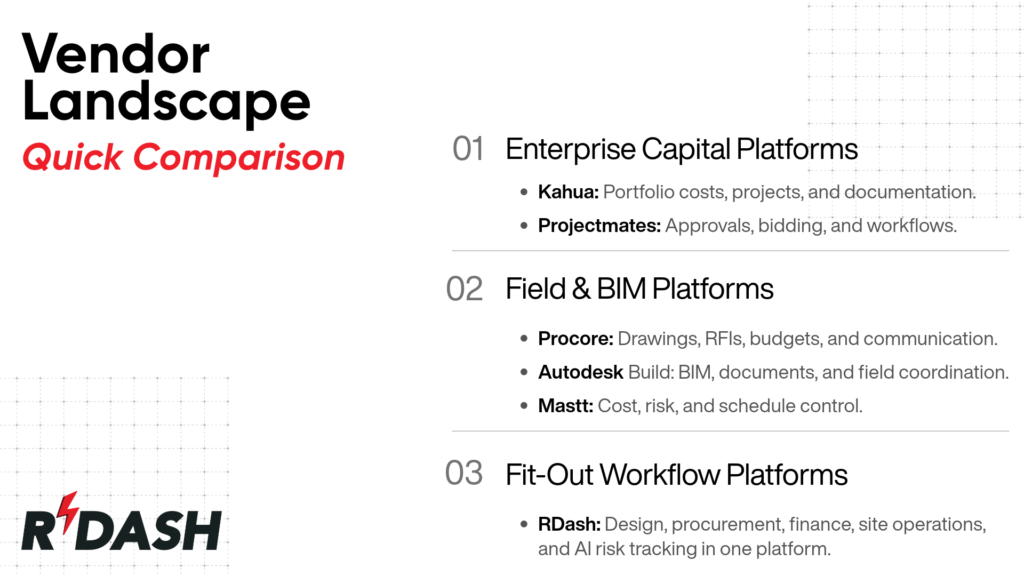
The market splits into a few distinct categories, and knowing which one you’re shopping in matters more than any single feature comparison.
Enterprise capital program platforms
Built for large health systems managing portfolios of hospital construction, with heavy emphasis on grant-, bond-, and appropriation-level financial reporting.
- Kahua brings projects, costs, and documentation into one system to improve cost predictability and maintain audit-ready documentation across a full capital portfolio.
- Projectmates focuses on approval workflows and digital bid management, with real-time notifications on pending approvals so delayed sign-offs don’t stall a project.
Field-and-BIM-centric platforms
Strong on document control, model coordination, and field operations; positioned for large, complex builds.
- Procore is the category benchmark for centralized drawings, RFIs, submittals, budgets, and communication, and offers tooling positioned for hospitals, clinics, and surgery centers. Its center of gravity is document and approval control for the general contractor.
- Autodesk Construction Cloud / Autodesk Build unifies BIM collaboration, document control, and field operations, with real-time model coordination valuable on model-driven hospital builds where clash detection during design is far cheaper than discovering a duct-versus-conduit conflict on site.
- Mastt positions around real-time cost, risk, and schedule control for the specific pressures of occupied, high-risk healthcare sites.
Unified workflow platforms for fit-out and interiors
Built around the full lifecycle of a fit-out project, from lead and design through procurement, finance, and handover rather than a single discipline like scheduling or BIM.
RDash sits in this category: an AI-powered construction management platform built for the construction and fit-out industry, unifying site teams, procurement, design, and finance in one system rather than the WhatsApp-plus-Excel-plus-Drive stack many teams default to.
- It lists Healthcare explicitly as one of its supported project types alongside retail, hospitality, corporate, and education, and its structure maps onto the healthcare fit-out risks above: design version control and BOQ-linked change orders for scope discipline;
- Procurement and finance management that ties vendor POs and invoices to installed progress for real cash-flow visibility;
- An AI Co-pilot that surfaces cost variance and schedule risk before it compounds.
RDash is used by 450+ construction teams across India and the UAE, is backed by Y-Combinator, Stellaris Venture Partners, and Zacua Ventures, and offers structured onboarding with a 90-day deployment window on its Enterprise plan. (RDash company overview) · (Y Combinator RDash)
Choosing by project profile
Project profile | Best-fit category |
Multi-hospital health system, capital-portfolio reporting | Kahua, Projectmates |
Large complex builds needing deep BIM/model coordination | Procore, Autodesk Construction Cloud |
Occupied hospital renovation with heavy phasing and risk focus | Mastt |
Healthcare interiors, MEP, or fit-out firm running multiple concurrent projects lead-to-handover | RDash |
Firms replacing Excel/WhatsApp coordination with a single connected system | RDash, Procore |
How To Evaluate Software For Your Healthcare Fit-Out Projects
Run any shortlisted platform through these questions before committing:
- Occupied, phased construction: Does it support sequencing tied to active clinical areas, or only linear timelines?
- On-demand compliance evidence: Can it store and surface ICRA and ILSM documentation instantly for an unannounced survey, rather than requiring manual compilation?
- Design-to-budget link: Does it connect change orders to cost tracking in real time? A change order approved in isolation from the budget is how overruns happen quietly.
- Reconciliation to installed progress: Is vendor and PO tracking tied to what’s actually installed, so invoices reconcile against site reality rather than just what was ordered?
- Multi-stakeholder approvals: Does it support approval hierarchies for infection control, facilities, and clinical leadership, not a single-approver chain?
- Deployment and onboarding: What’s the real timeline, and does the vendor offer structured onboarding for teams moving off spreadsheets mid-portfolio?
- Proactive analytics: Does it flag risk before the fact, or only report what already happened?
- Non-technical usability: Can clinical and facilities stakeholders actually use it, or does it need a dedicated administrator to extract any value?
A short pilot on one active phase or one department renovation, evaluated directly against these questions, remains the most reliable way to validate vendor claims against your facility’s operational reality.
What Unified Workflow Management Looks Like On A Real Project
The value of unifying design, procurement, finance, and site execution isn’t theoretical; it shows up most clearly on projects with the same complexity profile as a healthcare fit-out: high vendor count, tight tolerance for error, and no room for a missed detail.
RDash’s own field data illustrates the mechanism. On an HVAC and MEP fit-out for HDFC Bank at Candour TechSpace, Kolkata, run by pan-India MEP contractor HPV Elevate, the project carried a BOQ value of roughly USD 850,000, engaged 35+ vendors, and ran a master BOQ of 170+ line items against 125+ purchase orders. Managing that on a spreadsheet is where margin bleeds through over-ordering and duplicate payments.
On RDash, the team reconciled 125+ orders against the master BOQ for 100% visibility on USD 600,000+ of procurement spend, and the number was worth sitting with a maker-checker approval hierarchy flagged roughly USD 42,000 of site-expense requests and approved only about USD 20,000 initially. On a project whose entire margin might be USD 60,000–90,000, that roughly USD 22,000 of caught petty-cash bleed is the difference between a profitable job and a marginal one.
These are company-reported figures rather than independently audited ones; we flag that deliberately, because the honest version of a case study says so. But the pattern is what generalizes to healthcare: complex, multi-vendor, compliance-sensitive builds fail most often at the seams between design, procurement, and finance, not within any single discipline, and reconciliation in one system is what catches the leak before it becomes a crisis.
On the healthcare side specifically, RDash has been deployed on medical-sector work, including Semac Consultants’ project on the Poly Medicure manufacturing facility in Palwal, Haryana, the same class of high-spec, compliance-heavy build where BOQ-to-installed-value control matters most.
For teams that want to go deeper: RDash’s 2026 guide to AI in construction management covers the proactive risk-flagging that occupied, compliance-heavy projects need most, and its MEP contractor software guide walks through the BOQ-to-PO reconciliation discipline in detail, with MEP being 28–32% of a hospital’s cost and the category most exposed to reconciliation failure. When the case for a unified workflow makes sense for your portfolio, the RDash pricing page breaks down the Lite, Pro, and Enterprise tiers by team size and construction volume.
Bringing It Together
Healthcare fit-out and construction carries a risk profile that generic project management software was never built to handle: layered regulatory oversight that was itself restructured on January 1, 2026; infection control that dictates sequencing; life safety measures that need continuous, audit-ready documentation; and phasing that has to negotiate with a facility that never stops operating.
The available tools range from enterprise capital-portfolio platforms to BIM-centric field tools to unified fit-out workflow systems like RDash. The right choice depends far less on feature-list length than on whether the platform genuinely understands that a construction site inside a hospital is also, at the same time, someone’s workplace and someone else’s care environment. Shortlist against the eight evaluation questions, insist on a live pilot on one department, and let the people who’ll actually use it on the floor have a veto.

Frequently Asked Questions
What is the best software to manage healthcare facility fit-out and construction projects?
There’s no single universal answer; it depends on project type and organizational scale. Health systems managing large capital portfolios typically look at Kahua or Projectmates; complex builds needing deep BIM coordination lean toward Procore or Autodesk Construction Cloud; and fit-out or interiors firms managing multiple concurrent healthcare-adjacent projects from lead to handover often find a unified workflow platform like RDash a stronger operational fit. Evaluate by how the platform matches phased, compliance-heavy healthcare workflows, not by feature count.
What is ICRA and why does it matter for healthcare construction software?
ICRA (Infection Control Risk Assessment) is a required pre-construction process that crosses construction activity type against nearby patient risk to assign a class of infection-control precautions. Under the current ASHE ICRA 2.0 matrix, there are five classes (I–V). Software needs to store, track, and surface ICRA documentation on demand, because it directly gates when and how construction can proceed.
What is the difference between ICRA and ILSM?
ICRA addresses infection control, dust, airflow, and contamination risk. ILSM (Interim Life Safety Measures) addresses fire protection, egress, and life safety systems that construction may temporarily compromise. They govern different risks and are documented separately, but the same project usually triggers both simultaneously, and both require continuous, auditable tracking.
Did the rules for healthcare construction compliance change in 2026?
Yes. Effective January 1, 2026, the Joint Commission’s Accreditation 360 retired the Environment of Care and Life Safety chapters and merged them into a single Physical Environment (PE) chapter, aligning standards with the CMS Conditions of Participation. Infection Control remains a standalone chapter. Any documentation or software checklist still referencing legacy EC/LS numbering is now out of date.
How often do healthcare construction projects go over budget?
In the 2026 ASHE/HFM Hospital Construction Survey, 48% of health systems reported projects completed both on/under budget and on/ahead of schedule (up from 47% the prior year), while 16% reported projects that were both over budget and behind schedule (down from 24%). That is still below the pre-pandemic norm of 50–60%. Industry-wide, roughly nine in ten construction projects exceed their budgets, with an average overrun near 28%.
Can generic construction management software handle healthcare fit-out projects?
It can handle basic scheduling and budgeting, but generic tools typically lack native workflows for ICRA/ILSM documentation, phased occupied construction, and multi-stakeholder clinical approval chains the exact gaps that create compliance and cost risk on healthcare-specific projects.
What causes the most expensive mistakes in healthcare construction?
Missed compliance triggers during scoping. A renovation that overlooks a full life safety analysis can trigger a system-level requirement such as a facility-wide sprinkler upgrade under CMS’s adoption of NFPA 101 that reorganizes the entire project, adding cost, phasing, ILSM, and ICRA obligations that weren’t in the original plan.
How does phased construction work in an occupied hospital?
Phased construction sequences work around active clinical departments, so patient care continues uninterrupted, coordinating infection prevention, facilities, nursing leadership, environmental services, and security alongside the general contractor. Supporting software needs phase-based scheduling with dependency mapping, not just a flat linear timeline.
What features should I prioritize when comparing vendors?
Real-time budget tracking linked to the BOQ, audit-ready compliance-documentation storage, multi-stakeholder approval hierarchies, phase-based scheduling, and proactive risk analytics each map directly to a documented failure point in healthcare construction.
Is AI-based risk detection reliable for healthcare construction?
It’s best treated as a co-pilot, not a final verdict. It’s effective at surfacing cost variance, vendor risk, and delay patterns early, but a project manager still needs to judge whether a flag is a data error, a genuine overrun, or an acceptable variance.
How long does it take to implement construction management software for a healthcare team?
It varies by platform and portfolio size. Enterprise BIM and capital platforms often run weeks to months, while purpose-built fit-out platforms designed for non-technical teams can go live faster; RDash, for example, offers structured onboarding with a 90-day deployment window on Enterprise. Whatever you choose, pilot on one live site or department first; adoption, not features, is the strongest predictor of a successful rollout.