

TL;DR — Quick Summary
A construction takeoff is a process used in construction to understand the amount of resources, labour, and equipment that will be needed in order to complete a project as represented in the blueprints and schematic drawings. It is the first step in the creation of your Bill of Quantities, cost estimate, bid document, and your approach to procurement. If takeoffs contain errors, everything that comes after in the construction process will contain errors as well.
Construction takeoffs can be completed manually, which is a slow process and more prone to errors, in comparison to a digital takeoff. Digital takeoffs are more efficient, have the ability to cross-check for errors, and are version-controlled. Takeoff AI tools have a range of 95-99% accuracy for most typical construction takeoff elements.
Takeoff inaccuracy can be caused by many factors, like construction drawings being outdated, factors of construction waste not being accounted for, takeoff systems being poorly integrated with procurement systems, and project scope being defined too broadly.
Every construction project begins not on site, but on paper. Before procurement starts and site activities commence, teams must determine the quantities required to complete the project.
Construction takeoff is the process used to determine those quantities and forms the foundation of estimating, procurement planning, and project budgeting. 9 in 10 construction projects exceed their original budgets, with an average cost overrun of 28%. A significant share of those overruns trace directly to estimating errors that begin here. Source: McKinsey Global Institute
This guide covers everything construction companies, EPC firms, contractors, and project teams need to know: definitions, process, types, manual vs digital approaches, common mistakes, AI developments, and how to connect takeoff data to execution.
What Is a Construction Takeoff?
Construction takeoff is also called quantity takeoff (QTO) or material takeoff (MTO). Construction takeoffs involve the assessment of construction drawings and/or blueprints in order to determine the amount of material and/or resources required for the process.
The process originally required estimators to go through the drawings and take items off the drawings, one by one. The process has become more efficient, but the purpose remains the same – to gather the information required for every aspect of a project.
Construction takeoff provides a Bill of Quantities (BOQ) and a procurement forecast.
Quantity Takeoff vs Material Takeoff
These terms can be seen as interchangeable and similar; however, a few distinctions can be made.
- A Material Takeoff (MTO) documents what must be procured for a project. This would include a listing of the project’s development construction materials.
- A Quantity Takeoff (QTO) includes labour and equipment, in addition to materials. As a result, it defines the full project scope.
In the MTO vs QTO world, the MTO defines what must be procured, while the QTO provides data to the estimate and the Bill of Quantities (BOQ).
Why Does the Takeoff Matter?
Construction takeoff is a critical pre-construction activity that directly influences project planning and cost management. The quality of the takeoff has a direct impact on project budgets, procurement plans, and overall financial performance. Errors made during takeoff often carry through to BOQs, estimates, procurement schedules, and financial forecasts.
It Sets the Cost Baseline
Without a precise takeoff, no estimate can be correct. Any quantity error can affect the BOQ, supplier orders, contract pricing, and project financial forecasts. KPMG reports that only 32% of construction projects are completed within 10% of the estimated original costs. A significant amount of this error can be traced to the takeoff itself.
It Affects Both Procurement and Cash Flow
Takeoff quantities impact both the what and when of material orders. The impact becomes even more significant on large projects where procurement may involve hundreds or thousands of individual material line items. In these larger projects, even a small error in takeoff (e.g. 5%) can distort the procurement budget. Because procurement spending forms a major component of project expenditure, quantity errors can affect purchasing plans, payment schedules, and cash-flow forecasts.
It Forms the Basis of the Bid
For contractors and EPC firms, the takeoff is the basis of every bid. If quantities are overstated, the resulting bid may become less competitive. If quantities are understated, contractors may face cost overruns and reduced project margins during execution. The accuracy of a bid is based on the accuracy of the takeoff.
Step-by-Step Implementation Process of Construction Takeoff
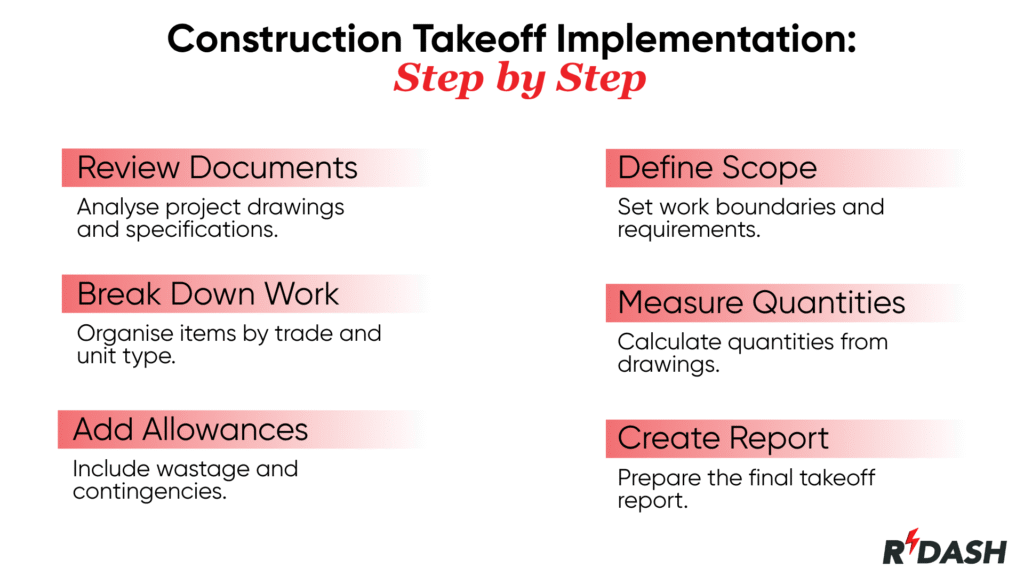
Takeoff, whether completed manually or through the use of software, includes the same steps.
Step 1: Collect and Analyse Project Information
Takeoff begins with a thorough analysis of all construction documents. Errors in takeoff often result from the omission or misinterpretation of one or more documents.
Step 2: Define the Scope of Work
The takeoff scope must be defined. This can be the full project or specific trades or zones. In projects with multiple trades, the work is often subdivided by the estimators. Boundaries that are not defined increase the chances of errors, such as omissions and double-counting.
Step 3: Break Down into Work Elements
Different project components include different elements of work. For example: masonry may include concrete, structural steel, roofing, glazing, and flooring. Electrical, plumbing, and HVAC work may also have their own components. When describing work components, elements that relate to specific trades may be further categorised as:
- Unit counts (nos) — doors, windows, light fixtures, valves.
- Linear metres (lm) — pipes, conduit, skirting, curtain tracks.
- Square metres (sqm) — flooring, ceilings, wall cladding, waterproofing.
- Cubic metres (cum) — concrete, earthwork, fill.
- Kilograms, metric tons (t) — structural steel, rebar.
- Lump sum (ls) — items quoted as packages.
Step 4: Measure Quantities from Drawings
This stage forms the core measurement activity within the takeoff process. The estimators analyse each project drawing and assess the quantities of materials that need to be procured. Manually, this is done with scale rules and spreadsheets. Digitally, takeoffs are done by estimating tools that allow takeoff by measuring on top of a PDF or DWG file.
To prevent double-counting and to show that an item is no longer being counted, estimators need to use a mark-off system. Mark-off systems are usually done using colour-coded systems.
Step 5: Apply Wastage and Contingency Factors
The net amounts represent the “in place” amounts. These are amounts we expect to actually see. Due to the nature of the industry, materials are cut, damaged, or destroyed, and standard allowances are:
- Tiles: 10 – 15% for cuts and breakage
- Concrete: 5 – 10% for losses in formwork and spillovers
- Structural Steel: 2 – 5% for cuts and welds
- Timber: 10 – 15% for cuts and defects
- Paint: 5 – 10% for overspill and absorption
Step 6: Prepare a Takeoff Report
Quantities must be grouped in a report by work element, trade, or by floor/zone of the building. Reports must include a description of the item, unit, quantity, a reference to the drawing, and notes. Reports that are clear and concise are captured in the Bill of Quantities (BOQ) and procurement plan.
Types of Construction Takeoffs
Full Project Takeoff
Most detailed type of takeoff, covering all trade takeoffs. Used for a complete BOQ and the first detailed estimate. Typically done in the pre-tender and detailed design stages.
Trade-Specific Takeoff
Focused on a single trade or discipline structural steel, plumbing, flooring. Used by speciality subcontractors preparing bids, or by general contractors breaking scope into procurement packages.
Takeoff is limited to a particular trade such as structural steel, plumbing, flooring. Generally done for the trade’s estimates or subs’ takeoff and bid.
Conceptual/Preliminary Takeoff
Usually done in the early design stage when detailed drawings are unavailable. Relies heavily on approximation and relationship estimates. Provides a takeoff for design feasibility and preliminary budget.
2D Digital Takeoff
Estimators can make measurements using 2D PDFs/DWGs with the digital methods available. Estimators indicate lengths, areas, and quantities directly on the screen. Compared to manual measurement, the digital method provides a notable improvement in speed, accuracy, and ease of use.
3D / BIM-Based Takeoff
Quantification in 3D Building Models is possible due to the data contained in the modelled elements. BIM allows for the quantification of walls, pipe runs, and each modelled element that contains data.
Specialist Trade Takeoffs (MEP, Civil, Structural)
- MEP Takeoffs: involve measuring lengths of pipe runs, conduit runs, duct runs, and counting valves, fittings, and fixtures.
- Civil / Earthworks Takeoffs: involve measuring the quantity of excavation and fill for construction, and measuring the quantity of other construction preparation activities. Also includes site surveys and assessments of the contour maps.
- Structural Steel Takeoffs: require measuring lengths of beams, columns, and steel tonnage.
How the Takeoff Connects to BOQ, Procurement, and Execution
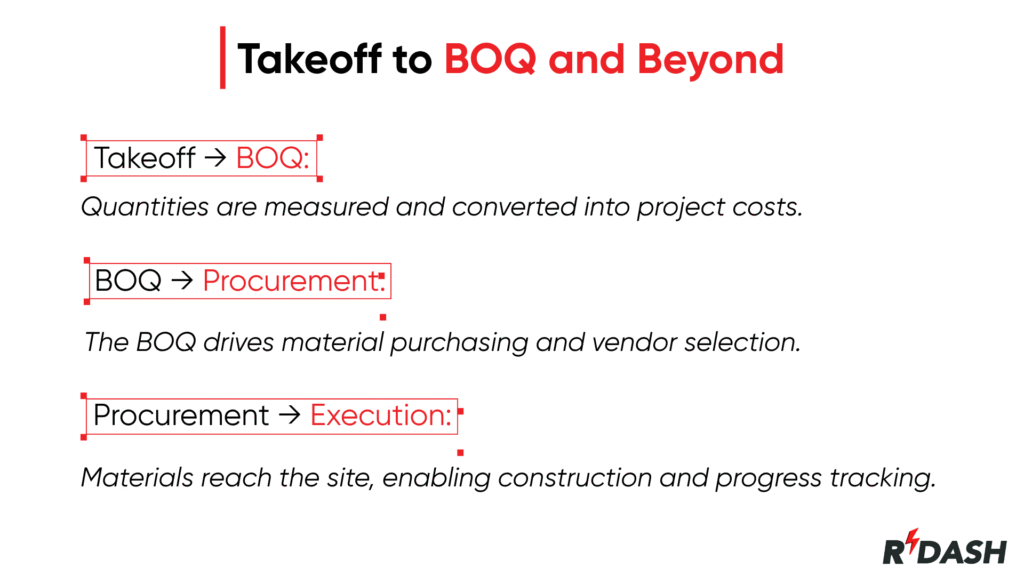
The takeoff does not live in isolation. It is the upstream data source that feeds the entire project lifecycle.
Takeoff → Bill of Quantities (BOQ)
The BOQ is a formal document that outlines each work item, including a description, quantity, unit rate, and total cost for a tender, and is used for contracting and cost control. The takeoff is the first input to the BOQ.
Major difference:
The takeoff is the measurement, and the BOQ is the price. The takeoff is done by the estimator, while the BOQ is signed by the client and the contractor.
BOQ → Procurement
The completed BOQ is integral to the procurement process. Quantities of materials and finishes form the basis of all purchase requests, vendor quotations, purchase orders, and scheduling of procurement. A strong and direct relationship between BOQ and procurement forms the basis of soliciting vendors for the correct quantities, at the right time, and at the previously agreed rates.
Procurement → Site Execution
Procurement establishes a commitment of expenditure which must correspond to the cash flow of the project. The delivery of materials will initiate site operations, which will determine the need for storage, and will affect the availability of labour, as well as the scheduling of labour and the timing of deliveries. Once the takeoff is integrated in the project management system, site managers will be able to compare actual and planned consumption of materials on site in real time. This provides an indication of potential changes in the scope and schedule of the project.
This gap is what modern construction management systems aim to close. By integrating quantities directly to the BOQ, automated procurement and payment to vendors, along with integrated on-site tracking and financing systems, are made available in real time. This allows construction and finance teams to address the average project cost overrun of 28% effectively.

Common Takeoff Mistakes That Derail Projects
1) Inaccurate or Incomplete Measurements
Manual takeoff often leads to a financial burden as it requires manually checking scaled drawings and calculations that often result in either excess or insufficient materials.
2) Missing Wastage Allowances
Not allowing wastage can lead to material shortages and procurement emergencies that can be financially burdensome for the project.
3) Outdated Drawing Versions
Using an older drawing for takeoff can create discrepancies that are discovered through the site team that can be financially burdensome. Digital tools that have a cloud-based and centralised version control drawing system eliminate this risk.
4) Undefined Scope Boundaries
In projects that engage many estimators and subcontractors, undefined scope boundaries will lead to both understating and overstating takeoffs in different work scopes. Both cases will incur additional costs.
5) Misreading Specifications
Specifications provide the grade, quality, and the make of the material, while drawings provide the geometry. Satisfying a given quantity of the wrong material causes procurement problems and leads to change orders.
6) No Peer Review
Not reviewing takeoffs is a major risk. At a minimum, a second-person review is required by the industry. The ideal practice is to review the takeoff against a past project to ensure its accuracy.
7) Disconnected from Procurement and Finance
This is the most understated and most systemic of all errors. The estimated takeoff cannot be looked at in isolation. When takeoff data is manually re-keyed into disconnected procurement, BOQ, or ERP systems, the link between estimated and actual quantities is lost.
How RDash Fixes These Takeoff Problems
Every mistake above shares one root cause: a takeoff is accurate the moment it is measured, then loses integrity as it travels into disconnected spreadsheets, drawings, and accounting systems. RDash keeps that link intact by holding the bill of quantities (BOQ) at the centre, with drawings, procurement, finance, and site progress tied to it, so quantities are never re-keyed where they can drift out of sync. On top of that connected data, AI agents handle anomaly detection, progress updates, and prompt-based analytics that let a project manager ask, in plain language, where margin is slipping. The takeoff stops being a one-time exercise and becomes continuous, self-checking cost control. Here is how that maps to each problem:
Inaccurate or incomplete measurements.
Once the takeoff feeds the quantity baseline, every figure becomes measurable against reality, and RDash’s anomaly-detection agents are built to catch exactly this. Budget guardrails on each line flag item-level margin bleed the moment installed work or material consumption runs ahead of the estimated quantity, so a measurement error is surfaced by the system itself rather than discovered months later in an overrun.
Missing wastage allowances.
Because consumption is tracked against each priced line in real time, any gap between the net estimated quantity and actual material movement shows up early. The same guardrails that catch over-ordering also catch under-allowance, turning wastage from a post-completion surprise into a flagged variance.
Outdated drawing versions.
RDash stores drawings in a centralised, version-controlled repository with approval workflows and a digital markup tool on both mobile and browser. Every quantity is taken off the latest coordinated set, and superseded versions cannot quietly drive procurement.
Undefined scope boundaries.
With the priced scope as the single source of truth, work items are tracked individually, client confirmation is captured per item, and budgets are assigned at the element level. This removes the overlaps and gaps that cause double-counting and omissions when several estimators and subcontractors work in parallel.
Misreading specifications.
Specs, drawings, make, and type are stored at the element level, so the correct grade and quality travel with each quantity. When a specification changes, it is routed through a formal variation order, priced and approved before work begins rather than negotiated into a change order afterward.
No peer review.
RDash enforces a maker-checker workflow with configurable approval hierarchies. Purchase requests convert into purchase orders only after approval, drawing on locked rate contracts and a material breakdown mapped to each line item, so nothing reaches procurement without a second set of eyes and a digital audit trail.
Disconnected from procurement and finance.
This is the systemic failure RDash is built to close. The same document that defines the budget drives procurement and connects to billing, and standard integrations with Tally, Zoho, Odoo, and SAP push and pull POs, invoices, and payments without re-keying. The link between estimated and actual quantities is never severed, which is exactly where most margin leakage and cash-flow drift begin.
From a one-time exercise to live, AI-assisted cost control.
This is where RDash’s AI layer does the heavy lifting. As teams log installed percentage from the field, the platform continuously reads spend against progress, while prompt-based analytics detect margin leakage and time lags, hold project context, and proactively flag risks in tables and charts. Instead of waiting for a month-end reconciliation, a project manager can ask the system where margin is slipping and get an answer from live data. The takeoff stops degrading the moment it leaves the estimator’s desk and stays connected, current, and accountable all the way to handover.
Best Practices Checklist
What high-performing estimation teams do consistently:
- Only begin estimating once the latest drawing set has been downloaded.
- Do not leave overlaps or gaps in estimating work when defining the estimate scope.
- Always account for material-specific wastage factors. This should be considered throughout the estimate, and not disregarded post-estimate completion.
- Colour coding or marking can be used to eliminate the possibility of duplicate counting when estimating.
- Validated estimated quantities should be compared to the estimates of similar previous projects.
- Takeoffs that exceed a defined value require a second reviewer.
- The takeoff and BOQ must be linked, and all required calculations must take place in the estimating application.
- The estimates and supporting documents should be prepared and completed by the same project team.
Conclusion
The construction takeoff sits at the beginning of everything. It defines what a project requires, sets the cost baseline, drives procurement, and connects pre-construction planning to on-site execution.
For firms that want to improve project margins and delivery consistency, the takeoff is not just a technical exercise; it is a strategic capability. The teams that invest in accurate takeoff processes and connected downstream systems will consistently outperform those that do not. It starts here.
FAQs
What is the difference between a construction takeoff and a Bill of Quantities?
During a construction takeoff, the estimator measures and extracts the quantities from the drawing set. A Bill of Quantities is a pricing document with the quantities that have been noted. It also contains the pricing of the unit to calculate the total cost of a project. A takeoff comes before a BOQ. If the takeoff is inaccurate, the BOQ will also be inaccurate.
How long does a construction takeoff take?
It depends on the size and method. A small, manual residential takeoff can take one or two days. A manual takeoff for a large, commercial, or MEP project can take one week or more. Construction takeoff software can shorten the takeoff duration by 50–70%. For common takeoff items, AI-enhanced, digital construction takeoff solutions can perform takeoffs in even less time.
Who is responsible for doing the construction takeoff?
Estimators and quantity surveyors perform construction takeoffs. In large projects, many estimators take off the quantities for each trade (civil, structural, MEP, finishes, etc.). A general contractor takes off the quantities for their bids. A subcontractor takes off the quantities for their trade. A quantity surveyor can be contracted by the project owner to take off the quantities to verify the contractor’s bid.
What causes takeoff errors?
There are three main reasons for takeoff errors: estimators using outdated plans and being unaware that the plans are outdated; estimating net quantities with no allowance for wastage; and uncertainty of scope on multi-trade projects, where the boundaries are unclear for estimators. All three are easily addressed with the right systems and discipline. Digital tools like RDash do assist a lot.
How does a takeoff connect to procurement and project execution?
Takeoffs are part of the overall process of estimating the cost of a project, which typically comes before procurement. There are other aspects involved, like ensuring the accurate pricing of materials at the time of purchase and other charges like transportation. The takeoff process gives you a good idea of what labour and materials will cost.
Ready to connect your takeoff to execution? Connect here!