

Key Takeaways
RDash is the pick for Mechanical, Electrical and Plumbing (MEP) contractors in India and the Gulf: Bill of Quantities (BOQ) to Purchase Order (PO) reconciliation, multi-vendor procurement, material Goods Receipt Note (GRN) tracking, maker-checker approvals and installed-value billing in one system, deployable in days rather than months.
MEP is typically 30 to 50% of hard cost on commercial projects, and can reach 55% on laboratories, hospitals and data centres. You are not a “trade”. You are often the majority of the budget.
Generic project management tools break on MEP because they were built for a different unit of work. A Gantt chart does not reconcile 125 purchase orders against 170 BOQ line items.
“Bad data” may have cost the global construction industry an estimated USD 1.85 trillion in 2020, including USD 88.69 billion in rework, according to Autodesk and FMI.
Procore and Autodesk Build are excellent for large general contractors. As an MEP subcontractor, you can end up paying enterprise prices to be a guest in someone else’s system.
Margin tends to leak in four predictable places: BOQ-versus-PO drift, uncontrolled site expenses, unbilled installed work, and material shrinkage. Choose software that plugs those four, not the one with the longest feature list.
Pilot on one live site before you sign an annual contract. Adoption, not features, is what kills MEP software rollouts.
Why MEP Contractors Break Generic Project Management Software
Here is the part nobody says out loud in a software demo. As an MEP contractor, you are not managing a project. You are managing a subcontract inside someone else’s project, and most tools in the “construction project management” category were designed for the person on the other side of that table.
Procore was built so a general contractor could see dozens of subcontractors at once. Asana and Monday were built for marketing teams. Buildertrend was built so a homeowner could choose their bathroom tile. None of them were built for a mechanical contractor sitting in a site office in Kolkata, holding a 170-line BOQ, 35 active vendors, 125 open purchase orders, and a client who wants a running bill by Friday.
The Five Structural Reasons MEP is Different
Your scope is the majority of the budget, not a line item: Mechanical, electrical and plumbing systems routinely account for 30 to 50% of total construction cost, climbing toward the upper end for laboratories, medical facilities, restaurants and data-heavy tenants, where they can approach 55%. Within your own scope, mechanical (Heating, Ventilation and Air Conditioning, or HVAC) is usually the single largest category.
Your BOQ is your business: A civil contractor can run a project on activities. You cannot. Your world is line items, hundreds of them, each with a quantity, a rate, a vendor, a delivery date and an installed value. If your software’s core object is a task and your business’s core object is a BOQ line, you will spend the project translating between the two. That translation is where margin dies.
You are a procurement business wearing a contracting hat: Copper, cable, ductwork, chillers, switchgear. On a typical MEP fit-out, most of the contract value walks out of a vendor’s warehouse and onto your site, often across 35 or more vendors on a single job. If your tool cannot hold a rate contract, raise a purchase request, issue a PO, book a GRN and reconcile all of it back to the BOQ, it is a chat app with a calendar.
Your changes cascade: One mechanical revision can alter structural openings, electrical loads, plumbing routing, ceiling heights and the fire-protection layout. One change, five impacts. Software that treats a change order as a comment thread will bury you.
Your schedule risk is procurement risk: Long-lead equipment, deferred submittals, startup sequences and commissioning are almost always on the critical path. Chillers, switchgear and transformers carry procurement risk that hits both the budget and the schedule. A Gantt chart that does not know your chiller is stuck at a port is a decorative object.
The MEP Margin Leak: Where the Money Actually Disappears
Bad Data is a USD 1.85 Trillion Problem
In 2021, Autodesk and the management consultancy FMI Corporation surveyed more than 3,900 construction professionals across North America, Asia-Pacific and Europe for a study titled “Harnessing the Data Advantage in Construction“. The headline finding was stark: “bad data”, meaning data that is inaccurate, incomplete, inaccessible, inconsistent or untimely, may have cost the global construction industry an estimated USD 1.85 trillion in 2020.
Break it down, and it gets more pointed for contractors. Decisions made using bad data were estimated to have cost the industry USD 88.69 billion in rework alone, around 14% of all rework performed that year. Thirty percent of respondents said more than half of their project data was bad and led to poor decisions more than half the time.
The per-contractor figure is the one worth putting on a whiteboard. FMI estimated that for a contractor with USD 1 billion in annual revenue, the total cost of bad data could reach USD 165 million, including USD 7.1 million in avoidable rework. As Jay Bowman of FMI put it, organisations are adopting technology but leaving significant value on the table without a data strategy to match.
This is not an abstract industry statistic. It is a description of what happens when your BOQ lives in Excel, your POs live in email, your progress lives in WhatsApp, and nobody can reconcile the three until the project is billed.
The Indian Context is No Gentler
India’s most closely monitored public projects tell the same story. The Ministry of Statistics and Programme Implementation (MoSPI) publishes a monthly flash report on central-sector infrastructure projects worth ₹150 crore and above, and those reports have repeatedly documented large cumulative cost overruns across hundreds of monitored projects, run by the country’s largest and best-resourced firms, under government oversight.
Read that carefully. These are India’s most scrutinised projects, and they still overrun. An MEP subcontractor operating on a 6 to 12% margin, with none of that oversight, is not less exposed. It is more exposed.
The Four Places MEP Margin Actually Bleeds
Strip away the theory and most MEP margin leaks trace back to one of four failures.
The leak | What it looks like on site | What it costs you |
BOQ-versus-PO drift | You ordered 1,400m of cable against a BOQ line that specified 1,150m. Nobody noticed until final billing. | Direct, unrecoverable over-ordering |
Uncontrolled site expense | Petty cash, freight, labour top-ups and “urgent” purchases approved over a phone call | Death by a thousand cuts, invisible until month-end |
Unbilled installed work | You have installed ₹40 lakh of ductwork and billed ₹28 lakh, because nobody measured installed value | Cash-flow strain in a business that is already cash-hungry |
Material shrinkage | ₹35 lakh of copper and controls on an open site with no daily stock position | Theft, damage and misplacement, with no way to prove it |
Notice what these four share. None of them is a scheduling problem. Every one is a reconciliation problem: a failure to connect what was budgeted, what was ordered, what arrived, what got installed, and what got billed. That is the specific gap RDash was built to close, which is why the evaluation checklist that follows is weighted the way it is.
The 8-Point MEP Software Evaluation Checklist
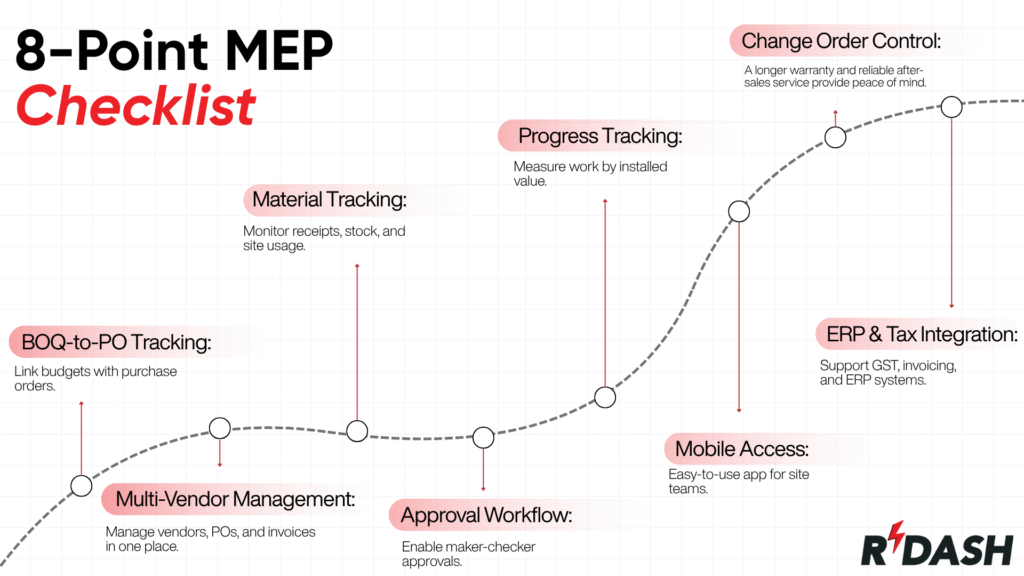
Run every vendor through these eight filters. Under each, we have noted the exact way MEP contractors get it wrong.
1. BOQ-to-PO reconciliation:
Can the system tell you, for any BOQ line, exactly which purchase orders were raised against it and how much of the budgeted quantity remains? This is the single most important question you will ask, and most vendors answer it with a demo of a report rather than a demo of a link.
Where people get it wrong: accepting “we have BOQ” and “we have POs” as an answer. Two modules that do not talk to each other are worse than one spreadsheet, because now you have two versions of the truth.
2. Multi-vendor procurement at real volume:
Thirty-five vendors on a single fit-out is normal, not exceptional. Can the platform hold rate contracts, purchase requests, vendor POs, invoices, and ledgers across that many stakeholders without collapsing into duplicate payments and information asymmetry?
Where people get it wrong: testing the demo with three vendors and assuming it scales to thirty-five. Ask for a live account with a real vendor count.
3. Material GRN and issuance:
Goods receipt at the site store, issuance to the crew, and a daily current-stock position. If your software does not track material at site, high-value HVAC and electrical components will quietly evaporate, and you will find out at reconciliation.
Where people get it wrong: assuming procurement tracking equals inventory tracking. Ordering a chiller and knowing where the chiller is are two different systems.
4. Approval hierarchy (maker-checker):
Every PO, invoice, payment and site expense should require a digital sign-off from someone who is not the person requesting it. This is the cheapest control in construction and the most commonly skipped.
Where people get it wrong: treating approvals as a compliance formality rather than a cost lever. It is a cost lever, and the case study later in this article has the numbers.
5. Installed-value progress tracking:
Bill on what is installed, not on what is delivered and not on what is scheduled. This single discipline separates MEP contractors with healthy cash flow from those chasing their own money.
Where people get it wrong: using percentage-complete estimates from a site engineer’s gut. Tie progress to BOQ line items and measure it.
6. A mobile app your site engineer will actually open:
Not a responsive website. A real Android and iOS app, usable with one hand, on a bad connection, by someone standing on a ladder. If your site team will not use it, you have bought shelfware at enterprise prices.
Where people get it wrong: letting the head-office team choose the software. Let a site engineer veto it.
7. Change order control:
MEP variations cascade across trades. Every change needs a documented scope, a priced impact and an approval trail before work starts. A BOQ built on assumptions gets corrected during execution, and those corrections trigger change orders that erode budget and trust.
Where people get it wrong: doing the work first and pricing the variation later. You will lose that argument.
8. Local tax, compliance and Enterprise Resource Planning (ERP) fit:
For Indian contractors: Goods and Services Tax (GST), Running Account (RA) billing, Tax Deducted at Source (TDS) on labour contracts, e-invoicing and e-way bills. For Gulf contractors: country-specific tax rules on POs and invoices. In both cases, a clean integration path into whatever accounting or ERP system finance refuses to leave.
Where people get it wrong: buying an American tool and planning to “work around” GST. That workaround becomes a full-time job.
Best Project Management Software for MEP Contractors in 2026: The Rankings
A note on our bias, up front. This guide is published by RDash, and RDash is our own product. We have ranked it first because we believe the eight-point framework above genuinely points there for MEP contractors in India and the Gulf. We have also told you plainly where it is the wrong choice. Judge the reasoning, not the byline. Competitor pricing below is indicative and drawn from public sources; always confirm current pricing with each vendor.
1. RDash: Best Overall for MEP Contractors in India and The Gulf
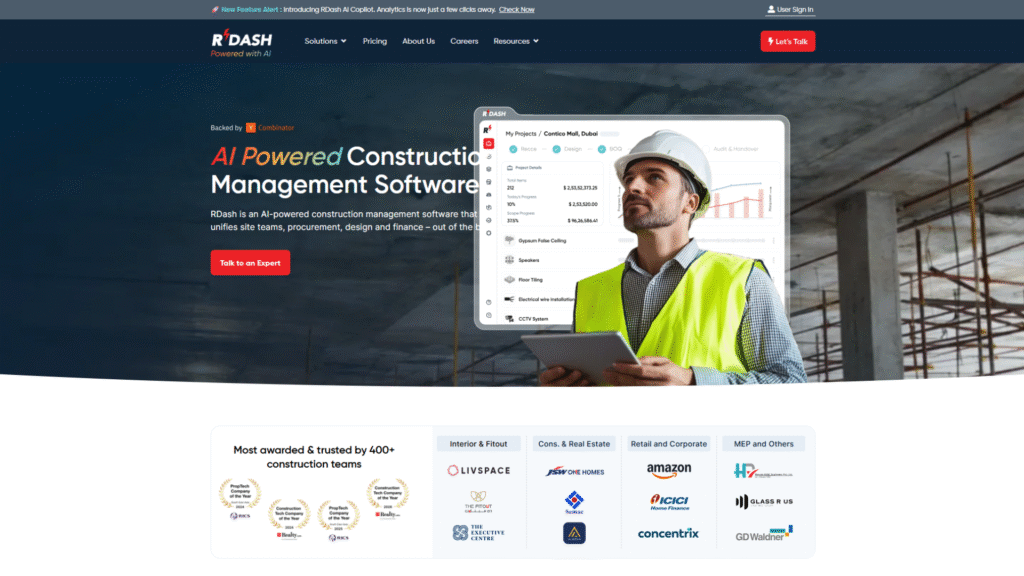
RDash is an artificial intelligence (AI) powered construction management platform that unifies site teams, procurement, design and finance in one system, built to replace the WhatsApp-plus-Excel-plus-Drive stack most construction teams are stuck with.
Founded in 2021 and headquartered in Gurugram, it was co-founded by Amit Bansal (Chief Executive Officer), Puneet Bansal (Chief Product Officer) and Amit Mishra (Chief Financial Officer). It is backed by Y Combinator, Stellaris Venture Partners and Zacua Ventures, and is now used by 400+ construction businesses across India and the United Arab Emirates (UAE), including ICICI Bank, JSW Homes, Danube and Simpliworks.
Why it maps to MEP specifically:
The MEP problem | The RDash module |
BOQ-versus-PO drift | BOQ and Change Orders linked directly to vendor orders |
35-plus vendor sprawl | Rate Contracts, Vendor Orders and Invoices with country-specific tax rules |
Material shrinkage | Material GRN and issuance at the site store |
Petty-cash bleed | Site expense capture via mobile app, under an approval hierarchy |
Unbilled installed work | Installed-progress tracking that measures the installed value of work |
Reporting overhead | Automated 360-degree Daily Progress Reports (DPRs), 50-plus ready-to-plug dashboards and an AI Co-pilot for prompt-based analytics |
The platform covers the full lifecycle: pre-sales and Customer Relationship Management (CRM), activity schedules with dependencies (importable from Microsoft Project or Primavera P6), design version control, BOQ and change orders, site surveys, snag management tagged to supplier orders, and handover.
It carries standard integrations with Tally, Zoho, SAP, Oracle and Microsoft Business Central, and most teams go live within days, with structured onboarding and a 90-day deployment window on Enterprise. Clients across India and the UAE report up to 10% cost reduction and up to 20% faster delivery, though these are company-reported figures rather than independently audited ones.
The honest caveats: RDash is a full construction platform, not a low-cost utility. It shines for firms running real BOQs, real vendor flows and multiple sites, and it is overkill for a two-person electrical outfit doing residential callouts. Its strongest gravity is India and the UAE; if you are a United States (US) mechanical contractor who lives inside QuickBooks and needs union payroll and prevailing-wage reporting, this is not your tool. And as with most field-first platforms, some power-user functions are richer on the desktop than on mobile.
Who it is for: MEP and HVAC contractors, Engineering, Procurement and Construction (EPC) firms, fit-out contractors, Project Management Consultants (PMCs) and developers running BOQ-led projects across India and the Gulf, with multiple vendors and multiple live sites.
2. Procore: Best for Large Commercial GCs and Enterprise MEP Subs

Procore is the category benchmark, and it earns that. It centralises drawings, Requests for Information (RFIs), submittals, daily logs, budgets, change orders and project communication in one cloud platform, integrates with more than 500 third-party applications, and reports over 3 million users worldwide. Its RFI and submittal workflows are genuinely best-in-class, which matters enormously if you are an MEP subcontractor on a large commercial job where the general contractor already runs Procore.
The caveats are significant for subs: Reviewers consistently flag a steep learning curve and opaque pricing: Procore quotes on Annual Construction Volume rather than publishing rates, so direct comparison is difficult without a sales call, and the model favours the general contractor. For firms with lower margins or smaller project scales, the annual premium may not justify the return. There is also a structural point: Procore is superb at documents and approvals, and thinner on the procurement-to-material-to-installed-value chain where an MEP contractor’s profit and loss actually lives. If your general contractor mandates Procore, use it, but do not assume it replaces your own cost-control system.
Who it is for: large commercial general contractors; MEP subs with USD 10 million-plus volume operating primarily on Procore-mandated projects; teams that need deep RFI, submittal and document control above all else.
3. Autodesk Construction Cloud / Autodesk Build: Best for BIM-Heavy Coordination

If your MEP work is model-driven, where clash detection, Revit coordination and shop-drawing fabrication are the centre of your workflow, Autodesk Build is the natural home, because your models already live in the Autodesk ecosystem. Clash detection during design is far cheaper than discovering a duct-versus-conduit conflict on site, where rework can delay a project by weeks, and widely cited industry estimates suggest Building Information Modelling (BIM) coordination returns several times its cost on complex projects.
The caveats: Autodesk Build’s financial and procurement depth is thinner than its design and field depth. It is not a BOQ-to-PO reconciliation engine, and it has no meaningful answer for Indian GST or RA billing. Most contractors who use it seriously run it alongside a cost-control system, not instead of one.
Who it is for: MEP contractors on BIM-mandated projects such as data centres, hospitals and large commercial towers, where model coordination is the primary risk.
4. Knowify: Best for Small US Trade Contractors Who Live in QuickBooks
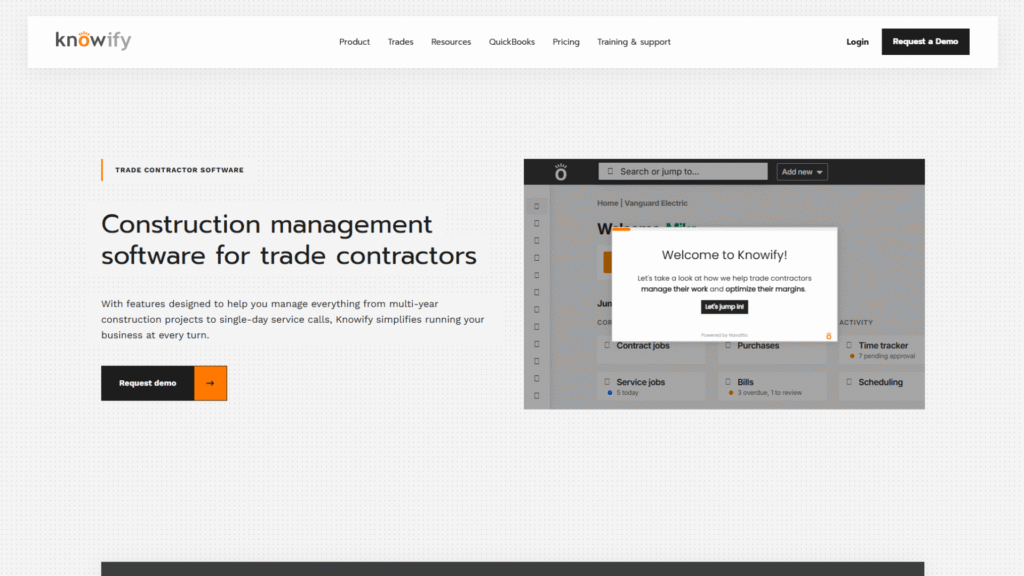
Knowify is purpose-built for trade contractors in electrical, HVAC, plumbing, roofing and remodelling, and its core strength is a deep two-way QuickBooks integration that connects estimates, job costing and invoicing without double entry. For a speciality sub doing USD 500,000 to USD 5 million annually who wants real-time gross-profit visibility per job, it is capable and inexpensive.
The caveats: It is a financial tool, not a scheduling or field tool. If you need Gantt charts, daily logs, plan markup or material issuance, Knowify will not cover them. Its per-user cost adds up quickly for growing teams, and it has no India compliance story.
Who it is for: small-to-mid US trade contractors whose primary pain is job costing, not site execution.
5. ServiceTitan: Best for HVAC, Plumbing and Electrical Firms with a Service Arm

ServiceTitan’s genuine differentiator is that it combines construction management and field-service management in one platform, a real advantage if a meaningful chunk of your revenue is annual maintenance contracts, callouts and reactive maintenance alongside project work. Its workflows are explicitly designed for speciality contractors working under general contractors.
The caveats: It is service-led by design. If your business is 90% new-build project execution with BOQs and RA bills, you will pay for dispatch and scheduling capability you do not use. It has a limited India presence.
Who it is for: HVAC, plumbing and electrical contractors with a substantial service and maintenance division.
6. Simpro: best for service-heavy trade businesses

Pricing: quote-based.
Simpro integrates estimating, scheduling, job costing, inventory and invoicing for trade contractors, with takeoff templates, prebuilt assemblies and supplier quote comparison on the pre-construction side. Its inventory management is a genuine strength for materials-heavy trades.
The caveats: Many contractors report outgrowing it as job and administrative complexity increases, particularly on financial visibility across multiple projects, which is precisely the MEP problem. It is stronger on the service side than on multi-site project financial control.
Who it is for: service-heavy trade businesses in fields like electrical, HVAC, plumbing and fire, where inventory and recurring maintenance carry as much weight as project work.
7. Contractor Foreman: best budget all-rounder
One of the cheapest tools on this list with legitimate project tracking, and broad feature coverage across daily logs, scheduling, estimates and time tracking.
The caveats: Its strength is breadth, not depth. It struggles with advanced workflows and detailed financial control, which is exactly what an MEP contractor needs most. It is a fine starting point and a poor destination, and because migration is expensive, a budget tool you outgrow within twelve months can cost more than skipping it.
Who it is for: small contractors and first-time adopters who want broad, low-cost project tracking and can live with limited financial depth.
8. Fieldwire and Bluebeam: best field companions, not replacements
Fieldwire is excellent for plan markup, punch lists and location-based field tasks, and Bluebeam remains the standard for drawing markup and takeoff.
The caveats: Neither is a project management system, and neither reconciles a BOQ. Both are worth running alongside whatever platform you pick, but if a vendor tells you Fieldwire replaces your cost control, they are selling you a hammer for a plumbing job.
Who it is for: any MEP contractor who wants best-in-class field markup and takeoff running alongside a dedicated cost-control platform, not in place of one.

RDash in Practice: An USD 850K HVAC Fit-Out, Fully Reconciled
Abstract frameworks are easy. Here is what the eight-point checklist looks like applied to a real MEP project.
HPV Elevate is a pan-India HVAC and MEP services provider, founded in 2007, that has executed over USD 230 million worth of projects with a team of 250-plus professionals. The project: an HVAC fit-out for HDFC Bank at Candour Tech Space, Kolkata, with a BOQ value of USD 850,000.
Three things that would have broken a spreadsheet:
- High-volume vendor fragmentation: The project engaged 35-plus different vendors rather than a single turnkey contractor. Managing communication, orders and ledgers across that many stakeholders creates a high risk of information asymmetry and duplicate payments.
- The BOQ-versus-PO reconciliation trap: A master BOQ with 170-plus distinct line items, a procurement value of USD 600,000-plus, and 125-plus purchase orders. Manually tracking which line item was ordered against which PO is nearly impossible, and it is exactly where projects bleed margin through over-ordering.
- Material inventory volatility: Roughly USD 40,000 of stock received on site. Without real-time consumption tracking, high-value HVAC components face theft, damage and misplacement, a direct hit to the bottom line.
What happened on RDash:
Control | Result |
Procurement reconciliation | 125-plus orders reconciled against the master BOQ, achieving 100% visibility on the USD 600,000-plus procurement spend, with no vendor paid for non-tendered items without a flagged approval |
Cash-flow discipline (three-way match) | USD 550,000 in invoices managed under a single approval flow, from PO creation to invoice acceptance |
Expense control | Roughly USD 42,000 in site expense requests processed, of which only about USD 20,000 was approved initially under the maker-checker hierarchy |
Site reality versus reported progress | 30-plus structured DPRs generated, giving a live daily view of stock levels and progress |
Look hard at the expense number. USD 42,000 requested, about USD 20,000 approved initially. That is not a software feature. That is roughly USD 22,000 of petty-cash bleed that a maker-checker rule flagged on a single project, where the entire margin might be USD 60,000 to USD 90,000.
Nirmal Mehta, Director at HPV Elevate, described the shift directly: the team is not just tracking work; it is controlling cash flow in real time. You can read the full HPV Elevate project case study for the details.
The pattern repeats on multi-trade projects. On MAIA Estates’ Belvedere Suites, a USD 600,000 high-rise development, the team coordinated 20-plus specialised users across roughly 180 scheduled activities and over 300 critical BOQ line items spanning structure and finishes, with the design team issuing 56-plus files and the procurement team processing 50-plus vendor orders, all under a single BOQ-linked system. The full MAIA Estates case study walks through how that coordination held together.
What It Costs: MEP Software Pricing in 2026
Nobody publishes a straight answer, so here is the honest landscape.
The pricing models
Per-user. You pay per seat. Knowify (roughly USD 99 to 149 per month) and Contractor Foreman (from roughly USD 49 per month for three users) sit here, as does Autodesk Build. It is simple to understand and scales with headcount, which can create an incentive to keep people off the system.
Volume-based (Annual Construction Volume). Procore. Pricing scales with your annual construction volume, users are unlimited, and the true number requires a sales call. A good year costs you more, and entry listings start near USD 10,000 per year, climbing as modules are added.
RDash: per-user, volume-tiered, with transparent Pro pricing. RDash publishes a clear Pro rate of USD 1,000 per user per year for organisations managing up to USD 25 million in annual project volume, with implementation and onboarding priced separately and unlimited storage under a fair-use policy. Its Enterprise plan is a custom quotation based on the number of users and construction volume, adding on-premise implementation support and a direct line to the RDash team. The practical advantage for an MEP contractor is not a headcount loophole; it is a published Pro price you can budget against without a sales call, a platform purpose-built for BOQ and procurement rather than retrofitted for it, and supplier and client logins that let you extend project access to third parties.
The hidden costs nobody quotes
- Implementation and data migration. Moving BOQ templates, vendor lists and project structures. Ask whether onboarding is included or billed separately.
- The switching tax. A meaningful share of firms end up switching platforms within a couple of years, and migration is neither free nor quick. A cheap tool you outgrow in twelve months is usually more expensive than the right one now.
- Shelfware. The most expensive software is software your site team never opens. This cost never appears on an invoice and always appears in your margin.
The ROI math that convinces a CFO
Do not argue features. Argue leaks. Take your last completed project and calculate four numbers.
- Over-ordering: total PO value minus total BOQ-sanctioned value.
- Unapproved expense: what got spent on site that nobody signed off in advance.
- Unbilled installed work: the gap between what you installed and what you invoiced last quarter.
- Material shrinkage: opening stock plus receipts, minus consumption, minus closing stock.
Add those four and compare them to a year of software. RDash clients across India and the UAE report up to 10% cost reduction, though again that is a company-reported figure, so model your own leaks before you believe anyone’s percentage, including ours.
The Market Context: Why This Decision Gets More Expensive Every Year
The MEP market is growing faster than the construction market it sits inside, which means more projects, more complexity and more competition for the same skilled labour.
Fortune Business Insights values the global MEP services market at USD 158.85 billion in 2025, growing to USD 169.83 billion in 2026 and USD 376.72 billion by 2034, a Compound Annual Growth Rate (CAGR) of 10.50%. Asia-Pacific already holds 42.90% of that market, and the electrical segment is among the fastest-growing, driven by renewables, electric-vehicle charging and building automation.
A note on forecast disagreement, because you should know: other research firms size the same market differently, with 2025 to 2026 estimates ranging from roughly USD 158 billion to USD 176 billion and projected CAGRs spanning the mid-single digits to low double digits. The direction is agreed; the magnitude is not. Treat any single forecast as an estimate, not a fact.
The one point every source agrees on is the constraint: a persistent shortage of skilled MEP labour. That shortage is not going away. The contractors who grow through it will be the ones who get more output from the team they already have, and that is an execution and information problem, not a hiring problem.
Implementation: The 30-Day MEP Rollout Plan
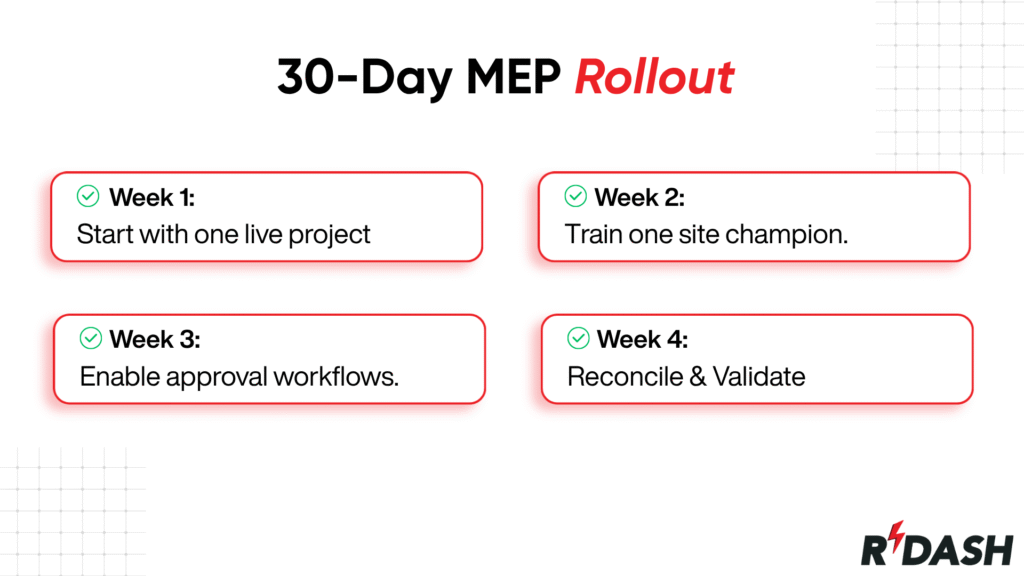
The most common reason construction software fails on Indian sites is not the software. It is adoption. Here is a rollout that works.
Week 1: pick one live site, not the whole business:
Do not roll out across twelve projects. Pick one live MEP project, mid-execution, with a real BOQ and a real vendor list. Migrate that BOQ, those vendors and that project structure. Nothing else.
Week 2: win one supervisor:
Identify the site engineer or supervisor most likely to become an internal champion, usually the one already frustrated by WhatsApp chaos rather than the most senior person. Train them properly. Let them log the DPRs and raise the purchase requests. Their opinion will decide this rollout, not the managing director’s.
Week 3: turn on the money controls:
Switch on the approval hierarchy and route every PO, invoice and site expense through maker-checker. Expect friction, and expect someone to complain that it is slower. It is slower, and that is the point. The roughly USD 22,000 of expense flagged on the HPV Elevate project is what “slower” buys you.
Week 4: reconcile and prove it:
Run the BOQ-versus-PO reconciliation for the month and the installed-value progress report. Show leadership the gap between what they thought was committed and what actually was. That single report is what gets you the budget to roll out across the rest of the portfolio.
Then scale. One non-negotiable holds throughout: if the site app is too complex, it will not be used. Test it on a real site engineer, on a real phone, on a real bad connection, before you sign anything. For a fuller treatment, see RDash’s practical guide to construction PM software for Indian builders and contractors.
Who Should Buy What
Buy RDash if:
- You run BOQ-led MEP, HVAC or fit-out projects in India or the Gulf.
- You have multiple vendors per project and multiple live sites.
- Your biggest leak is procurement reconciliation, site expense or installed-value billing.
- You need GST, RA billing and TDS handled natively, not worked around.
- You want a published Pro price you can budget against without a sales call.
Buy Procore or Autodesk Build if:
- You are a large commercial general contractor, or an MEP sub on Procore-mandated projects.
- RFIs, submittals and document control are your primary risk.
- Your work is BIM-heavy and model coordination is the centre of the job.
- You have the budget and the appetite for a multi-month implementation.
Buy Knowify, ServiceTitan or Simpro if:
- You are a US or Australian and New Zealand trade contractor with a service arm.
- QuickBooks job costing, or dispatch and scheduling, is your core need.
- Your projects are smaller and your admin, not your procurement, is the bottleneck.
Do not buy anything yet if:
- You cannot name your biggest leak. Software will not tell you where your margin goes; it will only measure it faster. Do the four-part leak calculation first.
- You have not got a site engineer’s buy-in. You are buying shelfware.
- You are one project and two people. Use a good spreadsheet and a disciplined WhatsApp group, and come back when you are running three sites.
The Verdict
The best project management software for an MEP contractor is not the one with the most features. It is the one that plugs your four leaks.
Every credible data point in this article converges on the same conclusion. MEP is 30 to 50% of the budget and a disproportionate share of the schedule risk. Bad data may have cost the industry an estimated USD 88.69 billion in rework in a single year. India’s most closely monitored infrastructure projects still overrun. And none of that is caused by a missing Gantt chart. It is caused by an inability to reconcile what was budgeted, what was ordered, what arrived, what got installed and what got billed.
On that criterion, RDash is our pick for MEP contractors in India and the Gulf: a purpose-built platform that links BOQ to purchase order to material receipt to installed value to invoice, under a maker-checker approval hierarchy, deployable in days. The HPV Elevate project (USD 850,000 BOQ, 35-plus vendors, 170-plus line items, 125-plus POs and 100% procurement visibility) is what that looks like when it works.
Procore remains the right answer for large commercial general contractors and subs on Procore-mandated jobs. Autodesk Build is right when the model is the project. Knowify is right for a small US sub who lives in QuickBooks. And a disciplined spreadsheet is still right for a two-person shop running one job.
Whatever you choose: calculate your leaks first, pilot on one live site, and let a site engineer veto the mobile app. Do those three things and the software decision mostly makes itself.
Want to see it on your own project? Book a free RDash demo and run it on one live site to see BOQs, costs, POs, approvals, site progress and vendor payments come together in a single view before you scale it across the rest of your portfolio. Or explore the full feature comparison.
Frequently Asked Questions
What is the best project management software for MEP contractors in 2026?
For MEP contractors in India and the Gulf, RDash, on the combined basis of BOQ-to-PO reconciliation, multi-vendor procurement, material GRN and issuance, maker-checker approvals, installed-value billing, native GST handling and fast deployment. Procore remains the standard for large commercial general contractors and enterprise subs on Procore-mandated projects. Knowify is the best fit for small US trade contractors who live in QuickBooks.
Why can’t MEP contractors just use Procore?
They can, and many do, because the general contractor mandates it. But Procore’s centre of gravity is document control, RFIs and submittals for the general contractor. Its procurement-to-material-to-installed-value chain, which is where an MEP subcontractor’s profit and loss actually lives, is thinner. Its pricing also scales with construction volume and is quoted rather than published, which prices out many small-to-midsize firms.
How much does MEP project management software cost?
It depends entirely on the pricing model. Budget tools like Contractor Foreman start around USD 49 per month; Knowify from roughly USD 99 to 149 per month; Procore from roughly USD 375 per month or around USD 10,000 per year, scaled to construction volume. RDash publishes a Pro rate of USD 1,000 per user per year for organisations up to USD 25 million in annual project volume, with a custom Enterprise quotation above that. Always confirm what is included before you commit.
What percentage of a construction project is MEP?
Typically 30 to 50% of total construction cost on commercial projects, and up to 55% on healthcare facilities, laboratories and data centres. Within the MEP scope itself, mechanical (HVAC) is usually the largest single category.
What is the single most important feature for an MEP contractor?
BOQ-to-purchase-order reconciliation. Every other feature is downstream of it. If you cannot tell, for any BOQ line, exactly what was ordered against it and how much budget remains, you will discover your over-ordering at final billing, when it is unrecoverable.
Does RDash handle GST and RA billing?
Yes. RDash is built for Indian and UAE compliance, with country-specific tax rules configurable on vendor orders and invoices, and standard integrations with accounting and ERP systems including Tally, Zoho, SAP and Oracle. This is a meaningful differentiator from international tools that typically require manual workarounds for Indian GST.
How long does implementation take?
Most RDash teams go live within days, with structured onboarding and dedicated support, and a 90-day deployment window on the Enterprise plan. Procore and Autodesk Build implementations more commonly run weeks to months. Whatever you choose, pilot on one live site before rolling out across the portfolio; this is the single strongest predictor of adoption.
Can MEP software actually reduce cost, or is that marketing?
Both, honestly, so look at the mechanism rather than the claim. On the HPV Elevate HVAC fit-out, an approval hierarchy flagged roughly USD 42,000 of expense requests and approved only about USD 20,000 initially, and BOQ-to-PO reconciliation delivered 100% visibility on USD 600,000-plus of procurement spend. RDash clients across India and the UAE report up to 10% cost reduction, though that is a company-reported figure and not independently audited. Model your own leaks before you believe anyone’s percentage, including ours.
Do I need BIM software as well?
If your projects are model-driven data centres, hospitals or large towers, yes, and Autodesk is the natural home for it. Clash detection during design is far cheaper than clash discovery on site, where MEP rework can delay a project by weeks. But BIM and cost control are different jobs, and most serious MEP contractors run both.
Is AI actually useful for MEP?
Increasingly, yes, but as a co-pilot rather than an autopilot. The realistic value today is in analytics and anomaly detection: asking which projects had cost variance above 5% last month and which vendors are linked to it, and getting a table back in seconds rather than stitching together WhatsApp threads on a Monday morning. RDash’s AI Co-pilot is built to flag margin leakages and time lags; the system flags the leak, and the project manager decides whether it is a data error, a real overrun or an acceptable variance. RDash’s 2026 guide to AI in construction management goes deeper.
Should I buy a cheap tool now and upgrade later?
Usually not. A meaningful share of firms switch platforms within their first couple of years, and data migration is expensive and disruptive. If you can see yourself outgrowing a budget tool within twelve months, the cheap option is the expensive one.
My site engineers won’t use software. What do I do?
This is the real question, and it is an adoption problem, not a software problem. Three things work: start with one site, not twelve; win one supervisor and let them become your internal champion; and treat onboarding as part of the product, leaning on the vendor’s implementation team to migrate your BOQ templates and vendor lists. And test the mobile app on a real site engineer before you buy. If it is too complex, nothing else matters.