


Key Takeaways
- Material that enters or leaves a site store without a GRN or an issue voucher becomes unaccounted stock that cannot be reconciled later.
- GRN verification is a three-way match of Purchase Order, delivery challan, and physical quantity received. Skip any one and disputes follow.
- Never issue material on a verbal request. A store issuing without an approved indent cannot explain its own consumption six months later.
- Wastage allowances differ by material and application, from about 2% for cement to over 10% for tiles; site figures far above them signal leakage.
- A bin card tracks physical quantity at the rack; a stock ledger tracks value and movement. A controlled store maintains both.
- Keep the requestor, the approver, and the issuer as three different people wherever staffing allows; it is the simplest fraud control.
- Digital GRN and issuance close the biggest weakness in manual stores: the lag between a physical stock movement and its record.
On most projects, the site store is treated as a shed with a lock on it. In reality, it is the last financial checkpoint before more than half the project budget either turns into finished work or quietly disappears.
Every bag, bundle, and box that enters or leaves that store should pass through one of two documented gates: a Goods Receipt Note (GRN) on the way in, and an issue voucher on the way out. When both gates hold, material accounts stay honest. When either one leaks, the loss surfaces months later as a variance nobody can explain.
This guide covers both gates end to end: the physical verification a GRN demands, the approved indent that must sit behind every issue, and the registers, roles, and wastage benchmarks that keep the loop closed.
Why The Site Store Is Where Projects Quietly Win Or Lose Money
Materials are one of the largest single levers on project profitability. On a typical build, material accounts for 50 to 60 per cent of total direct cost, which means the store controls the largest line on the budget.
The site store is the last point of control over that spend before material is either consumed productively or lost to waste, theft, and double ordering.
There is a second, less obvious reason it deserves attention: leakage here rarely happens as one dramatic event. It accumulates quietly, bag by bag, which is exactly why it is so hard to trace at final billing.
The scale of that quiet loss is well documented. The Association of Certified Fraud Examiners, in its 2026 Report to the Nations, estimates that organisations lose around 5 per cent of revenue to occupational fraud each year, and that asset misappropriation, the category that includes inventory theft, is by far the most common scheme. In construction specifically, the report records a median loss of USD 120,000 per case, with billing fraud, corruption, and payroll schemes being the most common, and it flags decentralised job sites and heavy subcontractor and vendor spending as the reasons purchasing and payment controls matter so much.
Notably, the same report finds that owners and executives cause a median loss of USD 475,000, roughly nine times the figure tied to staff-level employees, precisely because they have enough authority to bypass a control. That is the process argument, not an accusation against anyone: good controls catch honest error and deliberate misuse the same way.
The two processes that decide the outcome are the GRN and material issuance. Together they form a closed loop. Material comes in against a GRN, goes out against an issue voucher, and whatever remains should equal exactly what is on the shelf. This guide follows that loop: the receiving side first, then the issuing side, then the systems that keep it closed.
What Is A Goods Receipt Note (GRN)?
A Goods Receipt Note (GRN), also called a Goods Received Note, is the internal document a site store creates the moment material physically arrives from a supplier. It confirms what was actually delivered against what was ordered.
It is not the supplier’s invoice, and it is not the delivery challan. Those belong to the supplier. The GRN is the site’s own record, prepared and signed by site personnel, stating what was received, in what condition, on what date, and against which Purchase Order.
Why the GRN Is Your First Line of Defence
Remove the GRN and three problems appear at once. The accounts team loses any independent proof of what arrived and starts paying invoices on the supplier’s word. The site loses its defence when a delivery is short or damaged, because no timestamped record of the shortfall exists. And the inventory system stops reflecting reality, so the store manager works permanently from stale numbers.
The GRN closes all three gaps by sitting where physical reality meets paperwork. It is the document accounts teams rely on for three-way matching.
Three-way matching is an accounts payable check that cross-references the Purchase Order, the goods receipt, and the vendor invoice on quantity, price, and condition, so a business pays only for goods that were authorised, received, and correctly billed. Without the goods receipt in that trio, verification collapses into trust.
The failure mode is concrete. If a vendor invoices for 500 units but the goods receipt shows only 380 were delivered, three-way matching catches the gap before payment. Without it, the company pays for 120 units it never received.
What a GRN Must Contain
A usable GRN, on paper or in software, carries a set of non-negotiable fields:
- Purchase Order (PO) reference number, linking the delivery to the original order
- Supplier name and delivery challan number, for traceability and dispute resolution
- Item description, specification, and unit of measure, to catch specification mismatches early
- Quantity ordered versus quantity received, the core of the check
- Condition remarks, recording whether material was accepted, short, in excess, or damaged
- Date and time of receipt
- Signatures of the storekeeper who received the material and the site engineer who verified it
The Three Types of GRN a Site Store Will Encounter
|
GRN Type |
When It Is Used |
Key Risk if Skipped |
|
Full GRN |
The entire ordered quantity arrives in one shipment, matching the specification |
Overpayment if the quantity is not actually verified against the PO |
|
Partial GRN |
Only part of the order arrives; the balance is still pending |
The pending balance is forgotten, causing a shortage mid-work |
|
Rejection or Return GRN |
Goods arrive damaged, wrong-specification, or short, and are returned |
No paper trail for the rejected quantity, causing supplier disputes |
The GRN Process At A Site Store, Step By Step
The process is the same whether it runs on a clipboard or inside an app. Only the speed and error rate change. It moves through six checkpoints, and each is a decision point where a wrong call costs money later.
- Advance notice and gate entry: The storekeeper is alerted to the delivery through a dispatch note, a call, or a system alert. The vehicle is logged at the gate with vehicle number, driver, and challan number.
- Document matching before unloading: The delivery challan and invoice are checked against the Purchase Order before a single bag comes off the truck. A wrong-specification load rejected at the gate is far cheaper than one unloaded and mixed with existing stock.
- Physical verification: The team counts, weighs, or measures the material and inspects for damage. Steel is checked for diameter and grade, cement for bag weight and manufacturing date, tiles for batch number and breakage. The standard practice is to count against the packing list, cross-verify against the invoice, then move goods into storage.
- Recording discrepancies: Any shortage, excess, or damage is noted on the GRN itself, not on a separate slip. If ten cement bags arrive damp, that goes on the record now, not from memory three weeks later.
- GRN preparation and sign-off: Every required field is filled, and both the storekeeper and the receiving engineer sign. Where possible, the supplier’s delivery representative acknowledges a copy.
- Stock and ledger update: The accepted quantity is entered into the stock register or digital system the same day. A GRN that sits in a file without updating the ledger leaves the store’s official figure and its real figure at two different numbers.
Six GRN Mistakes That Quietly Cost Projects Money
Most stores bleed money through small repeated failures, not one big breakdown. Each of these is preventable at almost no cost:
- Accepting material without physical verification, signing on the invoice quantity alone rather than checking the delivery.
- Delayed GRN entry, where stock sits for days before it is logged, so the ledger and the yard never agree.
- No record of partial deliveries, where the pending balance is forgotten until the site runs short mid-work.
- One person doing everything, where the same individual receives, verifies, and approves, removing any independent check.
- Ignoring quality and batch data, skipping cement age, steel test certificates, or tile batch numbers until a quality dispute makes them matter.
- Paper GRNs that never reach accounts, where invoices are processed against unverified numbers before the document travels to the accounts department.
What Is Material Issuance, And Why It Is The Other Half Of The Story
If the GRN answers what came in, issuance answers what went out, to whom, for what work, and how much is left. It is the process by which the store releases material to a work team, a subcontractor, or another site, against a documented request rather than a verbal ask.
Issuance is easy to underestimate. A store’s stock figure is only as accurate as the discipline behind the exits.
GRNs are relatively easy to enforce because deliveries are infrequent and highly visible. Issuance happens dozens of times a day, often under pressure from a mason or gang leader who needs material now. That pressure is exactly why issuance is where most stores lose control.
The Document That Starts It All: The Indent or MRS
Every legitimate issue begins with a request, commonly called a Material Indent, a Material Requisition Slip (MRS), or a Stores Requisition. It is a formal, pre-emptive request from a site engineer or supervisor specifying what is needed, how much, and for which work item.
The governing principle, consistent across Enterprise Resource Planning (ERP) and inventory systems, is that no stock movement should happen without an approved request behind it. Casual verbal requests are precisely what turn a controlled store into an uncontrolled one.
The Material Issuance Process, Step by Step
- Raising the indent. The site engineer or supervisor specifies material, quantity, work location, and urgency on a physical slip or a system-generated request.
- Approval routing. The indent moves through an approval chain scaled to value and sensitivity. Routine items may need only the site engineer’s sign-off; a bulk steel release or restricted items such as chemicals and admixtures need a project manager’s approval. Most sites fix this as a delegation-of-authority matrix, so limits are set in advance, not negotiated case by case.
- Stock check by the storekeeper. Before issuing, the storekeeper confirms current stock can cover the request. If it cannot, the shortfall is flagged, and a fresh purchase requisition is raised, so the indent is not partially fulfilled and forgotten.
- Physical issue and dual sign-off. Material is picked and handed over. Both the storekeeper and the receiver, whether a mason, gang leader, or subcontractor, sign the issue voucher. That signature is the only proof that the material left the store and was received by someone accountable.
- Ledger and bin card update. The issued quantity is deducted from the stock ledger and the bin card the same day, not in a weekly batch.
- Reconciliation against work progress. Weekly, issued quantities for a work item are compared against what it should reasonably consume, based on the Bill of Quantities (BOQ). A wall that should have taken 500 bricks but consumed 650 is a signal to investigate now, not at final billing.
Handling the Edge Cases
Real sites rarely run in straight lines, so issuance needs rules for the exceptions:
- Over-issues to subcontractors. When a subcontractor is issued more than immediately needed for logistical reasons, track it separately so it is not mistaken for consumption.
- Store returns. Unused material coming back, such as leftover tiles or fittings, needs its own return voucher that updates stock upward.
- Loss or damage after issue. Once material leaves the store, responsibility shifts to the receiving team. Document that shift so accountability does not default back to the storekeeper.

Documents And Registers Every Site Store Must Maintain
A store does not run on GRNs and issue vouchers alone. A small set of supporting registers is what makes the system auditable months, or years, later.
|
Document |
Purpose |
Updated By |
Frequency |
|
GRN Register |
Log of every goods receipt with PO reference |
Storekeeper |
Every delivery |
|
Bin Card |
Physical quantity at each rack or location for one item |
Storekeeper |
Every movement, in or out |
|
Stock Ledger |
Value and quantity of all items, consolidated |
Storekeeper and Accounts |
Daily |
|
Material Indent or MRS |
Formal request for material before issue |
Site Engineer |
Every request |
|
Issue Voucher |
Record of material physically handed out |
Storekeeper |
Every issue |
|
Return Voucher |
Record of unused material coming back to store |
Storekeeper |
As needed |
|
Damage or Shortage Report |
Discrepancies found at receipt or during storage |
Storekeeper |
As needed |
Bin Card vs Stock Ledger: Why You Need Both
Keeping the bin card and the stock ledger separate is worth emphasising, because teams often assume one replaces the other.
The bin card is a physical-count document that sits at the material’s storage location. Anyone can walk up and tally what is on the rack against what the card says.
The stock ledger is a value-and-movement record, usually centralised, that accounts and management use for reporting. When the two disagree, that gap is exactly where a physical stock audit should start.
Inventory Control Methods That Keep The Loop Working
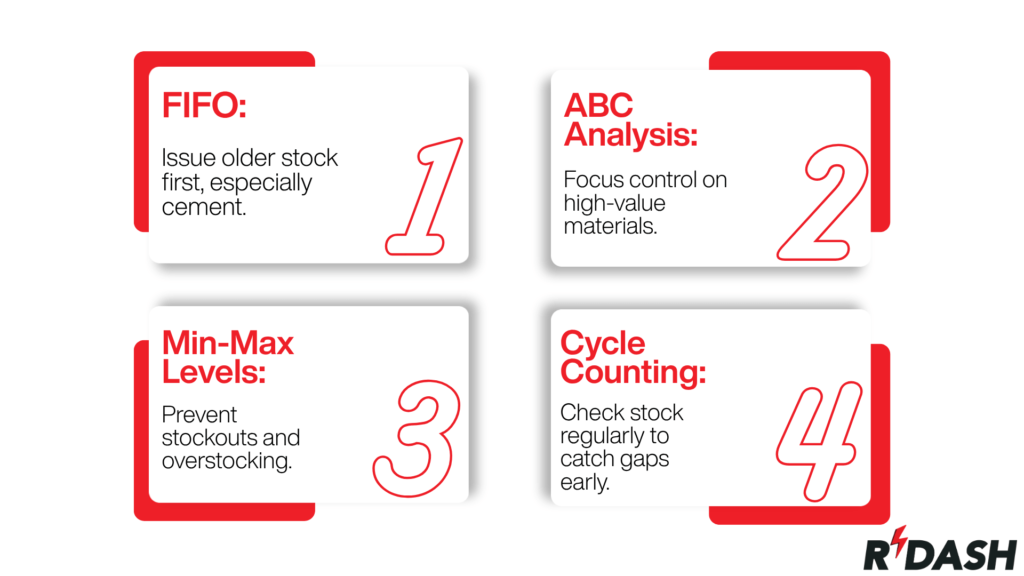
A GRN and an issue voucher tell you what happened on one day. Inventory control methods tell you whether the pattern across weeks is healthy.
First-In, First-Out (FIFO)
For materials that degrade with time, cement above all, issuing the oldest stock first is not optional. Cement is hygroscopic: it absorbs moisture from the air and begins to pre-hydrate, weakening before it is ever used.
Under general storage conditions, stored cement loses roughly 20 per cent of its strength after three months and 30 per cent after six, which is why cement older than three months should be tested before structural use. A FIFO discipline at issuance, backed by batch-date tracking on the GRN, keeps that risk contained.
ABC Analysis
Not every item deserves equal scrutiny. ABC analysis splits inventory into three bands:
- A-items: high-value, low-volume materials such as steel, electrical fittings, and sanitary ware, needing tight, near-daily control.
- B-items: moderate-value materials needing periodic checks.
- C-items: low-value, high-volume consumables such as nails and binding wire, where the cost of tight control outweighs the leakage risk.
The point is to stop a storekeeper spending equal energy on a box of screws and a truckload of Thermo-Mechanically Treated (TMT) bars.
Minimum-Maximum and Reorder Point Planning
Setting a minimum stock level per material, below which a reorder triggers automatically, prevents the two opposite failures of site stores: running out mid-work, and over-ordering so working capital sits idle under a tarpaulin.
Cycle Counting
Rather than waiting for an annual stock-take, cycle counts check a rotating subset of items each week. This catches discrepancies while they are small and traceable, instead of surfacing one large, unexplained gap once a year.
Wastage Benchmarks: The Numbers That Tell You Where You Stand

Better documentation stays abstract until it is tied to money. This is where wastage benchmarks earn their place.
One point up front, because it is widely misunderstood: India has no single national standard that fixes wastage percentages. Instead, allowances are embedded in the rate analysis of official schedule-of-rates documents such as the Central Public Works Department (CPWD) Delhi Schedule of Rates, and they vary by material, application, and site condition.
The useful figures are the standard allowances built into Indian rate analysis, drawn from CPWD DSR methodology and worked rate-analysis practice:
|
Material |
Standard Wastage Allowance |
Primary Cause |
|
Cement (OPC, PPC) |
2 to 5% |
Spillage during mixing, partial-bag rounding, leakage |
|
Reinforcement steel (TMT) |
2 to 5%, higher without cut-planning |
Cutting offcuts, lap and splice allowance, bend losses |
|
River sand and M-Sand |
8 to 12% |
Bulk-to-loose volume difference, moisture, spillage |
|
Bricks |
5 to 8% |
Breakage in transport, half-brick cuts in coursing |
|
Tiles (vitrified, ceramic) |
5 to 8% straight-lay; 15 to 25% diagonal |
Edge cuts, breakage, lay-pattern waste |
Two things stand out. First, the same material has a well-managed end and a poorly managed end of its range, and the gap between them is a function of control, not chemistry. Steel cut to a bar bending schedule wastes far less than site-cut steel, and diagonal tile layouts can double straight-lay wastage.
Second, the dominant causes are management-related, which is the whole point of this guide. A widely cited quantification study of construction sites found that cutting waste and management waste were the two leading causes across materials, and that management waste specifically can be avoided through adequate supervision and proper organisation of site activities.
How Reconciliation Catches Leakage: A Worked Example
Benchmarks only work when you reconcile against them. Take a brickwork item with a BOQ quantity of 500 bricks, carrying a standard 5 to 8 per cent wastage allowance, so expected consumption is roughly 525 to 540 bricks.
If the issue vouchers for that item total 650 bricks, actual wastage is running near 30 per cent, four to six times the allowance. That is not a rounding difference; it is a signal.
The value of catching it at weekly reconciliation, rather than at final billing, is that the causes are still visible. You can check whether the extra bricks went to breakage, to an over-issue that was never returned, or to an unrecorded transfer, while the people involved still remember. Left until the end, that same 125-brick gap becomes an unexplained line no one can close.
Roles And Responsibilities In The GRN-To-Issuance Cycle
Clarity about who does what makes a process stick more than the paperwork itself.
|
Role |
GRN Responsibility |
Issuance Responsibility |
|
Storekeeper |
Physical verification, GRN preparation, stock update |
Stock check, physical issue, ledger update |
|
Site Engineer or Supervisor |
Verifies technical specifications on receipt |
Raises indent, signs as requestor |
|
Project Manager |
Approves high-value or unusual receipts |
Approves high-value or restricted issues |
|
Accounts Team |
Matches GRN with invoice for payment |
Uses issuance data for cost tracking and billing |
|
Supplier Representative |
Acknowledges delivery and any discrepancy |
Not applicable |
The structural rule worth adopting from internal-control practice: the person who requests material, the person who approves the request, and the person who issues it should be three different people wherever site size allows.
When requesting, approving, and issuing sit with different people, it becomes far harder for error or misuse to slip through, because the separation creates natural checks. Where a small site genuinely cannot separate every function, a compensating control such as a documented supervisory review has to stand in for the missing separation. This is not bureaucracy for its own sake; it is the simplest defence against both honest error and deliberate misuse.
How Digital Tools Change GRN and Issuance

For decades, the receiving-to-issuance loop ran on carbon-copy slips, site registers, and a great deal of trust. That trust was not always misplaced, but it did not scale. A project with three sites and forty active work fronts cannot rely on one storekeeper’s memory and a stack of vouchers to stay accurate.
This is the gap construction platforms have moved to close. When a GRN is created on a connected system, it is not a slip in a file. It updates the central stock ledger instantly, flows into vendor-payment approvals, and becomes visible to the project manager without anyone carrying paper to head office.
The same holds for issuance. A digital indent-to-issue workflow carries an audit trail by default: who requested, who approved, who issued, and exactly when. That is the separation-of-duties principle enforced automatically, which manual stores struggle to sustain. The broader shift is away from stores that reconcile once a month, toward stores where the ledger and the yard agree every day.
For teams weighing the change, the useful question is not whether you need software. It is how many days currently pass between a physical stock movement and its appearance in your records. If the honest answer is more than a day, that lag is where money is already leaking.
This is the problem RDash’s material management module is built for, letting site teams run GRNs, issuance, consumption, and transfers inside the same system that handles procurement and finance, with site purchase requests and a configurable approval hierarchy that hold the separation of duties in place by design. For the wider context, RDash’s guide to construction material management is a useful companion read.
Best-Practice Checklist For A Site Store In Control
Whether your store runs on paper or software, hold it to this baseline:
- Check every delivery against the Purchase Order and delivery challan before accepting it.
- Never sign a GRN without physically counting, weighing, or measuring the material.
- Record discrepancies on the GRN itself, at the time of receipt.
- Update the stock ledger and bin card the same day for every receipt and issue.
- Require an approved indent for every issue; never release material on a verbal request.
- Separate the requestor, the approver, and the issuer wherever staffing allows.
- Apply FIFO for perishable or degradable materials such as cement.
- Run ABC analysis so tight control lands on high-value items, not consumables.
- Reconcile issued quantities against BOQ-based expected consumption weekly.
- Run rolling cycle counts instead of waiting for an annual stock-take.
The Bottom Line
The GRN and the issue voucher are two halves of one sentence: material came in, and material went out. Get both halves right, and the store stops being a black box. It becomes a single source of truth that procurement, finance, and site engineering can all trust at the same time.
If you do one thing after reading this, measure your own lag. Pick any material that moved on site this week and find the date it physically moved, then the date it hit your records. The size of that gap is the size of your exposure, and closing it, on paper or in software, is where control begins.
Frequently Asked Questions
What is the difference between a GRN and a delivery challan?
A delivery challan is issued by the supplier when goods are dispatched, listing what is being sent. A GRN is created by the receiving site after goods arrive and are verified. It is the buyer’s own confirmation of what was received, not the seller’s claim of what was sent.
Is a GRN legally required, or is it just best practice?
There is no single law mandating a GRN, but most organisations treat it as a mandatory internal control. Accounts teams rely on a valid goods receipt as part of standard three-way matching against the Purchase Order and invoice, so in practice no GRN usually means no payment.
What should happen if a delivery arrives short or damaged?
Record the shortage or damage on the GRN at the time of receipt, not later from memory. Inform the supplier immediately so the discrepancy is resolved before the invoice is processed. This protects the site from paying for material it never received in usable condition.
Can material be issued from the site store without an approved indent?
It should not be. Structured inventory control depends on the principle that no stock movement happens without an approved request behind it. Issuing on a verbal ask removes the audit trail needed to explain consumption later, and is one of the most common sources of unaccounted loss.
What is the difference between a bin card and a stock ledger?
A bin card tracks the physical quantity of a single item at its storage location, updated with every movement. A stock ledger is a broader, centralised record covering quantity and value across all items. When the two do not match, it signals a discrepancy worth investigating through a physical count.
How often should a site store reconcile its stock?
Update the ledger and bin card daily for every receipt and issue. Beyond that, reconcile issued quantities against expected BOQ-based consumption weekly, and run rolling cycle counts of a rotating subset of items to catch discrepancies while they are small.
What is FIFO and why does it matter for construction materials?
FIFO, First-In, First-Out, means issuing the oldest received stock before newer stock. It matters most for materials that degrade in storage, cement above all. Stored cement loses roughly 20 per cent of its strength after three months, so tracking batch dates on the GRN is what makes FIFO enforceable.
What is ABC analysis in a site store?
ABC analysis categorises inventory by value and volume. A-items are high-value, low-volume materials needing tight control. B-items need moderate oversight. C-items are low-value, high-volume consumables needing only light-touch tracking. It stops a storekeeper from spending equal effort on steel bundles and a box of screws.
How much material wastage is normal on a construction site?
It varies by material and application. Standard Indian rate-analysis allowances run around 2 to 5 per cent for cement, 8 to 12 per cent for sand, and 2 to 5 per cent for reinforcement steel, with tiles higher on diagonal layouts. Wastage well above these ranges usually signals weak verification or uncontrolled issuance.
How does digital software improve GRN and issuance versus paper?
Digital platforms update the central stock ledger the moment a GRN or issue voucher is recorded, instead of waiting for slips to reach an office. This closes the lag between what happens on site and what the records show, while enforcing separation of duties and keeping a full audit trail of every transaction.