

Key Takeaways
- RFQ has two meanings in construction: Request for Qualifications and Request for Quotation. Read the submission instructions, not the acronym.
- A Request for Qualifications precedes the RFP. A Request for Quotation follows it, once scope is frozen, and only price remains open.
- A quotation usually isn’t a binding offer. Under US federal rules, FAR 13.004 is explicit: a quotation cannot be accepted by the Government to form a contract; the purchase order is the offer. Private contracts turn on their own terms, which is exactly why validity periods and PO acknowledgement matter.
- Price is banned from the qualifications stage. FAR 36.303-1 prohibits cost factors in Phase One of design-build selection.
- Prequalification is not shortlisting. One establishes standing across projects; the other narrows the field on one specific project.
- Shortlist three to five firms. Federal rules cap Phase Two at five without documented justification; more firms means thinner proposals.
- India runs the same logic under other names: EOI, PQ envelope, two-bid system, governed by GFR 2017 Rules 163, 164 and 183–186.
- Procurement decides the margin. McKinsey puts it at 40–70% of a construction firm’s total spend.
RFQ vs RFP: The Direct AnswerA Request for Qualifications (RFQ) asks who is capable of doing this work. A Request for Proposal (RFP) asks how you would do it, and at what price. The RFQ comes first and produces a shortlist. The RFP goes only to that shortlist and produces a winner. A Request for Quotation, confusingly also abbreviated RFQ, is a third document entirely: it comes after scope is frozen and asks for nothing but price. The 10-second test: if the document forbids pricing, it’s a Request for Qualifications. If it wants only pricing, it’s a Request for Quotation. If it wants approach and price, it’s an RFP. |
A document lands in your inbox marked “RFQ.” Before you assign anyone to it, answer a question that sounds trivial and isn’t: which RFQ is this?
In construction, RFQ is two different documents wearing the same three letters.
One is a Request for Qualifications: no pricing, submitted before bidding opens, and it decides whether you’re even allowed to compete. The other is a Request for Quotation: pure pricing, against a scope somebody else already fixed.
They sit on opposite sides of the RFP in the procurement timeline. Answer one as though it were the other, and you either spend a week pricing work you were never eligible to win, or you send a capability deck to a buyer who wanted a rate for 400 tonnes of TMT bar.
Most guides on this topic pick one meaning, ignore the other, and produce a tidy three-column table that collapses the moment you’re holding a real tender document. This guide covers both plus the thing that actually costs money: what your response legally becomes the second you submit it.
What Is an RFQ in Construction?
An RFQ is a solicitation document that means one of two things depending on context: a Request for Qualifications, which screens firms for capability before bidding, or a Request for Quotation, which collects prices against a fixed specification.
Both usages are formally defined in real regulatory frameworks. Neither is wrong. That’s precisely why the confusion persists.
What is a Request for Qualifications?
A Request for Qualifications is the first phase of a two-phase selection process. It asks firms to prove capability and explicitly bars them from quoting a price.
The US Federal Highway Administration defines it in regulation. An RFQ is “the document issued by the owner in Phase I of the two-phased selection process.” It “typically describes the project in enough detail to let potential offerors determine if they wish to compete and forms the basis for requesting qualifications submissions from which the most highly qualified offerors can be identified” (23 CFR 636.103).
You respond with a Statement of Qualifications (SOQ): team structure, comparable projects, named key personnel, financial capacity, safety record, licences. The owner scores it and publishes a shortlist.
Typical uses: design-build projects, PPP concessions, architect and engineer appointments, PMC selection, large fit-out packages where the owner doesn’t yet know the credible field.
What is a Request for Quotation?
A Request for Quotation asks suppliers to price a specification the buyer has already written. Quantities, delivery dates, taxes, payment terms.
The World Bank uses this meaning in its Procurement Framework, where Request for Quotations is one selection method and Prequalification and Initial Selection are entirely separate documents. A useful reminder that the qualifications step doesn’t always carry the RFQ label.
Typical uses: cement, steel, tiles, electrical fittings, subcontract packages with a settled BOQ, change-order pricing.
How to tell which RFQ you’ve received
Signal | Request for Qualifications | Request for Quotation |
Pricing | Explicitly prohibited | The entire point |
You submit | Statement of Qualifications (SOQ) | Priced schedule or rate sheet |
What follows | A shortlist, then an RFP | A purchase order or work order |
Evaluation basis | Experience, capacity, personnel, past performance | Price, delivery, commercial terms |
Typical value | Large or complex projects | Defined packages and commodities |
Who issues it | Owner, PMC, government agency | Contractor, developer, procurement team |
Prep time | Days | Hours |
If the cover page says “do not include cost information in your submission,” you are holding a Request for Qualifications. That one line settles it faster than any glossary.
What Is an RFP in Construction?
A Request for Proposal asks shortlisted firms to submit both a technical solution and a price, then awards on best value rather than lowest cost alone.
An RFP assumes the owner already knows who is credible. What remains open is how the work should be done and what it should cost.
A construction RFP typically carries the design criteria, drawings, specifications and BOQ, the evaluation methodology and weightings, the contract form and risk allocation, and the programme with milestones and liquidated damages.
Responses run to a hundred pages or more and take weeks to prepare. That effort cost is exactly why the qualifications stage exists; you don’t ask twelve firms to do that work when only three can realistically deliver.
RFQ vs RFP: The Complete Comparison
Assuming RFQ means Request for Qualifications, the comparison most people are searching for:
Request for Qualifications (RFQ) | Request for Proposal (RFP) | |
Core question | Who is capable of delivering this? | How would you deliver it, and for how much? |
Stage | Phase 1: before offers are solicited | Phase 2: after shortlisting |
Contains price? | No | Yes, with technical approach |
You submit | Statement of Qualifications | Technical proposal + commercial proposal |
Typical length | 20–50 pages | 100+ pages, plus drawings and schedules |
Effort to prepare | Days | Weeks, sometimes months |
Outcome | Shortlist of most highly qualified firms | Contract award |
Legal weight of response | Not an offer; establishes eligibility only | An offer capable of acceptance |
Sent to | The open market | Shortlisted firms only |
Evaluation | Pass/fail thresholds plus scored criteria | Best value weighted technical and price |
Compensation for losers | None | Sometimes a stipend |
The second-to-last row is the one that changes commercial outcomes. It’s also the row nearly every competing article omits.
Which Comes First, RFQ or RFP?
A Request for Qualifications always comes before the RFP. A Request for Quotation always comes after it. That’s the whole source of the confusion: both carry the RFQ label, and they sit at opposite ends of the process.
The standard sequence:
- RFI (Request for Information): market scan. What solutions and vendors exist? No commitment either way.
- RFQ (Request for Qualifications) / EOI: who is allowed to compete? Produces a shortlist.
- RFP (Request for Proposal) — how, and how much? Goes only to the shortlist. Produces an award.
- RFQ (Request for Quotation) / ITB / Tender — price against a frozen scope. Produces a PO.
The four questions test
Every solicitation document answers exactly one question. Name the question, and you’ve named the document.
The question you need answered | The document you should issue |
What exists in the market? | RFI |
Who is allowed to compete? | Request for Qualifications / EOI / prequalification |
How would you solve this, and at what price? | RFP |
What’s your price for this exact scope? | Request for Quotation / ITB / tender |
If your draft asks for two of these at once, it’s a badly written document, and it will return responses you cannot compare fairly.
Is an RFQ Legally Binding? The Difference That Costs Money
No, and in most framings, neither is a quotation. US federal procurement is explicit on the point: under FAR 13.004, a quotation is not an offer and cannot be accepted by the Government to form a binding contract. The purchase order is the offer; the contract forms when the supplier accepts it in writing, by delivering, or by performing substantially. A proposal or bid, by contrast, is an offer, and acceptance creates a contract.
FAR is a US federal rule, not a global one, and it does not govern a private developer buying steel in Mumbai or Dubai. But the commercial logic travels, because the same question arises everywhere: does this document, on its own terms, commit the supplier to a price, or does it merely invite you to place an order? On most quotations, it is the latter. Treat the answer as something you fix in writing rather than something you inherit by default.
This is the single most under-reported difference between these documents, and it has direct commercial consequences.
The binding ladder
Rung | What you submit | Legal status |
0 | Response to an RFI | Not an offer. Cannot be accepted to form a contract (23 CFR 636.115(d)) |
1 | Statement of Qualifications | Not an offer. Earns eligibility only |
2 | Quotation | Not an offer. The buyer’s purchase order is the offer; the contract forms when you accept it (FAR 13.004) |
3 | Proposal or bid | An offer. Buyer’s acceptance forms a binding contract |
Rung 2 surprises most people. The federal rule is explicit: a quotation is not an offer, so issuing a purchase order in response “does not establish a contract.” The PO is itself the offer. A contract only exists once the supplier accepts it in writing, by delivering, or by performing substantially.
What this means on a live project. A supplier who quotes you a steel rate and walks away before acknowledging your PO has not, in that framing, breached a contract. There wasn’t one yet.
If you’re a developer or main contractor relying on a “quote” to hold a rate across a three-month procurement window, you’re relying on something weaker than you think. The fix isn’t chasing more quotes; it’s rate contracts with defined validity periods and documented PO acknowledgement.
The reverse error costs just as much. Ask for “quotations” when you intend to bind the bidder to their number, and you’ve engineered ambiguity into the most price-sensitive moment of the project.
Why Is Price Excluded From The Qualifications Stage?
Because you cannot meaningfully price a solution before deciding what the solution is. In several frameworks, this isn’t convention; it’s a rule.
Under US federal two-phase design-build procedures, Phase One evaluation factors cover technical approach and technical qualifications but expressly exclude “cost or price related factors, which are not permitted in Phase One” (FAR 36.303-1). Price appears only in Phase Two, where technical and price proposals are evaluated separately.
For architecture and engineering services, the exclusion is statutory. The Brooks Act requires federal agencies to negotiate A/E contracts “on the basis of demonstrated competence and qualification for the type of professional services required and at fair and reasonable prices” (40 U.S.C. 1101).
The mechanism is strict. The agency evaluates statements of qualifications, holds discussions with at least three firms, and ranks at least three in order of preference (40 U.S.C. 1103). It then negotiates a fee with the top-ranked firm only. If that negotiation fails, the agency must formally terminate it before approaching the next firm (40 U.S.C. 1104); it cannot shop the first firm’s number.
The logic travels well beyond government work. Ask a design-builder for a number while the design is still an idea and you get one of two things: a padded contingency, or a lowball that becomes a variation claim in month seven.
How many firms should you shortlist?
Three to five. FHWA design-build rules put it plainly: “Normally, three to five firms are shortlisted” (23 CFR 636.207). Federal acquisition rules set the same ceiling: the maximum number invited to submit Phase Two proposals must not exceed five unless the contracting officer determines a larger number is in the Government’s interest (FAR 36.303-1(a)(4)). Defence procurement tightens this further: for DoD contracts valued above $5.5 million, exceeding five requires approval from the head of the contracting activity, delegable no lower than the senior contracting official (DFARS 236.303-1(a)(4)).
The reasoning is economic, not bureaucratic. Shortlist eight firms and each one’s win probability drops to roughly 12%. Effort drops with it. You receive eight thin proposals instead of three serious ones, and you’ve made the process worse while appearing more competitive.
Should you pay a stipend?
If you’re asking shortlisted firms for real design work, someone is paying for it either way.
FHWA rules recommend stipends on large projects with substantial innovation opportunity, sized to cover “usually one-third to one-half of the estimated proposal development cost.” The stated purposes: encourage competition, compensate unsuccessful offerors, and ensure smaller firms aren’t priced out of participating (23 CFR 636.113).
Private developers in India rarely offer stipends. That’s a legitimate choice with a predictable consequence: the quality of unpaid design effort you receive is a direct function of how credible your shortlist and award timeline look to the bidder.
Prequalification Vs Shortlisting Vs Technical Qualification
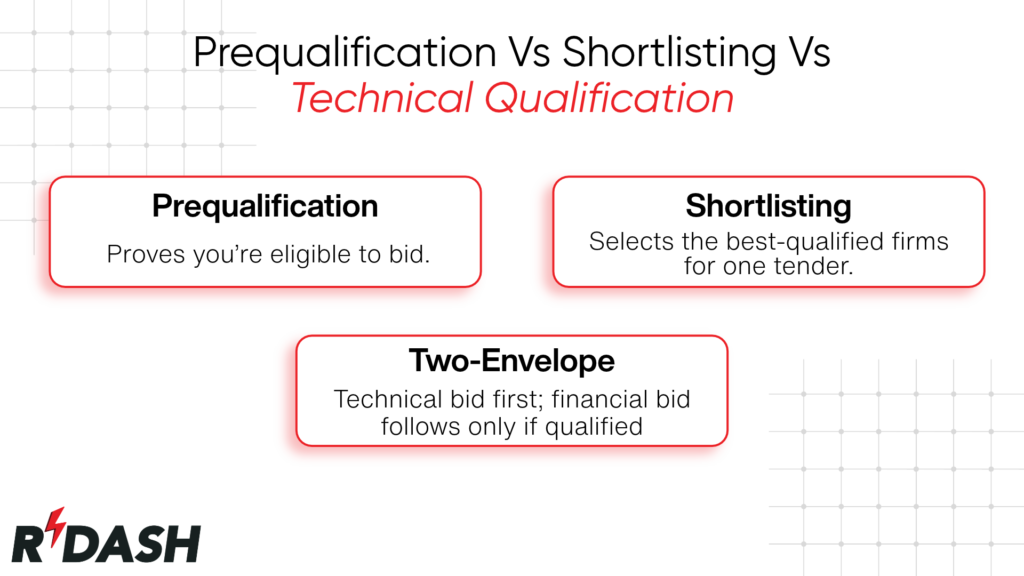
These are three different things, and confusing them is why firms assume a status they don’t have.
1. Prequalification:
A determination that a firm is fundamentally qualified to compete for a certain project or class of projects, based on financial, management, and other data. Its standing. It travels across tenders.
2. Shortlisting:
Narrowing the field on one specific procurement to the most qualified firms that responded to that RFQ.
The regulation states the distinction flatly: “Prequalification should be distinguished from shortlisting” (23 CFR 636.103).
3. Technical qualification inside a two-envelope tender:
A single bid submitted in two sealed parts. The technical envelope opens first; only technically qualified bidders have their financial envelope opened. There’s no separate RFQ document at all; the qualification step is embedded in the tender.
Prequalification | Shortlisting | Technical qualification | |
Scope | Class of projects | One project | One tender |
Duration | Ongoing/periodic renewal | Single procurement | Single bid opening |
Separate document? | Yes (registration/empanelment) | Yes (RFQ or EOI) | No inside the tender |
Result | Eligible to be invited | Invited to submit an RFP | Financial envelope opened |
Being on a developer’s approved vendor list does not mean you made the shortlist for their Bandra tower. Clearing the technical envelope on a CPWD tender is a third thing again. Firms lose work by assuming these are the same status.
RFQ vs RFP in Indian Construction: EOI, PQ, NIT and the Two-Bid System
India uses the same two-step logic: qualify first, price second, but almost nothing keeps the same name. If you work on Indian projects, this translation layer matters more than the American vocabulary.
Global term | Indian equivalent | Governing reference |
Request for Qualifications | Expression of Interest (EOI); PQ notice | GFR 2017, Rules 183–184 |
Shortlist | Shortlist of consultants | GFR 2017, Rule 184 |
RFP | RFP, issued only to shortlisted parties | GFR 2017, Rule 186 |
ITB / tender | Notice Inviting Tender (NIT) | CPWD Works Manual, State PWD rules |
Two-envelope tender | Two-bid system | GFR 2017, Rule 163 |
Two-stage procurement | Two-stage bidding | GFR 2017, Rule 164 |
Lowest evaluated bidder | L1 | Standard tender practice |
Rule 163 vs Rule 164: a distinction people routinely blur
Two provisions in the General Financial Rules 2017 sound similar and aren’t:
- Rule 163: two-bid system. Technical and financial bids are submitted simultaneously in separate sealed covers. The financial cover stays sealed until technical evaluation finishes.
- Rule 164: two-stage bidding. Financial bids aren’t submitted at all in stage one. Stage one gathers technical input used where detailed specifications cannot be written without bidder input, or where the bidder must carry out its own survey and risk assessment.
Rule 164 is the closest Indian statutory cousin to the RFQ-then-RFP structure, and it’s deliberately narrow. You cannot invoke it simply because a shortlist would be convenient.
The consultancy route is a two-step process in everything but name
For consultancy engagements, the sequence is explicit: an EOI is published above the prescribed threshold, responses are shortlisted under Rule 184, and the RFP goes only to shortlisted consultants under Rule 186. Rule 184 also sets a floor: the number of shortlisted consultants should not be fewer than three. The Department of Expenditure’s Manual for Procurement of Consultancy & Other Services devotes a full chapter to the shortlisting stage, including its risks.
What private developers and fit-out firms should take from this
None of the GFR is binding on private work. The structure is still worth borrowing.
Most Indian private-sector procurement already runs a compressed version: informal empanelment (prequalification), a limited invite list (shortlisting), then a BOQ-based tender (priced offer). Naming those steps properly is what makes them defensible when a director asks why a particular vendor got the work.
The stakes aren’t abstract. MoSPI monitors every central sector infrastructure project worth ₹150 crore and above through its PAIMANA platform, and publishes the numbers monthly. In the flash report for July 2026, released on 25 August 2026, 1,775 ongoing projects across 17 central ministries and departments carried a revised cost of ₹37.11 lakh crore against an original sanctioned cost of ₹33.70 lakh crore, a cumulative cost overrun of roughly ₹3.40 lakh crore.
Read the series carefully rather than as a trend line. The monitored set changes every month as projects are commissioned and new ones onboarded, so month-on-month totals are not directly comparable. What is stable is the gap: original cost and final cost diverge, at scale, consistently.
Land acquisition and clearances drive much of that. But selecting a contractor who could not deliver is a failure that begins at the qualification stage and surfaces two years later.
Which Document Should You Issue? A Two-Uncertainty Framework
Skip the flowcharts. Ask what you’re genuinely uncertain about: the who or the how.
You know WHO can do it | You don’t know WHO can do it | |
You know WHAT you want | RFQ → RFP. Price is the only variable. | Issue an RFQ (Qualifications), then a tender to the shortlist. |
You don’t know HOW it should be done | Issue an RFP directly to a known field. | Run the full two-step: RFQ →RFP. |
Two rules keep this honest.
Don’t run a two-step process to look rigorous. It adds four to eight weeks. Federal guidance treats two-phase selection as appropriate when three or more offers are anticipated, when design work must be performed before pricing is possible, and when offerors will incur substantial expense preparing offers (FAR 36.301(b)). Fail all three tests and your shortlist is ceremonial.
Don’t collapse to one step to save time when the field is unknown. Invite twelve unvetted firms to price a complex fit-out, and you’ll spend the time you saved normalising twelve incomparable submissions and still be guessing about the two cheapest.
What To Include In Each Document
Request for Qualifications checklist
- Project description with enough detail for a firm to decide whether to compete
- Specific scope of services sought (design, construction, CM, MEP, PMC)
- Mandatory pass/fail criteria: licences, registrations, turnover thresholds, insurance, statutory compliance
- Scored criteria with published weightings and the maximum shortlist size
- Required SOQ format, page limits, and named key personnel
- An explicit instruction excluding pricing. The RFP process that will follow, including any stipend
- Conflict-of-interest disclosure requirements
That last item isn’t boilerplate. Federal design-build rules generally bar consultants who helped prepare the RFP from bidding on it, with narrow exceptions (23 CFR 636.116). Any owner using a PMC to write the tender should apply the same discipline.
RFP checklist
- Full technical scope, design criteria, drawings, specifications and BOQ where applicable
- Evaluation methodology with weightings: technical versus price, and how trade-offs will be made
- Contract form and risk allocation, stated up front rather than negotiated post-award
- Programme, milestones, liquidated damages and payment terms
- Submission format for technical and commercial parts, separately sealed
- Clarification and pre-bid meeting procedure
Publish the weightings. An RFP that says “best value will be determined at the owner’s discretion” invites padded pricing, a challenge, or both.
Request for Quotation checklist
- Precise specification, make/brand acceptability, quantities with units
- Delivery location, schedule, and whether partial supply is acceptable
- Applicable taxes, freight and unloading responsibility
- Validity period for the quoted rate, the single most-omitted field
- Payment terms and retention
- Acknowledgement requirement, so PO acceptance is documented
Five Mistakes That Turn A Two-Step Process Into A One-Step Mess
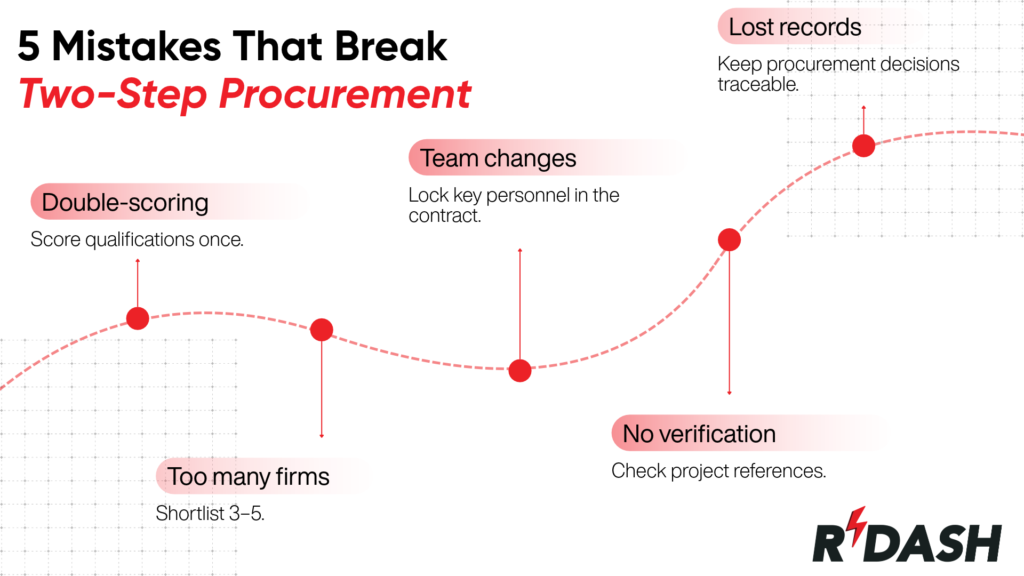
- Scoring the same thing twice:
If team experience is worth 40 points in the RFQ and 30 points in the RFP, you’ve double-counted qualifications and diluted the technical approach you shortlisted people to hear about. Score qualifications once. - Shortlisting eight firms:
Every additional firm reduces each one’s expected return on proposal effort. Three to five is where serious effort lives. - Letting the team change after award:
Firms win on named personnel and lose nothing when those people are quietly reassigned. FHWA rules discourage team switching after award where qualifications were a major selection factor (23 CFR 636.118). Write the named-personnel commitment into the contract with a substitution approval clause. - Never verifying the claim:
A firm claims five comparable projects in its SOQ. Nobody calls a single reference. The claim was the entire basis of eligibility, and it was never tested. - Losing the thread between award and purchase order:
Shortlist logic lives in one folder, the BOQ in a spreadsheet, the PO in an accounting system. Six months on, nobody can reconstruct why this vendor at this rate.
How To Respond As A Contractor: RFQ Vs RFP
Against a Request for Qualifications, relevance beats volume.
The evaluator has a scoring sheet with named criteria. Three genuinely comparable projects same building type, same scale, same city, same delivery model outscore fifteen assorted references.
Name the people who will actually be on site, because substituting them later becomes a contract issue. And if a mandatory criterion is a hard fail, don’t submit. You’re spending days to be disqualified on page two.
Against an RFP, the technical narrative differentiates, not the price.
Price is one weighted factor, and you rarely win on it alone. What separates proposals is a credible sequencing plan, honest identification of the two or three risks that could derail the programme, and a specific answer to whatever the owner is most anxious about, usually schedule certainty or interface management.
Reference the drawings and BOQ line items directly. Generic methodology sections read as filler because they are.
Against a Request for Quotation, precision and validity are everything.
State the rate validity period explicitly. Quote against the specification given, and list any deviation separately rather than burying it; an unflagged substitution discovered at GRN stage costs you the relationship.
And remember the binding ladder: your quote isn’t binding until you acknowledge the PO. Acknowledge it in writing before you commit inventory.
Why The RFQ-to-RFP Process Breaks Down After Award
The documents are the easy part. The failure is downstream: the qualification decision and the commercial record live in different systems, and nobody reconciles them.
Here’s the pattern, and it’s boringly consistent.
A developer shortlists four contractors on qualifications. The RFP goes out. One wins on a technical proposal promising a specific site team and a specific sequencing approach. The contract is signed.
Then procurement raises POs against a BOQ that’s been revised twice since tender. The promised site team never fully arrives. Variations accumulate against line items nobody can trace to the original priced scope. At final account, client and contractor are arguing about what was actually bought.
None of that is a document problem. It’s a continuity problem, and it’s where construction bid and procurement management quietly decides margin. McKinsey’s 2023 research puts procurement at 40 to 70 per cent of a construction company’s total spending, based on a survey of 101 construction CPOs. Firms with best-in-class procurement practices, it found, sometimes run margins five to ten percentage points above procurement laggards.
Three fixes apply regardless of what software you use:
- Keep the qualification record with the vendor, permanently. Licences, turnover, comparable projects, references, expiry dates re-verified annually, not rebuilt from scratch every tender.
- Make the priced scope the single source of truth. Every PO should trace to a BOQ line item, and every approved variation should update the baseline rather than living in an email thread.
- Keep an audit trail from shortlist to final account. Who was shortlisted, on what criteria, who won, on what basis, and what actually got ordered against it.
Firms running several live projects at once feel this hardest. MEP packages in particular, where a single project can carry a hundred-plus purchase orders against a BOQ that keeps moving.
How RDash keeps qualification connected to the purchase order

This section describes our platform. The rest of this guide is deliberately vendor-neutral, because the principles hold whatever tool you use.
RDash is an AI-powered construction management platform built for contractors, PMCs, developers, design studios and fit-out firms. Founded in 2021 and headquartered in Gurugram, it’s backed by Y Combinator, Stellaris Venture Partners and Zacua Ventures, and is used by 400+ construction businesses across India and the UAE.
Mapped to the three fixes above:
The problem | What RDash does |
Vendor qualification data scattered across drives and inboxes | Vendor records, documents and rate contracts held in one place, with expiry and renewal reminders |
Quotes and bids that don’t convert cleanly into orders | RFPs, purchase orders, GRNs and invoices run in one flow with defined approval hierarchies and full audit trails |
POs that drift from the priced scope | Procurement tied to the BOQ, so what gets ordered maps back to what was estimated and approved |
Variations that arrive undocumented | Scope-change approval workflows with automated change documentation and a full change history per line item |
Vendors and clients updating you over WhatsApp | Third-party logins so suppliers and clients update documentation and give approvals directly in the system |
For teams currently running procurement across spreadsheets and chat groups, that continuity is the entire point. AI-assisted analytics then surface cost variances against the baseline while there’s still time to act, rather than at final account.
Conclusion
The RFQ/RFP distinction gets taught as vocabulary. It isn’t. It’s a decision about what you’re willing to be uncertain about, and for how long.
A Request for Qualifications resolves uncertainty about who. An RFP resolves uncertainty about how and how much. A Request for Quotation is what you issue when both are settled, and only the number is open.
Every solicitation document is an admission of a specific gap in your knowledge. Issue the wrong one, and you’ve admitted to the wrong gap, then spent six weeks getting answers to a question you didn’t need answered.
Your next step is smaller than it sounds. Before drafting anything, write down the one question you need answered:
- “Who can do this?” → Request for Qualifications
- “How would you approach this?” → RFP
- “What will this cost?” → Request for Quotation
If you can’t reduce it to one question, your scope isn’t ready, and no document will rescue it.
Then make the answer survive. A shortlist nobody references at award, a proposal commitment that evaporates at mobilisation, a quoted rate nobody can locate when the invoice arrives these are the same failure at three different stages. The document was fine. The memory wasn’t

Frequently Asked Questions
Does RFQ mean Request for Quotation or Request for Qualifications?
Both, depending on context. In design-build, public works and consultant selection, RFQ almost always means Request for Qualifications. In materials and subcontractor buying, it means Request for Quotation. Check whether the document permits pricing; that settles it.
Which comes first, RFQ or RFP?
A Request for Qualifications comes before the RFP and produces the shortlist that receives it. A Request for Quotation comes after the RFP, once scope is fixed and only price remains open.
Can you skip the RFQ and go straight to an RFP?
Yes, and it’s often correct. Go direct when you already know the credible field, the scope is well defined, and proposal effort is modest. Use a two-step process when proposal preparation is expensive, and the bidder field is genuinely uncertain.
Is an RFQ legally binding?
Neither type binds the buyer to award. On the response side, a Statement of Qualifications creates no contractual obligation. For quotations, US federal rules are explicit: under FAR 13.004, a quotation is not an offer; the purchase order is the offer, and the contract forms when the supplier accepts it. Outside US federal procurement, whether a quotation binds depends on its own terms and the governing law, which is why stated validity periods and documented PO acknowledgement matter more than the label on the document.
What is the difference between an RFQ and an RFI?
An RFI explores what the market can do, with no commitment either way. A Request for Qualifications is a formal screening step that produces a shortlist with real consequences for who may bid.
What is a Statement of Qualifications?
The document you submit in response to a Request for Qualifications: firm profile, comparable projects, named key personnel, financial capacity, safety and compliance record, and organisational structure, with no pricing.
What is the Indian equivalent of a Request for Qualifications?
Usually an Expression of Interest (EOI) or a prequalification notice. Under GFR 2017 Rules 183–184, an EOI is published, responses are shortlisted, and the RFP goes only to shortlisted parties.
Is prequalification the same as shortlisting?
No. Prequalification establishes that a firm is fundamentally qualified for a class of projects; shortlisting narrows the field for one specific procurement. 23 CFR 636.103 explicitly distinguishes them.
Why can’t price be included in the qualifications stage?
Because you cannot price a solution that hasn’t been defined. US federal design-build rules prohibit cost factors in Phase One, and the Brooks Act requires A/E firms to be selected on competence before the fee is negotiated.
How many firms should be shortlisted from an RFQ?
Three to five. Federal rules cap Phase Two at five without documented justification. Beyond that, each firm’s win probability drops, and proposal quality drops with it.
What software manages the RFQ and RFP process in construction?
Look for tools that connect vendor qualification records to bids, purchase orders and the BOQ rather than treating tendering as a standalone step. Platforms such as RDash link RFPs, rate contracts, POs, and GRNs to the priced scope with approval hierarchies and audit trails.