
Key Takeaways
- Design-Bid-Build vs Design-Build comes down to contracts: Design-Bid-Build uses two separate owner contracts and a sequential process; Design-Build uses one entity, one contract.
- Design-Build’s edge is speed, not unit price: 102% faster delivery and 3.8% less cost growth, yet just 0.3% cheaper per square foot (CII/Pankow, 2018).
- Design-Bid-Build gives maximum design control and a built-in independent check: a separate designer reviews the builder’s work with no commercial stake.
- Design-Build provides one accountable entity for both phases, removing the gap where a separate designer and contractor otherwise assign blame when problems arise.
- Single-point accountability is a contract term, not an operational guarantee: it holds only if the entity’s design, procurement, and site teams share information.
- Scope certainty decides the choice: fixed scope favours Design-Bid-Build’s competitive bid; evolving scope favours Design-Build’s integrated, fast-tracked delivery.
- Neither method wins universally: some public work still requires Design-Bid-Build, while hybrids like Progressive Design-Build and Construction Manager at Risk bridge the gap.
- Public work no longer means Design-Bid-Build by default: in India, MoRTH, Railways and CPWD award many major works in EPC mode.
Every construction project starts with a decision made before the first drawing or budget line: how to contract the work. On a good project, that choice stays invisible. On a bad one, it resurfaces months later as a delay nobody will own, a change order two parties fight over, or a designer and contractor pointing at each other across a gap the owner is left standing in.
That decision is Design-Bid-Build (DBB) versus Design-Build (DB), the two dominant construction delivery methods. Most comparisons reduce it to speed and leave you with a pros and cons list. The real question is sharper: who carries which risk, and where the seam between design and construction sits. Speed, cost, and control all follow from that single structural choice.
This guide treats the choice the way an experienced owner’s representative would. Work out what can go wrong on your specific project, decide who is best placed to absorb that risk, then match a method to the answer. You will get clear definitions, verified research, a risk-allocation breakdown, and a six-lever framework you can apply to a live project today.
Design-Bid-Build vs Design-Build: The Short Answer
Design-Bid-Build and Design-Build are the two dominant construction project delivery methods, and they differ in how design and construction responsibility is contracted. In Design-Bid-Build, the owner hires a designer to complete the drawings first, then puts that finished design out to competitive bid among contractors, producing two separate contracts and a strictly sequential process. In Design-Build, the owner hires a single entity to handle both design and construction under one contract, which lets the two phases overlap and compresses the schedule.
Choose Design-Bid-Build when you need maximum control over a finished design before committing to a price, when an independent design check matters, or when public procurement rules require competitive bidding. Choose Design-Build when speed, a single point of accountability, and a lighter administrative load matter more than holding a fully separate design review over the builder.
What a Delivery Method Actually Decides: Risk and Coordination
Before comparing features, it helps to see what a delivery method actually decides. Two things, mainly.
First, it allocates risk: A construction project carries design risk (the drawings are wrong or incomplete), cost risk (the work costs more than planned), schedule risk (it finishes late), and coordination risk (design, procurement, and site fall out of sync). A delivery method is, at heart, a rulebook for who owns each of these when they go wrong.
Second, it decides where the design-to-construction seam sits: Every project has a handover point where design intent becomes something a crew can build. In Design-Bid-Build, that seam runs between two separate companies with two separate contracts, and the owner stands in the gap. In Design-Build, the seam moves inside one company.
This is the single most important thing to understand about the two methods, and the part most comparisons skip. Design-Build does not delete the seam. It relocates it. Whether that relocation helps depends entirely on how well the single entity coordinates its own people.
Hold these two ideas, risk allocation and seam location, and the rest of the comparison stops being a list to memorise and becomes a decision you can reason about.
What Is Design-Bid-Build?
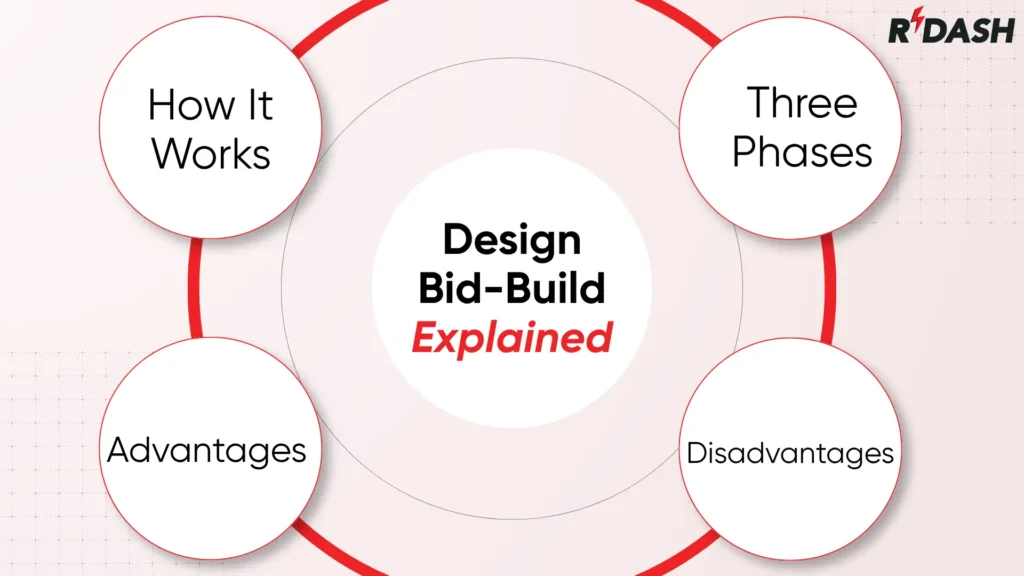
How Design-Bid-Build Works
Design-Bid-Build, abbreviated DBB, is the traditional and longest-established delivery method, and its name is its process. The owner first hires an architect or engineer to produce a complete set of construction documents. Only once that design is finished does it go out to competitive bid, with multiple contractors pricing the same drawings. The owner selects a contractor, often the lowest responsive bid, though not always, and construction begins under a second, separate contract.
That structure creates two distinct contractual relationships: owner to designer, and owner to contractor, with the owner coordinating between them. The designer usually stays involved through construction, reviewing the contractor’s work for compliance, answering requests for information, and certifying payments. That ongoing review is a built-in, independent check that the integrated models do not naturally include.
The Three Phases of Design-Bid-Build
Design-Bid-Build runs as three separate stages:
- Design: The designer takes the project from concept to a complete, biddable document set. Nothing downstream can start until this finishes.
- Bid: The finished documents go to market. Contractors submit questions and priced proposals within a set window, and the owner evaluates and selects.
- Build: Construction begins, with the original designer retained in a reduced oversight role.
The handover looks clean on paper. In practice, the contractor has no voice during design, so buildability problems often surface only once work starts, when they cost the most to fix. Whether design intent survives that handover is a known failure point, and the same challenge runs through Design Development vs Construction Documents.
Advantages of Design-Bid-Build
- Hard-cost competition: Multiple contractors pricing one finished, identical scope puts real downward pressure on construction cost. When the scope is fully defined, this is the method most likely to surface the lowest hard price.
- A genuine independent check: The reviewing designer has no financial incentive to overlook a shortcut, unlike a design-builder reviewing its own work.
- The traditional route for public work: Transparent competitive bidding and independent oversight are built into many procurement rules, which is why Design-Bid-Build is still common, and sometimes required, for government buildings, schools and publicly funded infrastructure.
- A mature, well-understood framework: Decades as the industry standard mean settled contract forms, dispute processes, and insurance products, which reduce legal ambiguity.
Disadvantages of Design-Bid-Build
- No early collaboration: Designer and contractor rarely work together until construction starts, so buildability issues and design gaps tend to appear mid-build as change orders rather than quick conversations.
- The timeline stacks end to end: Design, then bid, then build, in strict sequence, is the structural reason Design-Bid-Build runs longer than a comparable Design-Build project.
- Slower changes: A change after the contractor is on site usually has to move across two contracts, often requiring the designer to formally revise drawings before the contractor can price and act.
- The owner absorbs the coordination burden: Two contracts and two parties who may disagree leave the owner, or an owner’s representative, mediating who is responsible for what.
What Is Design-Build?
How Design-Build Works
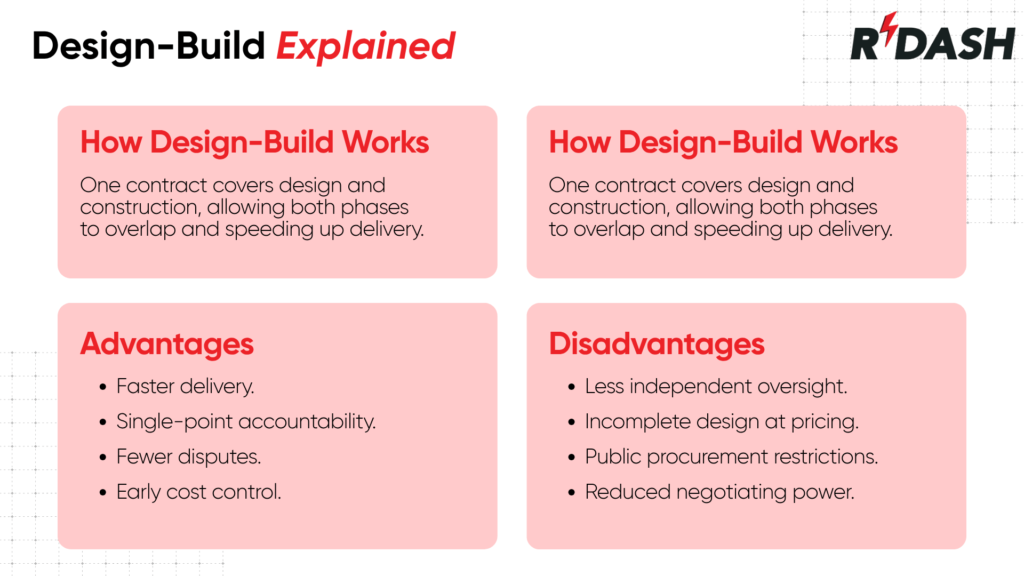
Design-Build, abbreviated DB, consolidates design and construction into one contract with one entity: a design-build firm, a contractor with an in-house design team, or a formal joint venture between a design firm and a builder. The owner selects that entity relatively early, usually on qualifications, experience, and proposed approach rather than a finished design, and the entity then owns both the drawings and the built outcome.
Because design and construction sit inside one organisation, the phases can overlap. Work on an early, approved package such as foundations or structural frame can begin while later packages such as finishes or landscaping are still being designed. This overlap, often called fast-tracking, is difficult to do safely across Design-Bid-Build’s two contracts but is a natural fit for Design-Build’s single structure, and it is the main mechanical reason Design-Build compresses the schedule.
How Design-Build Teams Are Selected
Design-Build selection is typically qualifications-based or best-value rather than low-bid. Owners issue a request for qualifications (RFQ) or request for proposals (RFP) that describes goals and constraints rather than complete drawings. Teams respond with their approach, relevant experience, key personnel, and often a preliminary or guaranteed maximum price (GMP) based on incomplete design. This front-loads judgement and trust into selection, which is one reason some public agencies remain cautious about Design-Build even where it is permitted.
Advantages of Design-Build
- Measurable speed: This is Design-Build’s strongest, best-evidenced claim, and the numbers are specific. According to Revisiting Project Delivery Performance, research by the Construction Industry Institute (CII) and the Charles Pankow Foundation published by the Design-Build Institute of America (DBIA), Design-Build projects are delivered 102% faster than Design-Bid-Build from design through completion, and 36% faster during the construction phase alone. The overlap of phases removes the dead time that a strictly sequential process builds in.
- One accountable entity: If something goes wrong, there is no question of whether the designer or the contractor is at fault, which simplifies claims and warranty considerably.
- Fewer internal disputes: Both design and construction share one commercial interest in the project succeeding, which reduces the finger-pointing that a separate designer and builder can fall into.
- Earlier cost and buildability input: Because the builder is involved from the start, estimating and constructability feed design decisions as they are made rather than after the fact, often producing a guaranteed maximum price earlier than a finished-design bid allows.
Disadvantages of Design-Build
- No automatic independent check: You lose the built-in oversight of an unaffiliated designer reviewing the builder, which puts more weight on your own due diligence, contract terms, and often a separate owner’s representative or commissioning agent.
- Less design certainty before you commit: The entity is usually chosen before the design is final, so you cannot competitively shop a complete scope, and early pricing rests on an incomplete picture.
- Possible friction with public procurement: Competitive-bid rules in many jurisdictions were written around Design-Bid-Build, which can restrict Design-Build on public projects or require special authorisation.
- Bargaining power shifts after signing: Once the single contract is signed, you have less room to renegotiate design detail than in Design-Bid-Build, where the design is locked before any construction commitment.
Design-Bid-Build vs Design-Build: Full Comparison Table
Dimension | Design-Bid-Build (DBB) | Design-Build (DB) |
Number of contracts | Two (owner-designer, owner-contractor) | One (owner to a single entity) |
Sequence | Strictly sequential: design, then bid, then build | Overlapping: construction can start before design is complete |
Point of responsibility | Split between designer and contractor | Single entity accountable for both |
Typical schedule | Slower; the full sequence stacks end to end | Faster; 36% quicker in construction, 102% faster overall in CII/Pankow data |
Owner’s design control | High; design finalised before pricing is locked | Lower; entity often selected before design is final |
Independent design oversight | Built in, via a separate reviewing designer | Not structural; owner must add it deliberately |
Competitive bidding | Standard, often legally required for public work | Less common; selection usually on qualifications |
Cost predictability | High at bid when scope is fully defined, but more exposed to change-order growth once construction starts | Set earlier with less design certainty; averaged 3.8% less cost growth than DBB in CII/Pankow data |
Hard-cost competition | Strong; multiple bids on identical documents | Weaker; single entity priced on approach |
Dispute risk | Higher, due to the designer and contractor split | Lower, single point of accountability |
Change-order handling | Slower; changes negotiated across two contracts | Faster; changes resolved within one contract |
Best suited to | Public projects, highly customised design, maximum owner control | Private, time-sensitive, repeatable projects wanting a lighter admin load |
Is Design-Build Faster and Cheaper Than Design-Bid-Build?
Design-Build is no longer a fringe alternative. FMI’s 2021 utilisation study for DBIA forecasts that it would account for 47% of US construction spending in the assessed segments by 2025, up from 42% in 2021. DBIA now describes some form of Design-Build as used on nearly half of US design and construction projects.
The figure repeated most often online is that Design-Build is “about 30% faster.” The real evidence is both stronger on schedule and more honest on cost.
The seminal benchmark came from the 1998 study by Konchar and Sanvido, published in the American Society of Civil Engineers’ Journal of Construction Engineering and Management, which compared delivery systems across 351 United States building projects. It found Design-Build delivered projects roughly 33% faster overall and 12% faster in construction than Design-Bid-Build, with about 6% lower unit cost.
Two decades later, the Construction Industry Institute (CII) and the Charles Pankow Foundation revisited the question. Their 2018 Revisiting Project Delivery Performance study, released by DBIA and covering 212 US projects, found the schedule gap had actually widened: Design-Build came in 36% faster during construction and 102% faster from design through completion, with schedule growth 1.7% lower than Design-Bid-Build.

The cost finding deserves attention, because it contradicts a common claim. In the 2018 data, Design-Build cost only 0.3% less per square foot than Design-Bid-Build, essentially level. Where Design-Build did pull ahead was cost growth: its projects averaged 3.8% less cost growth than Design-Bid-Build, so final costs stayed closer to the contracted price.
The honest reading is that Design-Build’s advantage is about time and cost certainty, not unit price. On hard cost against a fully defined scope, competitive Design-Bid-Build bidding can match or beat it. Where Design-Build saves money, the saving usually comes from a shorter schedule, earlier occupancy, and lower administrative overhead, not a lower price per square foot. If a vendor calls Design-Build simply “cheaper,” ask which cost they mean.
Two caveats keep this accurate. These are United States datasets, so the percentages are benchmarks, not guarantees for any single project, and not direct readings of Indian, Middle Eastern, or European markets. “Delivery speed” is also a normalised rate measure, not a promise that your building finishes in half the calendar time. As directional evidence, though, the finding has held for more than twenty years: Design-Build is consistently the faster method.
Risk Allocation: Who Carries What in Each Method
The clearest way to choose is to ask, for each major risk, who is best placed to absorb it on your project, and which method puts it there. This is where the decision is really made.
Risk | Under Design-Bid-Build | Under Design-Build |
Design errors and omissions | Sits with the designer; the owner may absorb the gap between a design flaw and a construction claim | Sits with the single entity; no gap for the owner to fall into |
Cost overrun from design gaps | Often lands on the owner through change orders once construction exposes the gap | Largely held by the design-builder, especially under a guaranteed maximum price |
Schedule slippage | Shared and diffuse; sequential phases give slippage room to compound | Concentrated in one accountable party with a commercial reason to protect the programme |
Coordination between design and site | Owner carries it, standing between two contracts | Contractually the entity’s, but only real if its internal teams are genuinely integrated |
Buildability problems | Surface late, as formal changes, because the builder had no design-stage voice | Surface early, because the builder shapes the design |
Loss of independent oversight | Low risk; independent review is built in | Higher; the owner must deliberately add an owner’s representative or commissioning agent |
Read down the Design-Build column and the pattern is clear: it concentrates most project risk in one entity. That is a genuine advantage when the entity is capable and the contract is sound, and a genuine exposure when it is not, because you have fewer independent parties checking the work. Read down the Design-Bid-Build column, and you see the opposite: risk is distributed and independently checked, but the owner inherits the coordination burden that sits between the pieces.
How to Choose: A Six-Lever Framework
Rather than a vague “it depends,” weigh these six levers. Where most point to one method, you have your answer. Where they split, a hybrid is usually the real solution.
- How certain is the scope? A fully defined and stable scope rewards Design-Bid-Build’s competitive bid. Scope that will evolve as the design develops rewards Design-Build’s integrated, fast-tracked model. This is the single most predictive lever.
- How much does speed matter? If the programme cannot absorb a strictly sequential design-then-bid-then-build timeline, overlapping phases are the specific mechanism that buys the time back, and the research backs this up more strongly than any other claim.
- Public or private? Public work usually comes with procurement rules, so check which methods your agency allows. In the US, some agencies still require competitive bidding on a finished design, though DBIA reports that only two states now limit agencies’ use of Design-Build. In India, MoRTH, Indian Railways and CPWD award many large works in EPC mode, while smaller public works typically still run on item-rate tenders. Private owners have a free choice.
- How much independent oversight do you need? Highly technical, unusual, or landmark projects benefit from a separate designer checking the builder. Well-understood, repeatable project types need it less.
- What is your in-house capability? If you can comfortably run two contracts and mediate between a designer and a contractor, you can capture Design-Bid-Build’s cost advantages. If you want a single accountable partner and a lighter load, Design-Build fits better.
- How likely are changes? Frequent changes are painful across two contracts and far smoother within one, so a change-heavy project leans Design-Build, while a locked, change-averse project leans Design-Bid-Build.
A quick rule of thumb: when scope is fixed, and oversight or public rules dominate, choose Design-Bid-Build; when speed and single-point accountability dominate, and scope will move, choose Design-Build; when those pull against each other, look hard at a hybrid.
Hybrid Delivery Methods: CMAR, Progressive Design-Build, IPD and EPC
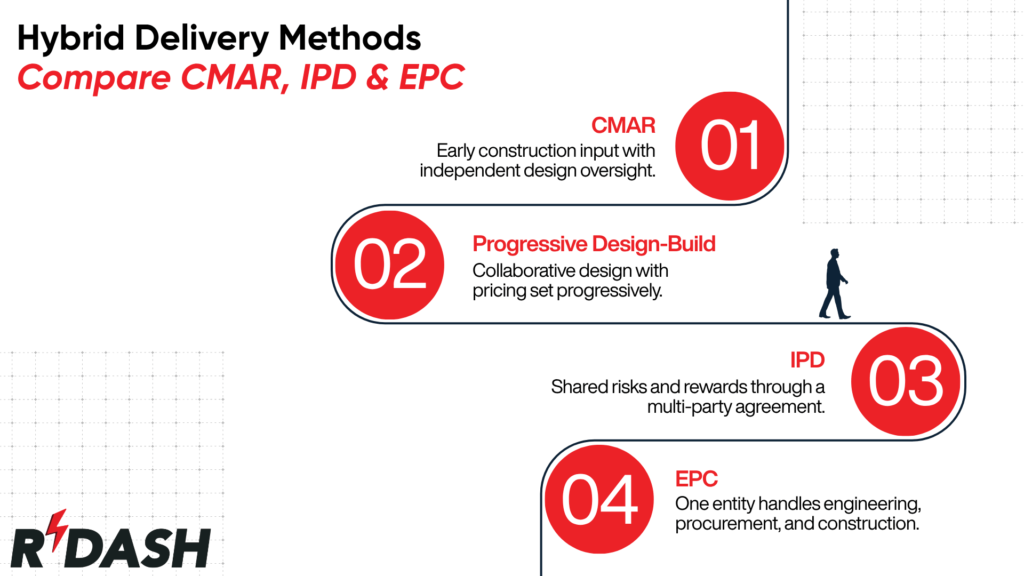
Design-Bid-Build and Design-Build are the poles, not the only options. Several methods exist specifically to borrow the strengths of one while covering the weakness of the other.
Construction Manager at Risk (CMAR) brings a construction manager in during design to give cost and buildability input, while staying financially at risk for the final cost and schedule. The owner still holds separate contracts with the designer and the construction manager, so independent design oversight is largely preserved. That early involvement narrows the buildability gap that causes so many Design-Bid-Build change orders. It is a strong middle path for owners who want collaboration without giving up the independent design check.
Progressive Design-Build deserves more attention than it usually gets, because it answers the most common objection to Design-Build. The owner selects a design-builder early, on qualifications. The team then develops the design openly with the owner, and the price is set progressively as the design matures. It usually lands on a guaranteed maximum price once the design is firm enough to price with confidence. In effect, it keeps Design-Build’s single accountable entity and speed, while recovering much of the cost transparency and design involvement owners value in Design-Bid-Build. For private owners torn between the two methods, this is often the real answer.
Integrated Project Delivery (IPD) goes further, binding owner, designer, and contractor into one multi-party agreement that shares risk and reward across all signatories. It is less common and generally reserved for large, complex projects where the owner is willing to invest in the trust and collaborative process it demands.
Engineering, Procurement and Construction (EPC) extends Design-Build’s single-entity logic to major infrastructure and industrial work such as power plants and refineries. It folds procurement in alongside engineering and construction, and in a turnkey arrangement it hands over a fully operational facility. In India, EPC is the main public-sector form of this single-entity model. MoRTH, Indian Railways and CPWD have adopted EPC mode for large works; CPWD publishes separate General Conditions of Contract for EPC projects, and Indian Railways set EPC as the mode for all works above ₹300 crore from 2016-17.
Common Mistakes When Choosing a Delivery Method
- Defaulting to Design-Bid-Build out of habit: On a private project with no competitive-bid requirement, sticking with tradition by reflex gives up Design-Build’s speed advantage for no actual reason.
- Choosing Design-Build purely for speed, then skipping oversight: The method removes the automatic independent check; it does not remove your responsibility to catch problems. That oversight has to be rebuilt deliberately, usually through an owner’s representative.
- Underestimating how much design certainty the project needs: Selecting a design-builder before an unusual or technically demanding scope is understood invites costly changes once the detail firms up.
- Treating the choice as a company-wide policy: Applying one method to every project, rather than evaluating each one’s scope, schedule, and oversight needs, guarantees a mismatch somewhere.
- Assuming the contract alone solves coordination: Neither method keeps design, procurement, and site visible to everyone by itself. That depends on the systems running underneath the contract, not the contract structure.
Why the Delivery Method Alone Does Not Guarantee Coordination
Whichever method you choose, the hard part starts after the contract is signed. It is the same hard part either way: keeping design, procurement, scheduling, and site progress visible and in sync as the project moves.
Design-Bid-Build makes this harder by default. Design changes, requests for information, and construction progress live in separate systems owned by separate parties, and the owner ends up manually relaying information between the designer’s office and the contractor’s site team. Design-Build removes that friction on paper, but only on paper.
A design-build firm that runs its design team on one set of tools and its site team on WhatsApp and spreadsheets has not captured the coordination advantage its contract promises. It has simply moved the same fragmentation inside one company. Single-point accountability is a signature; coordination is a daily practice, and the two are not the same thing.
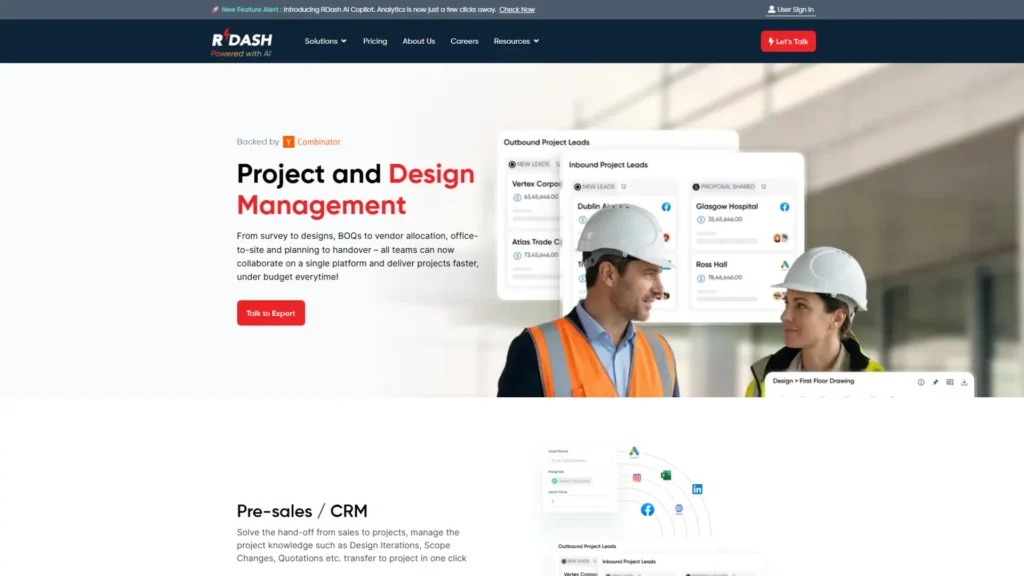
This is the operational gap a construction management platform is built to close, and it is where RDash fits regardless of which delivery method a project runs on. RDash connects design management with version control, Bill of Quantities and change orders, daily progress reporting, procurement, and finance into one system. That matters because the same workflow serves a single design-build entity or a designer, contractor and client working under separate contracts.
Under Design-Bid-Build’s two contracts, third-party collaborator logins let an external designer and client view documents and give approvals inside the same system the contractor uses. That is exactly the owner-in-the-middle coordination the two-contract structure otherwise leaves manual. Under Design-Build’s one contract, that same shared system is what makes one entity’s design, procurement, and site teams coordinated in practice, not just unified on an org chart.
An AI co-pilot sits across that shared data. It surfaces schedule delays, approval bottlenecks, and coordination gaps through plain-language prompts rather than hand-built reports, an approach covered in RDash’s guide to how AI is used in construction management software.
RDash is built for construction companies, interior fit-out firms, EPC contractors, project management consultants and developers. It is simple enough for site engineers to use daily, with enough oversight for ownership to trust that a project stays coordinated, whatever its contract structure.
The underlying discipline is the same one laid out in the 15 golden workflows of construction project management. It is the work no delivery method does for you.
The Bottom Line
Design-Bid-Build and Design-Build were never meant to be right or wrong in the abstract. They encode two answers to one question: who should carry the project’s risk, and where should the seam between design and construction sit.
Design-Bid-Build distributes risk and keeps an independent check, at the cost of a slower, sequential timeline and a coordination burden the owner inherits. Design-Build concentrates risk in one accountable entity and compresses the schedule, which the evidence supports strongly, while asking the owner to give up the automatic independent review and some pre-commitment design certainty. Scope stability, schedule pressure, public rules, and your own capacity to coordinate all point towards one method, the other, or increasingly a hybrid such as Progressive Design-Build that splits the difference on purpose.
Make that structural choice deliberately, not by habit. Then remember what the contract cannot do for you. Once it is signed, the project is won or lost on execution: on whether design, procurement, and site actually work from the same information, day after day. The delivery method decides who is responsible for that coordination. It does not decide whether the coordination happens.
Frequently Asked Questions
What is the main difference between Design-Bid-Build and Design-Build?
Design-Bid-Build uses two separate contracts, one for design and one for construction, completed in strict sequence. Design-Build uses a single contract with one entity responsible for both, which lets the phases overlap. The difference is contractual first; speed, control, and risk all follow from it.
Which method is faster, Design-Bid-Build or Design-Build?
Design-Build is faster, and the evidence is consistent. CII and Pankow Foundation research, published by DBIA, found Design-Build delivered 36% faster during construction and 102% faster from design through completion than Design-Bid-Build, because overlapping design and construction removes the dead time a sequential process builds in.
Is Design-Build always cheaper than Design-Bid-Build?
No. On unit cost, the two are close: the 2018 CII/Pankow study found Design-Build only 0.3% cheaper per square foot, though its projects averaged 3.8% less cost growth. Competitive Design-Bid-Build bidding on a fully defined scope can match or beat it on hard price. Design-Build’s savings come mainly from a shorter schedule and lower administrative load, not a lower price per square foot.
Why do many public sector projects still use Design-Bid-Build?
Many public procurement rules were built around transparent competitive bidding on a finished design, which Design-Bid-Build provides by structure. That is changing. In the US, DBIA reports that only two states now limit agencies’ use of Design-Build, and in India, MoRTH, Indian Railways and CPWD award many large works in EPC mode, a design-build model. Check the rules that apply to your agency and project size.
Does Design-Build remove the need for independent design oversight?
No. It removes the automatic check that a separately contracted designer provides under Design-Bid-Build. Owners using Design-Build should rebuild that oversight deliberately, usually through an owner’s representative or a commissioning agent, so design and construction issues are still caught by someone without a stake in overlooking them.
What is Progressive Design-Build?
It is a form of Design-Build where the owner selects the entity early on qualifications, then develops the design collaboratively, with the price set progressively and usually landing on a guaranteed maximum price once the design is mature. It keeps Design-Build’s single accountable entity and speed while recovering much of Design-Bid-Build’s cost transparency and design involvement.
Is Construction Manager at Risk the same as Design-Build?
No. In Construction Manager at Risk, the owner still holds separate contracts with the designer and the construction manager, so independent design oversight is preserved. The construction manager joins during design to give cost and buildability input while carrying risk for the final cost, capturing some of Design-Build’s early collaboration without fully merging the two contracts.
How does an EPC contract relate to Design-Build?
Engineering, Procurement and Construction (EPC) extends Design-Build’s single-entity model by adding procurement alongside design and construction, and is common in large infrastructure and industrial projects such as power plants and refineries. A turnkey EPC contract delivers a fully operational facility to the owner at completion. In India, EPC mode is widely used by MoRTH, Indian Railways and CPWD for large public works.
Which method reduces disputes between the designer and contractor?
Design-Build, because one entity is accountable for both design and construction, so there is no contractual gap to argue across. Design-Bid-Build’s separation can produce disputes when an independently contracted designer and builder disagree over whose fault a problem is.
What is the risk of choosing Design-Bid-Build for a fast-moving project?
Its strictly sequential structure, completing design before bidding and bidding before construction, stacks the whole timeline end to end, which makes it a poor fit when speed to completion is the priority. For time-sensitive work, Design-Build or Progressive Design-Build usually serves better.